



 Chat with AI
Exam 12: The Design of the Tax System.

Exam 1: Ten Principles of Economics.349 Questions
Exam 2: Thinking Like an Economist.535 Questions
Exam 3: Interdependence and the Gains from Trade.443 Questions
Exam 4: The Market Forces of Supply and Demand.571 Questions
Exam 5: Elasticity and Its Application510 Questions
Exam 6: Supply, Demand, And Government Policies.557 Questions
Exam 7: Consumers, Producers, and the Efficiency of Markets.460 Questions
Exam 8: Application: The Costs of Taxation.424 Questions
Exam 9: Application: International Trade.410 Questions
Exam 10: Externalities.441 Questions
Exam 11: Public Goods and Common Resources.349 Questions
Exam 12: The Design of the Tax System.478 Questions
Exam 13: The Costs of Production.533 Questions
Exam 14: Firms in Competitive Markets.478 Questions
Exam 15: Monopoly.526 Questions
Exam 16: Monopolistic Competition.497 Questions
Exam 17: Oligopoly.410 Questions
Exam 18: The Market For the Factors of Production.463 Questions
Exam 19: Earnings and Discrimination.398 Questions
Exam 20: Income Inequality and Poverty.374 Questions
Exam 21: The Theory of Consumer Choice.462 Questions
Exam 22: Frontiers in Microeconomics.353 Questions
Select questions type


Which of the following is not a way that a corporate tax on the income of U.S.car companies will affect markets?
(Multiple Choice)
4.8/5  (78)
(78) In the absence of taxes,Ashley would prefer to purchase a large sport utility vehicle (SUV).The government has recently decided to place a $10,000 nuisance tax on SUVs.If Ashley decides to purchase a small economy car as a result of the tax,which of the following statements is correct?
(Multiple Choice)
4.7/5 (84)
(84) Table 12-12
United States Income Tax Rates for a Single Individual, 2009 and 2010.
 -Refer to Table 12-12.Mia is a single person whose taxable income is $100,000 a year.What is her average tax rate in 2010?
 (Multiple Choice)
4.9/5 (86)
(86) In 2009,social insurance taxes represented approximately what percentage of total receipts for the federal government?
(Multiple Choice)
4.9/5 (85)
(85) Scenario 12-3
Suppose that Bob places a value of $10 on a movie ticket and that Lisa places a value of $7 on a movie ticket. In addition, suppose the price of a movie ticket is $5.
-Refer to Scenario 12-3.Suppose the government levies a tax of $3 on a movie ticket and that,as a result,the price of a movie ticket increases to $8.What is the deadweight loss from the tax?
(Multiple Choice)
4.8/5 (72)
(72) Deadweight losses arise because a tax causes some individuals to change their behavior.
(True/False)
4.7/5 (68)
(68) Resources devoted to complying with the tax laws are a type of deadweight loss.
(True/False)
4.9/5 (79)
(79) Scenario 12-1
Skip places a $20 value on a bottle of wine, and Walt places a $17 value on it. The equilibrium price for a bottle of wine is $15.
-Refer to Scenario 12-1.Suppose the government levies a tax of $1 on each bottle of wine,and the equilibrium price of a bottle of wine increases to $16.Because total consumer surplus has
(Multiple Choice)
4.8/5 (94)
(94) Vertical equity in taxation refers to the idea that people
(Multiple Choice)
4.7/5 (87)
(87) 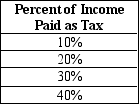 -Refer to Table 12-15.The tax system is
In 2009,the federal government spent 5 percent of the budget on net interest.Which of the following statements regarding net interest is correct?
(Multiple Choice)
4.7/5 (90)
(90) Table 12-2
Consider the tax rates shown in the table below.
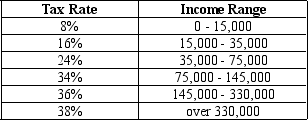 -Refer to Table 12-2.If Livi has taxable income of $78,000,her marginal tax rate is
 (Multiple Choice)
4.8/5 (84)
(84) Table 12-9
The table below shows the marginal tax rates for an unmarried taxpayer for various levels of taxable income.
 -Refer to Table 12-9.For this tax schedule,what is the marginal tax rate for an individual with $212,000 in taxable income?
 (Multiple Choice)
4.7/5 (85)
(85) Table 12-14
 -Refer to Table 12-14.A progressive tax is illustrated by tax
 (Multiple Choice)
4.8/5 (81)
(81) 
Filters
- Essay(0)
- Multiple Choice(0)
- Short Answer(0)
- True False(0)
- Matching(0)