



 Chat with AI
Exam 9: Application: International Trade.

Exam 1: Ten Principles of Economics.349 Questions
Exam 2: Thinking Like an Economist.535 Questions
Exam 3: Interdependence and the Gains from Trade.443 Questions
Exam 4: The Market Forces of Supply and Demand.571 Questions
Exam 5: Elasticity and Its Application510 Questions
Exam 6: Supply, Demand, And Government Policies.557 Questions
Exam 7: Consumers, Producers, and the Efficiency of Markets.460 Questions
Exam 8: Application: The Costs of Taxation.424 Questions
Exam 9: Application: International Trade.410 Questions
Exam 10: Externalities.441 Questions
Exam 11: Public Goods and Common Resources.349 Questions
Exam 12: The Design of the Tax System.478 Questions
Exam 13: The Costs of Production.533 Questions
Exam 14: Firms in Competitive Markets.478 Questions
Exam 15: Monopoly.526 Questions
Exam 16: Monopolistic Competition.497 Questions
Exam 17: Oligopoly.410 Questions
Exam 18: The Market For the Factors of Production.463 Questions
Exam 19: Earnings and Discrimination.398 Questions
Exam 20: Income Inequality and Poverty.374 Questions
Exam 21: The Theory of Consumer Choice.462 Questions
Exam 22: Frontiers in Microeconomics.353 Questions
Select questions type


Import quotas and tariffs produce some common results.Which of the following is not one of those common results?
(Multiple Choice)
4.9/5  (84)
(84) Figure 9-3. The domestic country is China.
 -Refer to Figure 9-3.With trade,producer surplus in China is
 (Multiple Choice)
4.9/5 (76)
(76) Free trade causes job losses in industries in which a country does not have a comparative advantage,but it also causes job gains in industries in which the country has a comparative advantage.
(True/False)
4.9/5 (95)
(95) When a country that imports shoes imposes a tariff on shoes,buyers of shoes in that country become worse off and sellers of shoes in that country become better off.
(True/False)
4.9/5 (89)
(89) Figure 9-20
The figure illustrates the market for rice in Vietnam.
 -Refer to Figure 9-20.Vietnam's gains from trade in rice amount to
 (Multiple Choice)
5.0/5 (84)
(84) The world price of a ton of steel is $1,000.Before Russia allowed trade in steel,the price of a ton of steel there was $650.Once Russia allowed trade in steel with other countries,Russia began
(Multiple Choice)
4.8/5 (94)
(94) Trade enhances the economic well-being of a nation in the sense that
(Multiple Choice)
4.8/5 (91)
(91) Figure 9-16. The figure below illustrates a tariff. On the graph, Q represents quantity and P represents price.
 -Refer to Figure 9-16.The tariff
 (Multiple Choice)
4.9/5 (75)
(75) Figure 9-19. On the diagram below, Q represents the quantity of textiles and P represents the price of textiles.
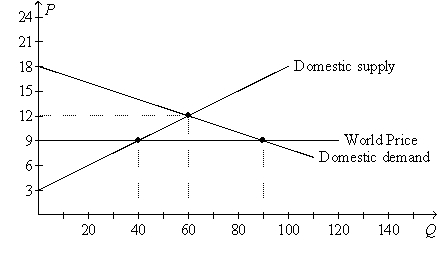 -Refer to Figure 9-19.With free trade,consumer surplus in the textile market amounts to
 (Multiple Choice)
4.9/5 (86)
(86) Figure 9-8. On the diagram below, Q represents the quantity of cars and P represents the price of cars.
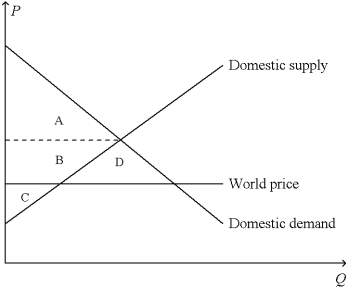 -Refer to Figure 9-8.In the country for which the figure is drawn,total surplus with international trade in cars
 (Multiple Choice)
4.9/5 (80)
(80) Figure 9-11
 -Refer to Figure 9-11.Consumer surplus in this market after trade is
 (Multiple Choice)
4.7/5 (77)
(77) NAFTA is an example of a multilateral approach to achieving free trade.
(True/False)
4.7/5 (90)
(90) Figure 9-13
 -Refer to Figure 9-13.With trade,domestic production and domestic consumption,respectively,are
 (Multiple Choice)
4.8/5 (91)
(91) If the world price of sugar is lower than Brazil's domestic price of sugar without trade,then Brazil
(Multiple Choice)
5.0/5 (76)
(76) Domestic producers of a good become better off,and domestic consumers of a good become worse off,when a country begins allowing international trade in that good and
(Multiple Choice)
5.0/5 (73)
(73) Figure 9-12
 -Refer to Figure 9-12.With trade,domestic production and domestic consumption,respectively,are
 (Multiple Choice)
4.9/5 (78)
(78) Figure 9-5
 -Refer to Figure 9-5.Total surplus with trade exceeds total surplus without trade by
 (Multiple Choice)
4.8/5 (91)
(91) A common argument in favor of restricting international trade in good x is based on the premise that
(Multiple Choice)
5.0/5 (88)
(88) Figure 9-15
 -Refer to Figure 9-15.With the tariff,the domestic price and domestic quantity demanded are
 (Multiple Choice)
4.9/5 (74)
(74) 
Filters
- Essay(0)
- Multiple Choice(0)
- Short Answer(0)
- True False(0)
- Matching(0)