



 Chat with AI
Exam 9: Application: International Trade.

Exam 1: Ten Principles of Economics.349 Questions
Exam 2: Thinking Like an Economist.535 Questions
Exam 3: Interdependence and the Gains from Trade.443 Questions
Exam 4: The Market Forces of Supply and Demand.571 Questions
Exam 5: Elasticity and Its Application510 Questions
Exam 6: Supply, Demand, And Government Policies.557 Questions
Exam 7: Consumers, Producers, and the Efficiency of Markets.460 Questions
Exam 8: Application: The Costs of Taxation.424 Questions
Exam 9: Application: International Trade.410 Questions
Exam 10: Externalities.441 Questions
Exam 11: Public Goods and Common Resources.349 Questions
Exam 12: The Design of the Tax System.478 Questions
Exam 13: The Costs of Production.533 Questions
Exam 14: Firms in Competitive Markets.478 Questions
Exam 15: Monopoly.526 Questions
Exam 16: Monopolistic Competition.497 Questions
Exam 17: Oligopoly.410 Questions
Exam 18: The Market For the Factors of Production.463 Questions
Exam 19: Earnings and Discrimination.398 Questions
Exam 20: Income Inequality and Poverty.374 Questions
Exam 21: The Theory of Consumer Choice.462 Questions
Exam 22: Frontiers in Microeconomics.353 Questions
Select questions type


Figure 9-13
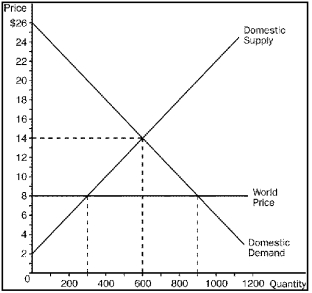 -Refer to Figure 9-13.Consumer surplus after trade is
 (Multiple Choice)
4.8/5  (76)
(76) If a country allows free trade and its domestic price for a given good is lower than the world price,then it will import that good.
(True/False)
4.8/5 (75)
(75) Figure 9-18. On the diagram below, Q represents the quantity of peaches and P represents the price of peaches. The domestic country is Isoland.
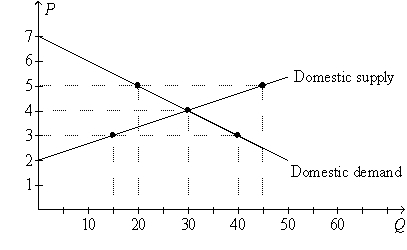 -Refer to Figure 9-18.If Isoland allows international trade and the world price of peaches is $5,then
 (Multiple Choice)
4.9/5 (75)
(75) Figure 9-17
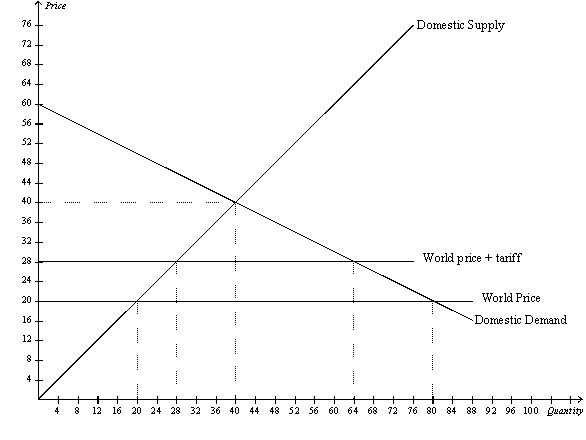 -Refer to Figure 9-17.With trade and a tariff,consumer surplus is
 (Multiple Choice)
4.9/5 (74)
(74) When,in our analysis of the gains and losses from international trade,we assume that a country is small,we are in effect assuming that the country
(Multiple Choice)
4.8/5 (90)
(90) Import quotas and tariffs make domestic sellers better off and domestic buyers worse off.
(True/False)
4.8/5 (72)
(72) The nation of Pineland forbids international trade.In Pineland,you can buy 1 pound of fish for 2 pounds of pineapples.In other countries,you can buy 1 pound of fish for 1.5 pounds of pineapples.These facts indicate that
(Multiple Choice)
4.8/5 (86)
(86) Suppose Haiti has an absolute advantage over other countries in producing oranges,but other countries have a comparative advantage over Haiti in producing oranges.If trade in oranges is allowed,Haiti
(Multiple Choice)
5.0/5 (96)
(96) If the Korean steel industry subsidizes the steel that it sells to the United States,the
(Multiple Choice)
4.8/5 (94)
(94) The market for corn in Wheatland consists solely of domestic buyers of corn and domestic sellers of corn if
(Multiple Choice)
4.8/5 (69)
(69) Import quotas and tariffs both cause the quantity of imports to fall.
(True/False)
4.8/5 (92)
(92) When a country allows trade and becomes an exporter of a good,
(Multiple Choice)
4.8/5 (81)
(81) When a country that imported a particular good abandons a free-trade policy and adopts a no-trade policy,
(Multiple Choice)
4.9/5 (92)
(92) Figure 9-10. The figure applies to Mexico and the good is rifles.
 -Refer to Figure 9-10.The area bounded by the points (Q₀,P₀),(Q₂,P₁),and (Q₁,P₁)represents
 (Multiple Choice)
4.8/5 (87)
(87) When a country that imports a particular good imposes an import quota on that good,
(Multiple Choice)
4.9/5 (77)
(77) Scenario 9-2
For a small country called Boxland, the equation of the domestic demand curve for cardboard is  where
 represents the domestic quantity of cardboard demanded, in tons, and
 represents the price of a ton of cardboard.
For Boxland, the equation of the domestic supply curve for cardboard is
 where
 represents the domestic quantity of cardboard supplied, in tons, and
 again represents the price of a ton of cardboard.
-Refer to Scenario 9-2.Suppose the world price of cardboard is $60 and international trade is allowed.Then Boxland's consumers demand
where represents the domestic quantity of cardboard demanded, in tons, and
represents the price of a ton of cardboard.
For Boxland, the equation of the domestic supply curve for cardboard is
where represents the domestic quantity of cardboard supplied, in tons, and again represents the price of a ton of cardboard.
-Refer to Scenario 9-2.Suppose the world price of cardboard is $60 and international trade is allowed.Then Boxland's consumers demand (Multiple Choice)
4.8/5 (79)
(79) Figure 9-14. On the diagram below, Q represents the quantity of crude oil and P represents the price of crude oil.
 -Refer to Figure 9-14.When the country for which the figure is drawn allows international trade in crude oil,
 (Multiple Choice)
4.9/5 (94)
(94) When a country that imports a particular good imposes a tariff on that good,
(Multiple Choice)
4.8/5 (84)
(84) Scenario 9-2
For a small country called Boxland, the equation of the domestic demand curve for cardboard is
where represents the domestic quantity of cardboard demanded, in tons, and
represents the price of a ton of cardboard.
For Boxland, the equation of the domestic supply curve for cardboard is
where represents the domestic quantity of cardboard supplied, in tons, and again represents the price of a ton of cardboard.
-Refer to Scenario 9-2.Suppose the world price of cardboard is $45 and international trade is allowed.Then Boxland's consumers demand
where represents the domestic quantity of cardboard demanded, in tons, and
represents the price of a ton of cardboard.
For Boxland, the equation of the domestic supply curve for cardboard is
where represents the domestic quantity of cardboard supplied, in tons, and again represents the price of a ton of cardboard.
-Refer to Scenario 9-2.Suppose the world price of cardboard is $45 and international trade is allowed.Then Boxland's consumers demand (Multiple Choice)
4.9/5 (80)
(80) Figure 9-18. On the diagram below, Q represents the quantity of peaches and P represents the price of peaches. The domestic country is Isoland.
-Refer to Figure 9-18.If Isoland allows international trade and if the world price of peaches is $5,then
-Refer to Figure 9-18.If Isoland allows international trade and if the world price of peaches is $5,then (Multiple Choice)
5.0/5 (81)
(81) 
Filters
- Essay(0)
- Multiple Choice(0)
- Short Answer(0)
- True False(0)
- Matching(0)