



 Chat with AI
Exam 18: Rent, Interest, and Profit

Exam 1: Limits, Alternatives, and Choices107 Questions
Exam 2: The Market System and the Circular Flow287 Questions
Exam 3: Demand, Supply, and Market Equilibrium151 Questions
Exam 4: Market Failures Caused by Externalities Asymmetric Information229 Questions
Exam 5: Public Goods, Public Choice, and Government Failure268 Questions
Exam 6: Elasticity399 Questions
Exam 7: Utility Maximization358 Questions
Exam 8: Behavioral Economics311 Questions
Exam 9: Businesses and the Costs of Production445 Questions
Exam 10: Pure Competition in the Short Run342 Questions
Exam 11: Pure Competition in the Long Run250 Questions
Exam 12: Pure Monopoly407 Questions
Exam 13: Monopolistic Competition279 Questions
Exam 14: Oligopoly and Strategic Behavior362 Questions
Exam 15: Technology, RD, and Efficiency309 Questions
Exam 16: The Demand for Resources359 Questions
Exam 17: Wage Determination168 Questions
Exam 18: Rent, Interest, and Profit305 Questions
Exam 19: Natural Resource and Energy Economics337 Questions
Exam 20: Public Finance: Expenditures and Taxes336 Questions
Exam 21: Antitrust Policy and Regulation264 Questions
Exam 22: Agriculture: Economics and Policy265 Questions
Exam 23: Income Inequality, Poverty, and Discrimination324 Questions
Exam 24: Health Care280 Questions
Exam 25: Immigration259 Questions
Exam 26: International Trade347 Questions
Exam 27: The Balance of Payments, Exchange Rates, and Trade Deficits318 Questions
Exam 28: The Economics of Developing Countries277 Questions
Select questions type


Government monetary authorities manipulate the supply of money in the economy primarily to
(Multiple Choice)
4.8/5  (75)
(75) 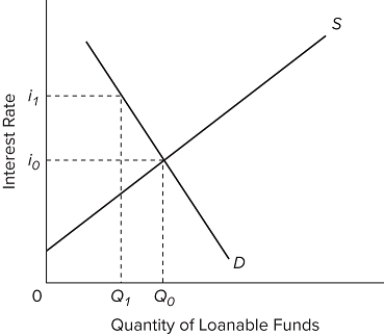 Refer to the market for loanable funds, as shown in the graph. Suppose the market for loanable funds is originally in equilibrium at interest rate i ₀ and quantity Q ₀ . In the next period, the equilibrium interest rate increases to i ₁ and quantity decreases to Q ₁. Which of the following could be the cause of this shift?
 (Multiple Choice)
4.8/5 (77)
(77) Which of the following interest rates is usually the highest?
(Multiple Choice)
4.9/5 (89)
(89) The free-land era of U.S. history reflected a situation in which the quantity of land available at a zero price exceeded the quantity of land demanded.
(True/False)
4.8/5 (82)
(82) If you pay $10,625 annually on a $125,000 loan and the rate of inflation is 3 percent, then the
(Multiple Choice)
4.7/5 (75)
(75) Suppose you borrow $500 and agree to pay this $500 plus $75 of interest at the end of a year. The interest rate is
(Multiple Choice)
4.8/5 (85)
(85) Suppose you borrow $500 and agree to pay this $500 plus $75 of interest at the end of a year. The interest rate is
(Multiple Choice)
4.9/5 (90)
(90) Distinguish between the nominal rate of interest and real rate of interest.
(Essay)
4.8/5 (87)
(87)  Refer to the table representing Kara's bank account. If the $2,000 was deposited into her account at the beginning of year 1 and no further deposits or withdrawals were made, the value for cell D
 (Multiple Choice)
4.9/5 (73)
(73) A decrease in the supply of loanable funds and an increase in the demand for loanable funds will
(Multiple Choice)
4.8/5 (74)
(74) The basic function of profits and losses is to allocate society's scarce resources to their highest valued uses.
(True/False)
4.7/5 (81)
(81) Unlike most demand curves, the demand curve for loanable funds is upsloping.
(True/False)
4.9/5 (86)
(86) If labor's share of the income paid to American resource suppliers is broadly defined as the sum of wages and salaries and proprietors' income, we can say that labor's relative share has
(Multiple Choice)
4.9/5 (75)
(75) 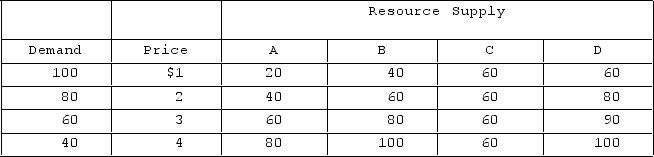 Refer to the demand schedule and possible supply schedules, A-D. Suppose that price influences the availability of the economic resource, and the equilibrium price is $2. Which resource supply schedule would apply in this case?
 (Multiple Choice)
4.8/5 (78)
(78) Entrepreneurs can generate economic profits by all of the following, except
(Multiple Choice)
4.8/5 (73)
(73) 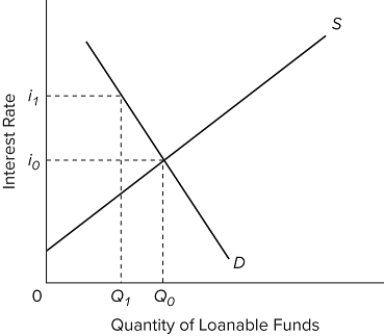 Refer to the market for loanable funds, as shown in the graph. Suppose investors who borrow money in the loanable funds market become nervous and pessimistic about the economy in general, and expected returns on investments in particular. We would expect to see a(n)
 (Multiple Choice)
4.8/5 (86)
(86) 
Filters
- Essay(0)
- Multiple Choice(0)
- Short Answer(0)
- True False(0)
- Matching(0)