



 Chat with AI
Exam 18: Rent, Interest, and Profit

Exam 1: Limits, Alternatives, and Choices107 Questions
Exam 2: The Market System and the Circular Flow287 Questions
Exam 3: Demand, Supply, and Market Equilibrium151 Questions
Exam 4: Market Failures Caused by Externalities Asymmetric Information229 Questions
Exam 5: Public Goods, Public Choice, and Government Failure268 Questions
Exam 6: Elasticity399 Questions
Exam 7: Utility Maximization358 Questions
Exam 8: Behavioral Economics311 Questions
Exam 9: Businesses and the Costs of Production445 Questions
Exam 10: Pure Competition in the Short Run342 Questions
Exam 11: Pure Competition in the Long Run250 Questions
Exam 12: Pure Monopoly407 Questions
Exam 13: Monopolistic Competition279 Questions
Exam 14: Oligopoly and Strategic Behavior362 Questions
Exam 15: Technology, RD, and Efficiency309 Questions
Exam 16: The Demand for Resources359 Questions
Exam 17: Wage Determination168 Questions
Exam 18: Rent, Interest, and Profit305 Questions
Exam 19: Natural Resource and Energy Economics337 Questions
Exam 20: Public Finance: Expenditures and Taxes336 Questions
Exam 21: Antitrust Policy and Regulation264 Questions
Exam 22: Agriculture: Economics and Policy265 Questions
Exam 23: Income Inequality, Poverty, and Discrimination324 Questions
Exam 24: Health Care280 Questions
Exam 25: Immigration259 Questions
Exam 26: International Trade347 Questions
Exam 27: The Balance of Payments, Exchange Rates, and Trade Deficits318 Questions
Exam 28: The Economics of Developing Countries277 Questions
Select questions type


The pure rate of interest in economic models is best approximated by the
(Multiple Choice)
4.9/5  (75)
(75)  Refer to the table, in which the values for columns (2)through (5)are in acres. If the relevant columns are (1), (2), and (3), land rent will be
 (Multiple Choice)
4.9/5 (66)
(66) 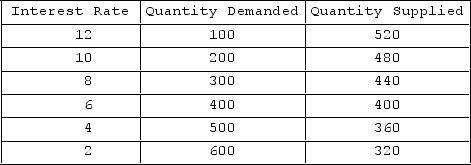 The schedule shows various interest rates, the associated quantity demanded of loanable funds, and the quantity supplied of loanable funds in billions of dollars at those interest rates. If changes in tax laws made households save more by $140 billion at each interest rate, then the new equilibrium interest rate would be
 (Multiple Choice)
4.8/5 (66)
(66) 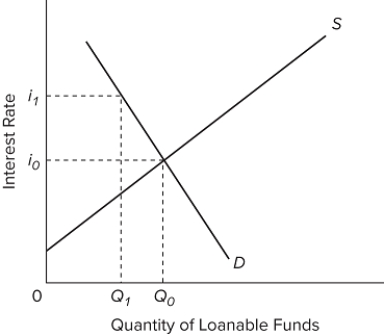 Refer to the market for loanable funds, as shown in the graph. A decline in the interest rate is likely to
 (Multiple Choice)
4.9/5 (73)
(73) 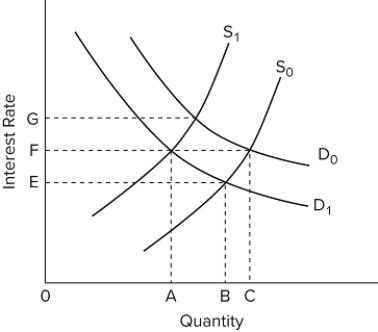 Refer to the diagram. Suppose that the demand for loanable funds is D₀ and the supply of loanable funds initially is S₀ . If the supply of loanable funds declines to S₁, the equilibrium interest rate will
 (Multiple Choice)
4.9/5 (71)
(71) Economic rent is the payment made to a resource that has a perfectly inelastic demand curve.
(True/False)
4.9/5 (87)
(87) Other things equal, an increase in the productivity of capital goods will
(Multiple Choice)
4.8/5 (69)
(69) Suppose you deposit $3,000 in a bank that pays 5 percent interest compounded twice a year. The actual annual interest rate you receive is
(Multiple Choice)
4.7/5 (83)
(83) To an individual firm or landowner, land rents do not appear to be a surplus because
(Multiple Choice)
4.9/5 (77)
(77) Profit-maximizing businesses will buy more new machinery only if
(Multiple Choice)
4.8/5 (78)
(78) 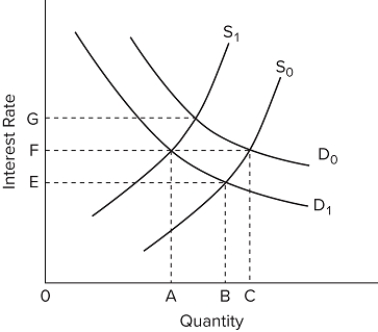 Refer to the diagram. If the supply of loanable funds is S ₀ and the demand for loanable funds is D ₀ , the equilibrium interest rate and quantity of funds borrowed will be
 (Multiple Choice)
4.9/5 (88)
(88) 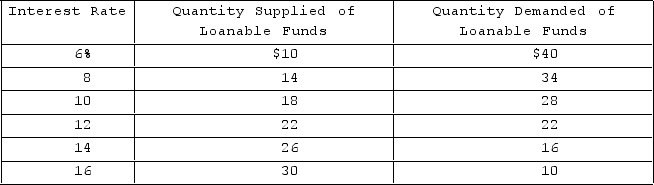 Answer the question using the table. Figures are in billions of dollars. A usury law that sets the interest rate 4 percent below the market rate of interest will result in a shortage of loanable funds of
 (Multiple Choice)
4.8/5 (79)
(79) Economic profits are the salaries received by the hired managers of business corporations.
(True/False)
4.8/5 (85)
(85)  The table applies to a loan with an interest rate of 5 percent per period. What value goes in the cell labeled Z?
 (Multiple Choice)
4.8/5 (73)
(73) 
Filters
- Essay(0)
- Multiple Choice(0)
- Short Answer(0)
- True False(0)
- Matching(0)