



 Chat with AI
Exam 6: Elasticity

Exam 1: Limits, Alternatives, and Choices107 Questions
Exam 2: The Market System and the Circular Flow287 Questions
Exam 3: Demand, Supply, and Market Equilibrium151 Questions
Exam 4: Market Failures Caused by Externalities Asymmetric Information229 Questions
Exam 5: Public Goods, Public Choice, and Government Failure268 Questions
Exam 6: Elasticity399 Questions
Exam 7: Utility Maximization358 Questions
Exam 8: Behavioral Economics311 Questions
Exam 9: Businesses and the Costs of Production445 Questions
Exam 10: Pure Competition in the Short Run342 Questions
Exam 11: Pure Competition in the Long Run250 Questions
Exam 12: Pure Monopoly407 Questions
Exam 13: Monopolistic Competition279 Questions
Exam 14: Oligopoly and Strategic Behavior362 Questions
Exam 15: Technology, RD, and Efficiency309 Questions
Exam 16: The Demand for Resources359 Questions
Exam 17: Wage Determination168 Questions
Exam 18: Rent, Interest, and Profit305 Questions
Exam 19: Natural Resource and Energy Economics337 Questions
Exam 20: Public Finance: Expenditures and Taxes336 Questions
Exam 21: Antitrust Policy and Regulation264 Questions
Exam 22: Agriculture: Economics and Policy265 Questions
Exam 23: Income Inequality, Poverty, and Discrimination324 Questions
Exam 24: Health Care280 Questions
Exam 25: Immigration259 Questions
Exam 26: International Trade347 Questions
Exam 27: The Balance of Payments, Exchange Rates, and Trade Deficits318 Questions
Exam 28: The Economics of Developing Countries277 Questions
Select questions type


In some markets consumers may buy many different brands of a product. Which of the statements below best represents a situation where demand for a particular brand would be very elastic?
(Multiple Choice)
4.9/5  (84)
(84) The supply of antiques is highly inelastic. Thus, increases in demand would have a small effect on price.
(True/False)
4.8/5 (78)
(78) Suppose the income elasticity of demand for toys is +2.0. This means that
(Multiple Choice)
4.7/5 (68)
(68) Most goods can be classified as normal goods rather than inferior goods. The definition of a normal good suggests that
(Multiple Choice)
5.0/5 (85)
(85) Movie theaters charge lower prices to see a movie in the afternoon than in the evening because there is an
(Multiple Choice)
4.9/5 (77)
(77) 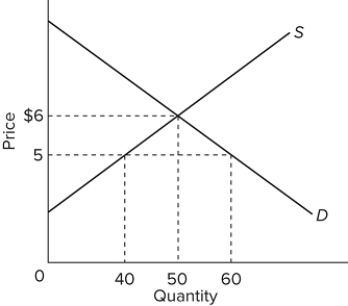 Refer to the graph above. If demand decreases, then total revenues will
 (Multiple Choice)
4.9/5 (69)
(69) Suppose the price of local cable TV service increased from$15.00 to$20.00 and as a result the number of cable subscribers decreased from 248,000 to 200,000. Along this portion of the demand curve, using the midpoint method, price elasticity of demand is approximately
(Multiple Choice)
4.8/5 (85)
(85) If a 10 percent increase in the price of one good results in no change in the quantity demanded of another good, then it can be concluded that the two goods are
(Multiple Choice)
5.0/5 (82)
(82) You are the sales manager for a software company and have been informed that the price elasticity of demand for your most popular software is less than 1. In order to increase total revenues from that product, you should
(Multiple Choice)
5.0/5 (88)
(88) The price-elasticity of demand is always negative because of
(Multiple Choice)
4.8/5 (87)
(87) A 3 percent increase in the price of tea causes 6 percent increase in the demand for coffee. The cross elasticity of demand for coffee with respect to the price of tea is
(Multiple Choice)
4.8/5 (84)
(84) Along a linear downward-sloping demand curve, the price elasticity of demand will be
(Multiple Choice)
4.8/5 (70)
(70) In the price range where demand is elastic, if the seller of the good raises its price, then total revenues will increase.
(True/False)
4.8/5 (84)
(84) A 10 percent increase in the price of tea causes 8 percent increase in the demand for coffee. The cross elasticity of demand for coffee with respect to the price of tea is
(Multiple Choice)
4.8/5 (87)
(87) A firm can sell as much as it wants at a constant price. Demand is thus
(Multiple Choice)
4.9/5 (62)
(62) An increase in the price of tickets to a popular sporting event will increase total revenue if
(Multiple Choice)
4.8/5 (77)
(77) 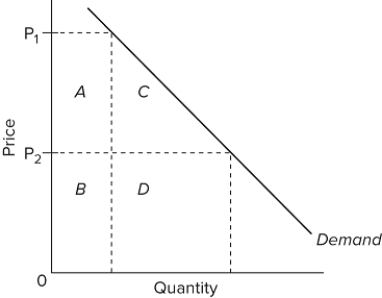 Refer to the diagram. Total revenue at price P₁ is indicated by area(s)
 (Multiple Choice)
5.0/5 (82)
(82) A price increase from $43 to $49 results in an increase in quantity supplied from 220 units to 240 units. The price elasticity of supply in this price range is
(Multiple Choice)
4.8/5 (70)
(70) 
Filters
- Essay(0)
- Multiple Choice(0)
- Short Answer(0)
- True False(0)
- Matching(0)