



 Chat with AI
Exam 6: Elasticity

Exam 1: Limits, Alternatives, and Choices107 Questions
Exam 2: The Market System and the Circular Flow287 Questions
Exam 3: Demand, Supply, and Market Equilibrium151 Questions
Exam 4: Market Failures Caused by Externalities Asymmetric Information229 Questions
Exam 5: Public Goods, Public Choice, and Government Failure268 Questions
Exam 6: Elasticity399 Questions
Exam 7: Utility Maximization358 Questions
Exam 8: Behavioral Economics311 Questions
Exam 9: Businesses and the Costs of Production445 Questions
Exam 10: Pure Competition in the Short Run342 Questions
Exam 11: Pure Competition in the Long Run250 Questions
Exam 12: Pure Monopoly407 Questions
Exam 13: Monopolistic Competition279 Questions
Exam 14: Oligopoly and Strategic Behavior362 Questions
Exam 15: Technology, RD, and Efficiency309 Questions
Exam 16: The Demand for Resources359 Questions
Exam 17: Wage Determination168 Questions
Exam 18: Rent, Interest, and Profit305 Questions
Exam 19: Natural Resource and Energy Economics337 Questions
Exam 20: Public Finance: Expenditures and Taxes336 Questions
Exam 21: Antitrust Policy and Regulation264 Questions
Exam 22: Agriculture: Economics and Policy265 Questions
Exam 23: Income Inequality, Poverty, and Discrimination324 Questions
Exam 24: Health Care280 Questions
Exam 25: Immigration259 Questions
Exam 26: International Trade347 Questions
Exam 27: The Balance of Payments, Exchange Rates, and Trade Deficits318 Questions
Exam 28: The Economics of Developing Countries277 Questions
Select questions type


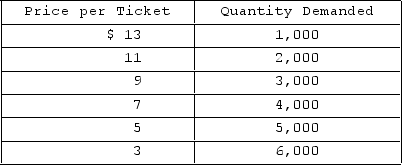 Refer to the information. If the Mudhens' management wanted to maximize total ticket revenue from the game, it would set the ticket price at
 (Multiple Choice)
4.8/5  (78)
(78) The income elasticity of demand for food is roughly 1. Suppose a consumer's monthly income is $2,000, of which 20 percent is spent on food. If the income of this consumer doubles, the amount she'll spend on food will be
(Multiple Choice)
4.9/5 (80)
(80) Assume that a 9 percent increase in income across the economy produces a 6 percent decrease in the quantity demanded of good X. The coefficient of income elasticity of demand is
(Multiple Choice)
4.9/5 (87)
(87) 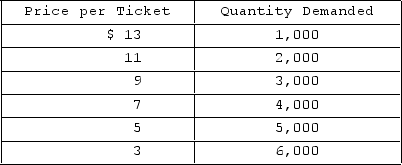 Refer to the information and assume the stadium capacity is 5,000. The supply of seats for the game
 (Multiple Choice)
5.0/5 (76)
(76) The larger the positive cross elasticity coefficient of demand between products X and Y, the
(Multiple Choice)
4.9/5 (85)
(85) Economists distinguish among the immediate market period, the short run, and the long run by noting that
(Multiple Choice)
4.8/5 (72)
(72) If demand for a product is elastic, the value of the price elasticity coefficient is
(Multiple Choice)
4.9/5 (77)
(77) 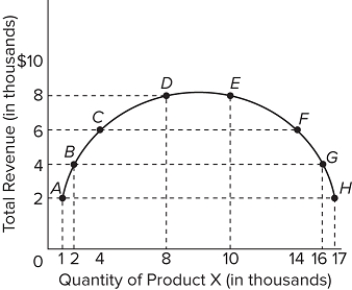 Refer to the total revenue graph above. An increase in the quantity of product X demanded from 14,000 to 16,000 units implies that the price of product X was
 (Multiple Choice)
4.9/5 (82)
(82) Suppose the price of a product rises and the total revenue of sellers increases.
(Multiple Choice)
4.9/5 (84)
(84) A good with a price-elasticity of demand coefficient of 0.75 has a demand that is price-inelastic.
(True/False)
4.9/5 (75)
(75) The price of season tickets to a performing arts theater decreases by 3 percent. As a result, the quantity demanded increases by 6 percent. The price elasticity of demand for season tickets is
(Multiple Choice)
4.8/5 (91)
(91) 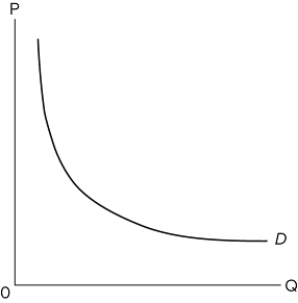 Refer to the diagram, which is a rectangular hyperbola, that is, a curve such that each rectangle drawn from any point on the curve will be of identical area. If this rectangular hyperbola was a demand curve, we could say that it would be
 (Multiple Choice)
4.9/5 (62)
(62) Which of the following goods will least likely suffer a decline in demand during a recession?
(Multiple Choice)
4.8/5 (82)
(82) Describe the elasticity of supply of a farm product that is sold at a farmer's market on a particular day.
(Essay)
4.9/5 (95)
(95) The supply of product X is inelastic (but not perfectly inelastic)if the price of X rises by
(Multiple Choice)
4.8/5 (79)
(79) If price changes and total revenue changes in the opposite direction, demand is relatively elastic.
(True/False)
4.8/5 (90)
(90) If the price elasticity of demand for a product is equal to 0.5, then a decrease in price of 10 percent will increase quantity demanded by
(Multiple Choice)
4.7/5 (81)
(81) 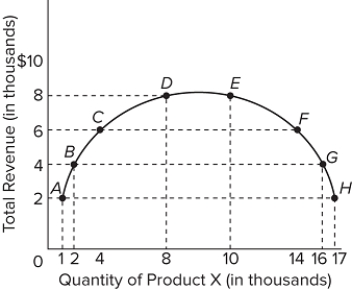 Refer to the total revenue graph above. Demand is price-elastic between points
 (Multiple Choice)
5.0/5 (78)
(78) 
Filters
- Essay(0)
- Multiple Choice(0)
- Short Answer(0)
- True False(0)
- Matching(0)