Exam 9: Differential Equations

arrow
  • Select Tags
search iconSearch Question
  • Select Tags

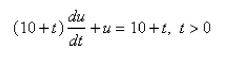
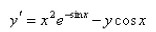
Solve the differential equation. Solve the differential equation.

(Essay)
4.7/5
(59)

Solve the differential equation. Solve the differential equation.

(Essay)
4.8/5
(76)

Select the correct Answer: for each question. -For what nonzero values of Select the correct Answer: for each question. -For what nonzero values of   does the function   satisfy the differential equation   for all values of A and B?  a.    b.    c.    d.    e.  does the function Select the correct Answer: for each question. -For what nonzero values of   does the function   satisfy the differential equation   for all values of A and B?  a.    b.    c.    d.    e.  satisfy the differential equation Select the correct Answer: for each question. -For what nonzero values of   does the function   satisfy the differential equation   for all values of A and B?  a.    b.    c.    d.    e.  for all values of A and B? a. Select the correct Answer: for each question. -For what nonzero values of   does the function   satisfy the differential equation   for all values of A and B?  a.    b.    c.    d.    e.  b. Select the correct Answer: for each question. -For what nonzero values of   does the function   satisfy the differential equation   for all values of A and B?  a.    b.    c.    d.    e.  c. Select the correct Answer: for each question. -For what nonzero values of   does the function   satisfy the differential equation   for all values of A and B?  a.    b.    c.    d.    e.  d. Select the correct Answer: for each question. -For what nonzero values of   does the function   satisfy the differential equation   for all values of A and B?  a.    b.    c.    d.    e.  e. Select the correct Answer: for each question. -For what nonzero values of   does the function   satisfy the differential equation   for all values of A and B?  a.    b.    c.    d.    e.

(Short Answer)
4.7/5
(79)

Determine whether the differential equation is linear. Determine whether the differential equation is linear.

(Short Answer)
4.7/5
(86)

Choose the differential equation corresponding to this direction field.Select the correct Answer Choose the differential equation corresponding to this direction field.Select the correct Answer
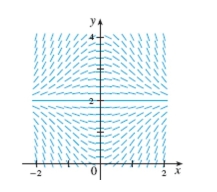
(Multiple Choice)
4.8/5
(78)

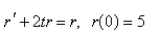
Solve the initial-value problem. Solve the initial-value problem.

(Multiple Choice)
4.8/5
(71)

Let Let   be a positive number.A differential equation of the form   where   is a positive constant is called   because the exponent in the expression   is larger than the exponent 1 for natural growth.An especially prolific breed of rabbits has the growth term   If   such rabbits breed initially and the warren has   rabbits after   months, then when is doomsday? be a positive number.A differential equation of the form Let   be a positive number.A differential equation of the form   where   is a positive constant is called   because the exponent in the expression   is larger than the exponent 1 for natural growth.An especially prolific breed of rabbits has the growth term   If   such rabbits breed initially and the warren has   rabbits after   months, then when is doomsday? where Let   be a positive number.A differential equation of the form   where   is a positive constant is called   because the exponent in the expression   is larger than the exponent 1 for natural growth.An especially prolific breed of rabbits has the growth term   If   such rabbits breed initially and the warren has   rabbits after   months, then when is doomsday? is a positive constant is called Let   be a positive number.A differential equation of the form   where   is a positive constant is called   because the exponent in the expression   is larger than the exponent 1 for natural growth.An especially prolific breed of rabbits has the growth term   If   such rabbits breed initially and the warren has   rabbits after   months, then when is doomsday? because the exponent in the expression Let   be a positive number.A differential equation of the form   where   is a positive constant is called   because the exponent in the expression   is larger than the exponent 1 for natural growth.An especially prolific breed of rabbits has the growth term   If   such rabbits breed initially and the warren has   rabbits after   months, then when is doomsday? is larger than the exponent 1 for natural growth.An especially prolific breed of rabbits has the growth term Let   be a positive number.A differential equation of the form   where   is a positive constant is called   because the exponent in the expression   is larger than the exponent 1 for natural growth.An especially prolific breed of rabbits has the growth term   If   such rabbits breed initially and the warren has   rabbits after   months, then when is doomsday? If Let   be a positive number.A differential equation of the form   where   is a positive constant is called   because the exponent in the expression   is larger than the exponent 1 for natural growth.An especially prolific breed of rabbits has the growth term   If   such rabbits breed initially and the warren has   rabbits after   months, then when is doomsday? such rabbits breed initially and the warren has Let   be a positive number.A differential equation of the form   where   is a positive constant is called   because the exponent in the expression   is larger than the exponent 1 for natural growth.An especially prolific breed of rabbits has the growth term   If   such rabbits breed initially and the warren has   rabbits after   months, then when is doomsday? rabbits after Let   be a positive number.A differential equation of the form   where   is a positive constant is called   because the exponent in the expression   is larger than the exponent 1 for natural growth.An especially prolific breed of rabbits has the growth term   If   such rabbits breed initially and the warren has   rabbits after   months, then when is doomsday? months, then when is doomsday?

(Multiple Choice)
4.9/5
(78)

Solve the differential equation. Solve the differential equation.

(Essay)
4.8/5
(80)

A curve passes through the point A curve passes through the point   and has the property that the slope of the curve at every point P is   times the y-coordinate P.What is the equation of the curve? and has the property that the slope of the curve at every point P is A curve passes through the point   and has the property that the slope of the curve at every point P is   times the y-coordinate P.What is the equation of the curve? times the y-coordinate P.What is the equation of the curve?

(Essay)
4.7/5
(74)

Solve the initial-value problem.Select the correct Answer Solve the initial-value problem.Select the correct Answer

(Multiple Choice)
4.9/5
(70)

A certain small country has $20 billion in paper currency in circulation, and each day $70 million comes into the country's banks.The government decides to introduce new currency by having the banks replace old bills with new ones whenever old currency comes into the banks.Let A certain small country has $20 billion in paper currency in circulation, and each day $70 million comes into the country's banks.The government decides to introduce new currency by having the banks replace old bills with new ones whenever old currency comes into the banks.Let   denote the amount of new currency in circulation at time   with   Formulate and solve a mathematical model in the form of an initial-value problem that represents the flow of the new currency into circulation (in billions per day). denote the amount of new currency in circulation at time A certain small country has $20 billion in paper currency in circulation, and each day $70 million comes into the country's banks.The government decides to introduce new currency by having the banks replace old bills with new ones whenever old currency comes into the banks.Let   denote the amount of new currency in circulation at time   with   Formulate and solve a mathematical model in the form of an initial-value problem that represents the flow of the new currency into circulation (in billions per day). with A certain small country has $20 billion in paper currency in circulation, and each day $70 million comes into the country's banks.The government decides to introduce new currency by having the banks replace old bills with new ones whenever old currency comes into the banks.Let   denote the amount of new currency in circulation at time   with   Formulate and solve a mathematical model in the form of an initial-value problem that represents the flow of the new currency into circulation (in billions per day). Formulate and solve a mathematical model in the form of an initial-value problem that represents the "flow" of the new currency into circulation (in billions per day).

(Essay)
4.9/5
(73)

Kirchhoff's Law gives us the derivative equation Kirchhoff's Law gives us the derivative equation   If   use Euler's method with step size 0.1 to estimate   after 0.3 second. If Kirchhoff's Law gives us the derivative equation   If   use Euler's method with step size 0.1 to estimate   after 0.3 second. use Euler's method with step size 0.1 to estimate Kirchhoff's Law gives us the derivative equation   If   use Euler's method with step size 0.1 to estimate   after 0.3 second. after 0.3 second.

(Short Answer)
4.9/5
(69)

Select the correct Answer: for each question. -Solve the differential equation. Select the correct Answer: for each question. -Solve the differential equation.

(Multiple Choice)
4.9/5
(78)

Solve the differential equation.Select the correct Answer Solve the differential equation.Select the correct Answer

(Multiple Choice)
4.8/5
(73)

Solve the initial-value problem. Solve the initial-value problem.

(Essay)
5.0/5
(84)

A function A function   satisfies the differential equation   What are the constant solutions of the equation? satisfies the differential equation A function   satisfies the differential equation   What are the constant solutions of the equation? What are the constant solutions of the equation?

(Essay)
4.9/5
(76)

Solve the initial-value problem. Solve the initial-value problem.

(Essay)
4.8/5
(76)

Solve the differential equation. Solve the differential equation.

(Multiple Choice)
4.8/5
(75)

Suppose that a population develops according to the logistic equation Suppose that a population develops according to the logistic equation   where   is measured in weeks.What is the carrying capacity? where Suppose that a population develops according to the logistic equation   where   is measured in weeks.What is the carrying capacity? is measured in weeks.What is the carrying capacity?
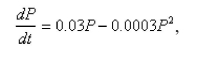
(Essay)
4.8/5
(78)

Solve the initial-value problem. Solve the initial-value problem.

(Essay)
4.8/5
(66)
Showing 81 - 100 of 160
close modal

Filters

  • Essay(0)
  • Multiple Choice(0)
  • Short Answer(0)
  • True False(0)
  • Matching(0)