Exam 9: Differential Equations

arrow
  • Select Tags
search iconSearch Question
  • Select Tags

Find the orthogonal trajectories of the family of curves. Find the orthogonal trajectories of the family of curves.

(Essay)
4.8/5
(88)

A sum of A sum of   s invested at   interest.If   is the amount of the investment at time t for the case of continuous compounding, write a differential equation and an initial condition satisfied by  s invested at A sum of   s invested at   interest.If   is the amount of the investment at time t for the case of continuous compounding, write a differential equation and an initial condition satisfied by  interest.If A sum of   s invested at   interest.If   is the amount of the investment at time t for the case of continuous compounding, write a differential equation and an initial condition satisfied by  is the amount of the investment at time t for the case of continuous compounding, write a differential equation and an initial condition satisfied by A sum of   s invested at   interest.If   is the amount of the investment at time t for the case of continuous compounding, write a differential equation and an initial condition satisfied by

(Essay)
4.7/5
(77)

Choose the differential equation corresponding to this direction field. Choose the differential equation corresponding to this direction field.
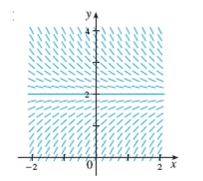
(Essay)
4.8/5
(94)

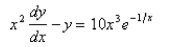
Solve the differential equation. Solve the differential equation.

(Multiple Choice)
4.7/5
(81)

One model for the spread of an epidemic is that the rate of spread is jointly proportional to the number of infected people and the number of uninfected people.In an isolated town of One model for the spread of an epidemic is that the rate of spread is jointly proportional to the number of infected people and the number of uninfected people.In an isolated town of   inhabitants,   people have a disease at the beginning of the week and   have it at the end of the week.How long does it take for   of the population to be infected? Select the correct Answer inhabitants, One model for the spread of an epidemic is that the rate of spread is jointly proportional to the number of infected people and the number of uninfected people.In an isolated town of   inhabitants,   people have a disease at the beginning of the week and   have it at the end of the week.How long does it take for   of the population to be infected? Select the correct Answer people have a disease at the beginning of the week and One model for the spread of an epidemic is that the rate of spread is jointly proportional to the number of infected people and the number of uninfected people.In an isolated town of   inhabitants,   people have a disease at the beginning of the week and   have it at the end of the week.How long does it take for   of the population to be infected? Select the correct Answer have it at the end of the week.How long does it take for One model for the spread of an epidemic is that the rate of spread is jointly proportional to the number of infected people and the number of uninfected people.In an isolated town of   inhabitants,   people have a disease at the beginning of the week and   have it at the end of the week.How long does it take for   of the population to be infected? Select the correct Answer of the population to be infected? Select the correct Answer

(Multiple Choice)
4.9/5
(76)

In the circuit shown in Figure, a generator supplies a voltage of In the circuit shown in Figure, a generator supplies a voltage of   volts, the inductance is   the resistance is 40   , and   Find the current 0.2 s after the switch is closed.Round yourAnswer to two decimal places.  volts, the inductance is In the circuit shown in Figure, a generator supplies a voltage of   volts, the inductance is   the resistance is 40   , and   Find the current 0.2 s after the switch is closed.Round yourAnswer to two decimal places.  the resistance is 40 In the circuit shown in Figure, a generator supplies a voltage of   volts, the inductance is   the resistance is 40   , and   Find the current 0.2 s after the switch is closed.Round yourAnswer to two decimal places.  , and In the circuit shown in Figure, a generator supplies a voltage of   volts, the inductance is   the resistance is 40   , and   Find the current 0.2 s after the switch is closed.Round yourAnswer to two decimal places.  Find the current 0.2 s after the switch is closed.Round yourAnswer to two decimal places. In the circuit shown in Figure, a generator supplies a voltage of   volts, the inductance is   the resistance is 40   , and   Find the current 0.2 s after the switch is closed.Round yourAnswer to two decimal places.
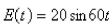
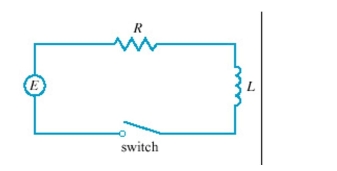
(Essay)
4.9/5
(77)

A curve passes through the point A curve passes through the point   and has the property that the slope of the curve at every point P is   times the y-coordinate P.What is the equation of the curve? and has the property that the slope of the curve at every point P is A curve passes through the point   and has the property that the slope of the curve at every point P is   times the y-coordinate P.What is the equation of the curve? times the y-coordinate P.What is the equation of the curve?

(Essay)
4.8/5
(89)

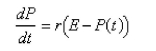
  be the performance level of someone learning a skill as a function of the training time   The graph of P is called a   We propose the differential equation   as a reasonable model for learning, where r is a positive constant.Solve it as a linear differential equation. be the performance level of someone learning a skill as a function of the training time   be the performance level of someone learning a skill as a function of the training time   The graph of P is called a   We propose the differential equation   as a reasonable model for learning, where r is a positive constant.Solve it as a linear differential equation. The graph of P is called a   be the performance level of someone learning a skill as a function of the training time   The graph of P is called a   We propose the differential equation   as a reasonable model for learning, where r is a positive constant.Solve it as a linear differential equation. We propose the differential equation   be the performance level of someone learning a skill as a function of the training time   The graph of P is called a   We propose the differential equation   as a reasonable model for learning, where r is a positive constant.Solve it as a linear differential equation. as a reasonable model for learning, where r is a positive constant.Solve it as a linear differential equation.

(Essay)
4.9/5
(73)

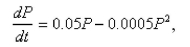
Suppose that a population develops according to the logistic equation Suppose that a population develops according to the logistic equation   where   is measured in weeks.What is the carrying capacity? Select the correct Answer where Suppose that a population develops according to the logistic equation   where   is measured in weeks.What is the carrying capacity? Select the correct Answer is measured in weeks.What is the carrying capacity? Select the correct Answer
(Multiple Choice)
4.9/5
(72)

One model for the spread of an epidemic is that the rate of spread is jointly proportional to the number of infected people and the number of uninfected people.In an isolated town of One model for the spread of an epidemic is that the rate of spread is jointly proportional to the number of infected people and the number of uninfected people.In an isolated town of   inhabitants,   people have a disease at the beginning of the week and   have it at the end of the week.How long does it take for   of the population to be infected? inhabitants, One model for the spread of an epidemic is that the rate of spread is jointly proportional to the number of infected people and the number of uninfected people.In an isolated town of   inhabitants,   people have a disease at the beginning of the week and   have it at the end of the week.How long does it take for   of the population to be infected? people have a disease at the beginning of the week and One model for the spread of an epidemic is that the rate of spread is jointly proportional to the number of infected people and the number of uninfected people.In an isolated town of   inhabitants,   people have a disease at the beginning of the week and   have it at the end of the week.How long does it take for   of the population to be infected? have it at the end of the week.How long does it take for One model for the spread of an epidemic is that the rate of spread is jointly proportional to the number of infected people and the number of uninfected people.In an isolated town of   inhabitants,   people have a disease at the beginning of the week and   have it at the end of the week.How long does it take for   of the population to be infected? of the population to be infected?

(Essay)
5.0/5
(69)

One model for the spread of an epidemic is that the rate of spread is jointly proportional to the number of infected people and the number of uninfected people.In an isolated town of One model for the spread of an epidemic is that the rate of spread is jointly proportional to the number of infected people and the number of uninfected people.In an isolated town of   inhabitants,   people have a disease at the beginning of the week and   have it at the end of the week.How long does it take for   of the population to be infected? Select the correct Answer inhabitants, One model for the spread of an epidemic is that the rate of spread is jointly proportional to the number of infected people and the number of uninfected people.In an isolated town of   inhabitants,   people have a disease at the beginning of the week and   have it at the end of the week.How long does it take for   of the population to be infected? Select the correct Answer people have a disease at the beginning of the week and One model for the spread of an epidemic is that the rate of spread is jointly proportional to the number of infected people and the number of uninfected people.In an isolated town of   inhabitants,   people have a disease at the beginning of the week and   have it at the end of the week.How long does it take for   of the population to be infected? Select the correct Answer have it at the end of the week.How long does it take for One model for the spread of an epidemic is that the rate of spread is jointly proportional to the number of infected people and the number of uninfected people.In an isolated town of   inhabitants,   people have a disease at the beginning of the week and   have it at the end of the week.How long does it take for   of the population to be infected? Select the correct Answer of the population to be infected? Select the correct Answer

(Multiple Choice)
4.8/5
(88)

Determine whether the differential equation is linear. Determine whether the differential equation is linear.

(Multiple Choice)
4.8/5
(79)

Biologists stocked a lake with Biologists stocked a lake with   fish and estimated the carrying capacity (the maximal population for the fish of that species in that lake) to be   The number of fish tripled in the first year.Assuming that the size of the fish population satisfies the logistic equation, find an expression for the size of the population after t years. fish and estimated the carrying capacity (the maximal population for the fish of that species in that lake) to be Biologists stocked a lake with   fish and estimated the carrying capacity (the maximal population for the fish of that species in that lake) to be   The number of fish tripled in the first year.Assuming that the size of the fish population satisfies the logistic equation, find an expression for the size of the population after t years. The number of fish tripled in the first year.Assuming that the size of the fish population satisfies the logistic equation, find an expression for the size of the population after t years.

(Essay)
4.9/5
(73)

Solve the initial-value problem. Solve the initial-value problem.

(Multiple Choice)
4.7/5
(74)

Suppose that a population grows according to a logistic model with carrying capacity Suppose that a population grows according to a logistic model with carrying capacity   and   per year.Choose the logistic differential equation for these data. and Suppose that a population grows according to a logistic model with carrying capacity   and   per year.Choose the logistic differential equation for these data. per year.Choose the logistic differential equation for these data.

(Multiple Choice)
4.7/5
(84)

Select the correct Answer: for each question. -Solve the differential equation. Select the correct Answer: for each question. -Solve the differential equation.

(Multiple Choice)
4.8/5
(81)

Solve the differential equation. Solve the differential equation.

(Multiple Choice)
4.9/5
(86)

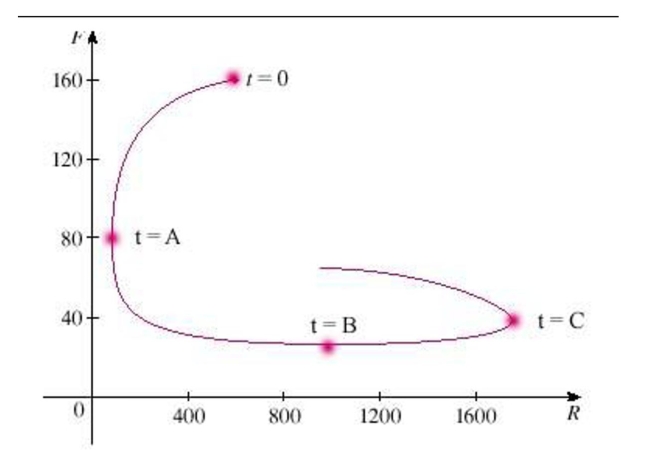
A phase trajectory is shown for populations of rabbits A phase trajectory is shown for populations of rabbits   and foxes   Describe how each population changes as time goes by.Select the correct Answer   Select the correct statement. and foxes A phase trajectory is shown for populations of rabbits   and foxes   Describe how each population changes as time goes by.Select the correct Answer   Select the correct statement. Describe how each population changes as time goes by.Select the correct Answer A phase trajectory is shown for populations of rabbits   and foxes   Describe how each population changes as time goes by.Select the correct Answer   Select the correct statement. Select the correct statement.
(Multiple Choice)
4.8/5
(70)

Solve the differential equation.Select the correct Answer Solve the differential equation.Select the correct Answer

(Multiple Choice)
4.9/5
(69)

A common inhabitant of human intestines is the bacterium A common inhabitant of human intestines is the bacterium   A cell of this bacterium in a nutrient-broth medium divides into two cells every   The initial population of a culture is   cells.Find the number of cells after   hours. A cell of this bacterium in a nutrient-broth medium divides into two cells every A common inhabitant of human intestines is the bacterium   A cell of this bacterium in a nutrient-broth medium divides into two cells every   The initial population of a culture is   cells.Find the number of cells after   hours. The initial population of a culture is A common inhabitant of human intestines is the bacterium   A cell of this bacterium in a nutrient-broth medium divides into two cells every   The initial population of a culture is   cells.Find the number of cells after   hours. cells.Find the number of cells after A common inhabitant of human intestines is the bacterium   A cell of this bacterium in a nutrient-broth medium divides into two cells every   The initial population of a culture is   cells.Find the number of cells after   hours. hours.

(Essay)
5.0/5
(65)
Showing 61 - 80 of 160
close modal

Filters

  • Essay(0)
  • Multiple Choice(0)
  • Short Answer(0)
  • True False(0)
  • Matching(0)