



 Chat with AI
Exam 23: Pathogens and Infection

Exam 1: Cells and Genomes34 Questions
Exam 2: Cell Chemistry and Bioenergetics54 Questions
Exam 3: Proteins52 Questions
Exam 4: DNA, Chromosomes, and Genomes57 Questions
Exam 5: DNA Replication, Repair, and Recombination51 Questions
Exam 6: How Cells Read the Genome: From DNA to Protein58 Questions
Exam 7: Control of Gene Expression62 Questions
Exam 8: Analyzing Cells, Molecules, and Systems95 Questions
Exam 9: Visualizing Cells29 Questions
Exam 10: Membrane Structure26 Questions
Exam 11: Membrane Transport of Small Molecules and the Electrical Properties of Membranes46 Questions
Exam 12: Intracellular Compartments and Protein Sorting46 Questions
Exam 13: Intracellular Membrane Traffic54 Questions
Exam 14: Energy Conversion: Mitochondria and Chloroplasts49 Questions
Exam 15: Cell Signaling63 Questions
Exam 16: The Cytoskeleton75 Questions
Exam 17: The Cell Cycle57 Questions
Exam 18: Cell Death12 Questions
Exam 19: Cell Junctions and the Extracellular Matrix56 Questions
Exam 20: Cancer50 Questions
Exam 21: Development of Multicellular Organisms61 Questions
Exam 22: Stem Cells and Tissue Renewal45 Questions
Exam 23: Pathogens and Infection32 Questions
Exam 24: The Innate and Adaptive Immune Systems47 Questions
Select questions type


Which of the following illnesses is NOT associated with infection with the pathogen indicated?
(Multiple Choice)
4.8/5  (88)
(88) In which of the following groups of viruses is an RNA-dependent RNA polymerase packaged as a structural protein in each newly made viral particle?
(Multiple Choice)
4.8/5 (68)
(68) Consider the movement in the host cell of two intracellular pathogens, the herpes simplex virus (H) and the bacterium Listeria monocytogenes (L). Indicate whether each of the following descriptions better applies to the virus (H) or the bacterium (L). Your answer would be a four-letter string composed of letters L and H only, e.g. HLLL.
( ) It moves by a "pushing" mechanism (as opposed to a "pulling" mechanism).
( ) It can collide with the plasma membrane and create long, thin protrusions from the cell that can then be engulfed by a neighboring cell.
( ) Its movement is powered by ATP hydrolysis by kinesin and dynein motors.
( ) Its movement relies on dynamic cytoskeletal filaments.
(Short Answer)
4.7/5 (81)
(81) How has pathogenicity in pandemic strains of Vibrio cholerae been acquired?
(Multiple Choice)
4.9/5 (84)
(84) Indicate whether each of the following descriptions better applies to enveloped (E) or nonenveloped (N) viruses. Your answer would be a four-letter string composed of letters E and N only, e.g. NNNN.
( ) They include retroviruses.
( ) They include adenoviruses.
( ) To leave the cell, they normally lyse it.
( ) They are more sensitive to treatment with detergents, heat, or drying.
(Short Answer)
4.8/5 (79)
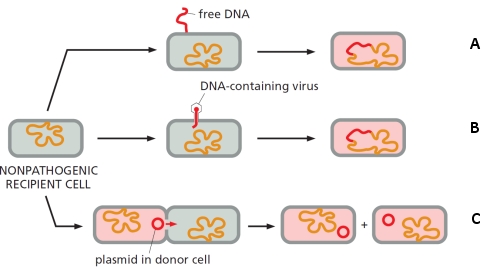
(79) In the following simplified diagram, three mechanisms for the horizontal transfer of virulence genes to an avirulent bacterium are depicted. Indicate which mechanism (A to C) corresponds to conjugation, transduction, and transformation, respectively. Your answer would be a three-letter string composed of letters A to C only, e.g. CAB.
(Short Answer)
4.9/5 (80)
(80) In Gram staining, crystal violet (a violet dye) is used to specifically stain Gram-positive bacteria. After performing Gram staining on a bacterial sample taken from an infected animal tissue, you observe the results with a microscope. You find two major types of bacteria in the sample, as shown in the schematic drawing below. According to these results, indicate whether each of the following statements is correct (C) or incorrect (I). Your answer would be a three-letter string composed of letters C and I only, e.g. CCC.
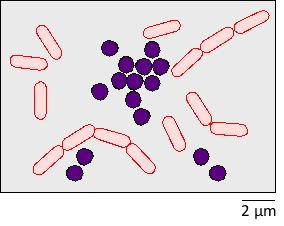 ( ) The Gram-positive bacteria in this sample are bacilli.
( ) Crystal violet stains lipopolysaccharide (LPS).
( ) The bacteria stained violet in this sample have a thicker layer of peptidoglycan compared to the other bacteria.
( ) The Gram-positive bacteria in this sample are bacilli.
( ) Crystal violet stains lipopolysaccharide (LPS).
( ) The bacteria stained violet in this sample have a thicker layer of peptidoglycan compared to the other bacteria.
(Short Answer)
4.7/5 (86)
(86) Indicate whether each of the following descriptions better applies to bacterial (B), fungal (F), protozoan (P), or viral (V) pathogens. Your answer would be a four-letter string composed of letters B, F, P, and V only, e.g. FFFB.
( ) They cannot be all grouped neatly into a single phylogenetic tree.
( ) They have the most complex life cycles.
( ) They are essentially fragments of nucleic acid wrapped in a protective shell of proteins and (in some cases) an outer membrane.
( ) They are responsible for diseases such as polio and smallpox.
(Short Answer)
4.7/5 (75)
(75) After gaining entry into the host cell by the zipper mechanism, the bacterium Listeria monocytogenes escapes phagosomes by secreting listeriolysin O. This protein …
(Multiple Choice)
4.9/5 (86)
(86) Trypanosoma cruzi uses two alternative strategies to invade its host cells. To examine the contribution of each of these strategies to the pathogenicity, you culture mammalian cells that can be infected with this pathogen. The cells are engineered to express green fluorescent protein (GFP) fused to a plasma membrane protein, as well as red fluorescent protein (RFP) fused to a lysosome-specific transmembrane protein. You then either add only tiny latex beads (as a negative control) or add T. cruzi protozoa (to infect the cells). After 10 minutes, you fix the cells and examine them under a fluorescence microscope. You observe that a significant fraction (~30%) of phagosomes/vacuoles in sample 1 are RFP-positive (i.e. show RFP fluorescence at their membrane), whereas all phagosomes in sample 2 are RFP-negative. Which sample (1 or 2) is the one infected with T. cruzi? In this infected sample, would you expect the RFP-negative trypanosome-containing vacuoles to be GFP-positive or GFP-negative?
(Multiple Choice)
4.7/5 (64)
(64) Indicate whether each of the following examples better applies to commensalism (C), mutualism (M), or parasitism (P) in the interaction between a host and a microbe. Your answer would be a four-letter string composed of letters C, M, and P only, e.g. CCPP.
( ) Due to poor public sanitation, a child catches cholera.
( ) A mouse is infected with a virus but shows no noticeable health defect whatsoever.
( ) Biotin and other vitamins produced by intestinal microbiota are regularly absorbed in the human intestine.
( ) Bacteria on the skin of cattle produce antifungal compounds.
(Short Answer)
4.8/5 (95)
(95) To enter the host cell, intracellular bacterial pathogens can induce phagocytosis in cells that are normally nonphagocytic. This is done by two major mechanisms depicted in the following schematic diagrams (A and B). Indicate whether each of the following descriptions better applies to mechanism A or B. Your answer would be a four-letter string composed of letters A and B only, e.g. ABAA.
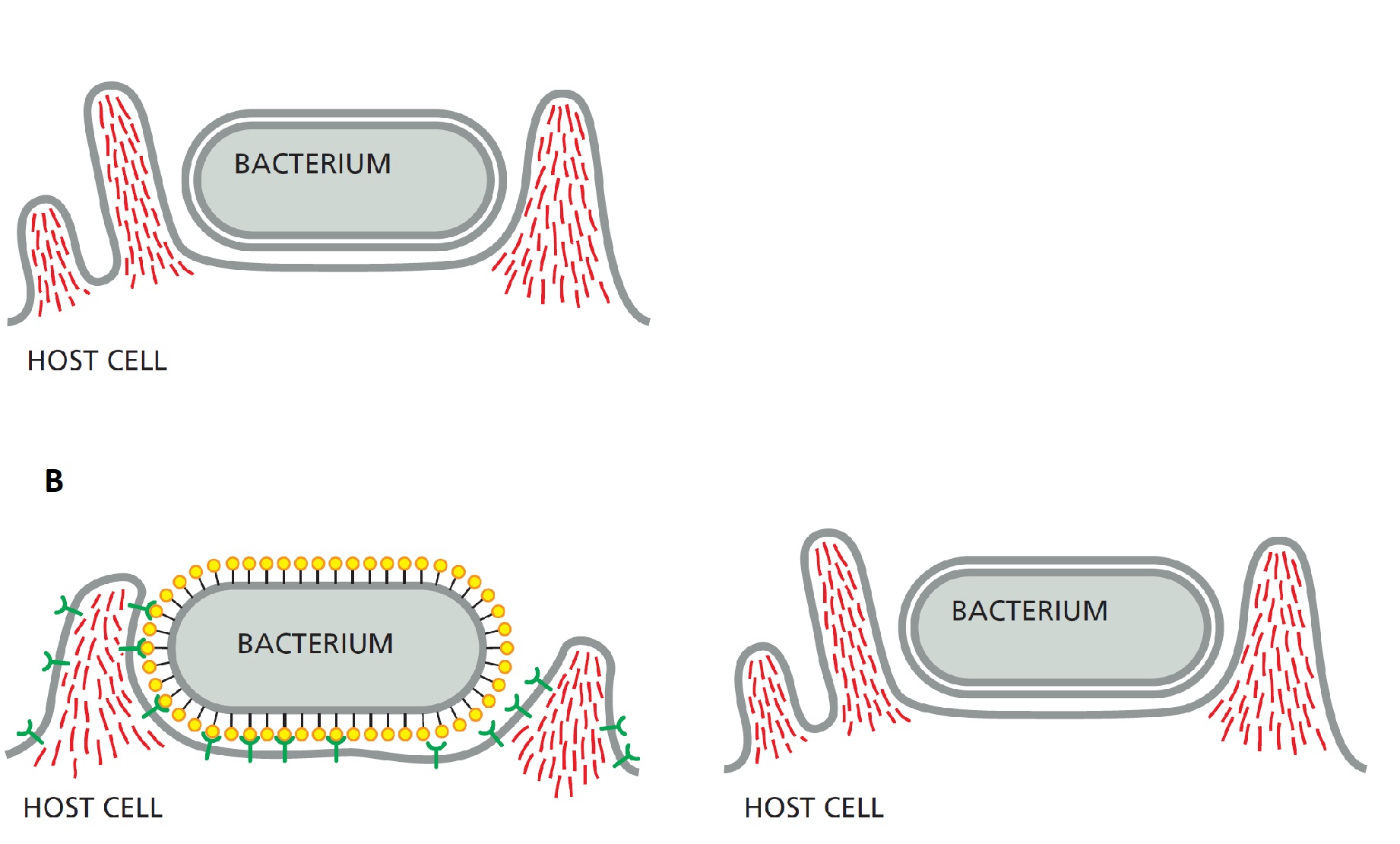 ( ) It is called the zipper mechanism.
( ) It depends on invasin proteins on the surface of the bacterium that bind to their receptors on the surface of the host cell.
( ) It depends on the injection of effector proteins into the host cell by a bacterial secretion system.
( ) It resembles the process of macropinocytosis.
( ) It is called the zipper mechanism.
( ) It depends on invasin proteins on the surface of the bacterium that bind to their receptors on the surface of the host cell.
( ) It depends on the injection of effector proteins into the host cell by a bacterial secretion system.
( ) It resembles the process of macropinocytosis.
(Short Answer)
4.8/5 (80)
(80) 
Filters
- Essay(0)
- Multiple Choice(0)
- Short Answer(0)
- True False(0)
- Matching(0)