



 Chat with AI
Exam 15: Cell Signaling

Exam 1: Cells and Genomes34 Questions
Exam 2: Cell Chemistry and Bioenergetics54 Questions
Exam 3: Proteins52 Questions
Exam 4: DNA, Chromosomes, and Genomes57 Questions
Exam 5: DNA Replication, Repair, and Recombination51 Questions
Exam 6: How Cells Read the Genome: From DNA to Protein58 Questions
Exam 7: Control of Gene Expression62 Questions
Exam 8: Analyzing Cells, Molecules, and Systems95 Questions
Exam 9: Visualizing Cells29 Questions
Exam 10: Membrane Structure26 Questions
Exam 11: Membrane Transport of Small Molecules and the Electrical Properties of Membranes46 Questions
Exam 12: Intracellular Compartments and Protein Sorting46 Questions
Exam 13: Intracellular Membrane Traffic54 Questions
Exam 14: Energy Conversion: Mitochondria and Chloroplasts49 Questions
Exam 15: Cell Signaling63 Questions
Exam 16: The Cytoskeleton75 Questions
Exam 17: The Cell Cycle57 Questions
Exam 18: Cell Death12 Questions
Exam 19: Cell Junctions and the Extracellular Matrix56 Questions
Exam 20: Cancer50 Questions
Exam 21: Development of Multicellular Organisms61 Questions
Exam 22: Stem Cells and Tissue Renewal45 Questions
Exam 23: Pathogens and Infection32 Questions
Exam 24: The Innate and Adaptive Immune Systems47 Questions
Select questions type


The phosphorylation state of a human protein follows the oscillatory pattern shown in the first graph below. The protein is phosphorylated by two kinases (1 and 2), both of which are activated in an oscillatory pattern. Kinase 1 oscillates in congruence with the circadian rhythm, while kinase 2 oscillates at a higher frequency and is independent of the circadian clock. The second graph shows the phosphorylation state of the same protein in mutant cells lacking one of the kinases mentioned above. Which kinase (1 or 2) do you think is missing in these mutant cells? Write down 1 or 2 as your answer.

(Short Answer)
4.8/5  (79)
(79) In the following simplified diagram, the activation of a hypothetical allosteric protein is plotted as a function of effector molecule concentration. Which curve (A to E) do you think corresponds to a condition in which activation requires the highest number of effector molecules bound to each protein? 
(Short Answer)
4.9/5 (76)
(76) Sort the following events into the order that they take place in phototransduction in response to a flash of light. Your answer would be a four-letter string composed of letters A to E, e.g. BCDEA.
(A) The cGMP level drops.
(B) The cGMP level rises.
(C) The Ca²? level drops.
(D) Retinal isomerizes to an all-trans configuration.
(E) Gt exchanges its bound nucleotide.
(Short Answer)
4.9/5 (78)
(78) The SH2 domain of STAT proteins plays a key role in cytokine receptor signaling. This domain can bind to phosphotyrosine ...
(Multiple Choice)
4.8/5 (80)
(80) Fill in the blank in the following paragraph.
"Cytosolic Ca2+ can be sensed by ..., a small, conserved, dumbbell-shaped protein with four Ca2+-binding sites. Upon Ca2+ binding, it binds and activates dozens of proteins by changing its conformation in different ways."
(Short Answer)
4.9/5 (88)
(88) In the following schematic diagram showing the initial signaling steps in growth cone collapse in motor neurons, indicate which protein (A to E) corresponds to the following. Your answer would be a four-letter string composed of letters A to E only, e.g. CBAE.
 ( ) Ephrin
( ) Ephexin
( ) RhoA GTPase
( ) Cytoplasmic tyrosine kinase
( ) Ephrin
( ) Ephexin
( ) RhoA GTPase
( ) Cytoplasmic tyrosine kinase
(Short Answer)
4.9/5 (86)
(86) How is the activation of epidermal growth factor receptor (EGFR) different from that of insulin receptor (IR)?
(Multiple Choice)
4.8/5 (68)
(68) A genetic form of "night blindness" (i.e. poor vision in dim light) is caused by mutations in genes encoding rhodopsin kinase (RK) and arrestin. The mutations reduce the dynamic range of light perception, and the affected individuals have a prolonged light response and adapt very slowly to low light (when entering a dark theater room, for example). Which of the following mutations do you expect to be the cause?
(Multiple Choice)
4.9/5 (81)
(81) Which of the following phosphoinositides is the preferred binding target for a PH-domain-containing protein? 
(Short Answer)
5.0/5 (81)
(81) Regulation of the Ci (Cubitus interruptus) protein in the Hedgehog signaling pathway is reminiscent of that of β-catenin in the Wnt pathway. Which of the following features is shared among these two proteins?
(Multiple Choice)
4.8/5 (69)
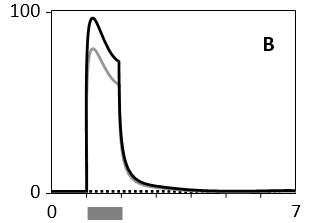
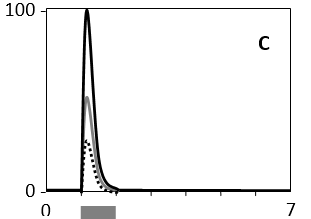
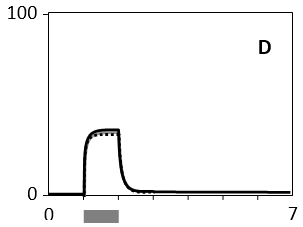
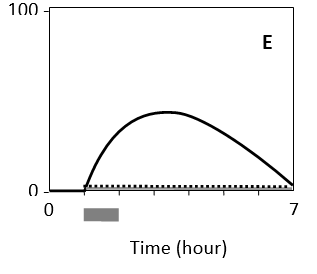
(69) In the following graphs, the cellular response, as measured in real time by the concentration of a certain active effector protein, is plotted over time for five cell types (A to E) that are treated with three different concentrations of a signal molecule. During the time period indicated by the horizontal gray bar, the signal molecule is present in the culture media at a concentration of 1 nM (dotted curve), 5 nM (gray curve), or 25 nM (solid curve). Answer the following question(s) based on these graphs.
-Which of the cell types A to E shows the fastest signal adaptation?
A)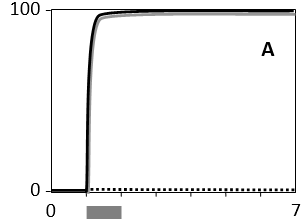 B)
 C)
 D)
 E)
B)
C)
D)
E) (Short Answer)
4.9/5 (82)
(82) A cell expresses a transmembrane protein that is cleaved at the plasma membrane to release an extracellular fragment. The fragment binds to receptor proteins on nearby cells and activates signaling pathways resulting in altered gene expression patterns in the cells. What form of intercellular signaling does this represent?
(Multiple Choice)
4.9/5 (86)
(86) Intracellular Ca2+ oscillations, initiated by the activation of IP3 receptors and orchestrated via intricate positive and negative feedback loops, can be subject to frequency modulation, an example of which is the increase in oscillation frequency with increasing stimulus strength. Caffeine is known to bind to and sensitize the ryanodine receptors, resulting in their opening in response to lower calcium ion concentrations. Do you think caffeine would tend to increase (I) or decrease (D) the frequency of calcium ion oscillations in stimulated cells? Write down I or D as your answer.
(Short Answer)
4.8/5 (75)
(75) What two cell-surface receptors are represented in the two simplified diagrams below (from left to right)? 
(Multiple Choice)
4.9/5 (76)
(76) Which of the following events normally activates a GTP-binding protein?
(Multiple Choice)
4.8/5 (74)
(74) What is the effect of using scaffold proteins on precision and amplification capacity in cell signaling?
(Multiple Choice)
4.7/5 (81)
(81) Proteins of the Src family (e.g. Src, Fyn, Lck, and Hck) have important roles in several signaling pathways in mammals. A typical Src family protein ...
(Multiple Choice)
4.7/5 (72)
(72) Genetic screens for enhancers and suppressors of temperature-sensitive loss-of-function mutations in sevenless (sev) in Drosophila melanogaster led to the discovery of some other genes involved in the Ras-MAP-kinase pathway. Would you expect loss-of-function mutations in genes encoding each of the following proteins to be an enhancer (E) or suppressor (S) of sev? An enhancer mutation exacerbates the effect of the original mutation, whereas a suppressor mutation alleviates it. Note that loss-of-function mutations can be just partial defects and not necessarily null mutations. Your answer would be a four-letter string composed of letters E and S only, e.g. EEEE.
( ) Sos
( ) Ras
( ) Ras-GAP
( ) Raf
(Short Answer)
4.8/5 (81)
(81) Some signaling pathways in the cell are chiefly based on inhibition rather than activation. For example, proteins that initiate programmed cell death by apoptosis are inhibited by anti-apoptotic proteins, which can in turn be inhibited by a group of pro-apoptotic proteins, and so on. Consider the following networks of inhibitory interactions, in which each protein is inactive if at least one of its inhibitors is active. In which pathway is the activation of either upstream protein (1 or 2) sufficient to inhibit apoptosis?
(Multiple Choice)
4.9/5 (85)
(85) 
Filters
- Essay(0)
- Multiple Choice(0)
- Short Answer(0)
- True False(0)
- Matching(0)