



 Chat with AI
Exam 14: Energy Conversion: Mitochondria and Chloroplasts

Exam 1: Cells and Genomes34 Questions
Exam 2: Cell Chemistry and Bioenergetics54 Questions
Exam 3: Proteins52 Questions
Exam 4: DNA, Chromosomes, and Genomes57 Questions
Exam 5: DNA Replication, Repair, and Recombination51 Questions
Exam 6: How Cells Read the Genome: From DNA to Protein58 Questions
Exam 7: Control of Gene Expression62 Questions
Exam 8: Analyzing Cells, Molecules, and Systems95 Questions
Exam 9: Visualizing Cells29 Questions
Exam 10: Membrane Structure26 Questions
Exam 11: Membrane Transport of Small Molecules and the Electrical Properties of Membranes46 Questions
Exam 12: Intracellular Compartments and Protein Sorting46 Questions
Exam 13: Intracellular Membrane Traffic54 Questions
Exam 14: Energy Conversion: Mitochondria and Chloroplasts49 Questions
Exam 15: Cell Signaling63 Questions
Exam 16: The Cytoskeleton75 Questions
Exam 17: The Cell Cycle57 Questions
Exam 18: Cell Death12 Questions
Exam 19: Cell Junctions and the Extracellular Matrix56 Questions
Exam 20: Cancer50 Questions
Exam 21: Development of Multicellular Organisms61 Questions
Exam 22: Stem Cells and Tissue Renewal45 Questions
Exam 23: Pathogens and Infection32 Questions
Exam 24: The Innate and Adaptive Immune Systems47 Questions
Select questions type


Indicate whether each of the following descriptions better matches the outer mitochondrial membrane (O), the intermembrane space (S), the crista membrane portion of the inner mitochondrial membrane (I), or the matrix (M). Your answer would be a four-letter string composed of letters O, S, I, and M only, e.g. OMIM.
( ) It is where NADH is produced.
( ) It is composed of 75% protein by weight.
( ) It is where the respiratory chain is located.
( ) It has the same electrochemical potential for H? as the cytoplasm.
(Short Answer)
4.9/5  (76)
(76) The cytochrome b₆-f complex that transfers electrons between the two photosystems in photosynthesis is structurally and functionally similar to which of the complexes in the mitochondrial electron-transport chain?
(Multiple Choice)
4.9/5 (70)
(70) Indicate which letter (A to D) in the schematic drawings below of a mitochondrion and a chloroplast corresponds to each of the following features. Your answer would be a four-letter string composed of letters A to D only, e.g. BDCA. Each letter should be used once.
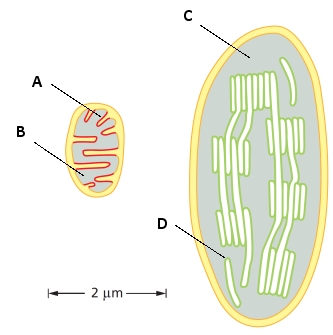 ( ) Crista
( ) Stroma
( ) Matrix
( ) Thylakoid
( ) Crista
( ) Stroma
( ) Matrix
( ) Thylakoid
(Short Answer)
4.9/5 (90)
(90) The synthetic toxin 2,4-dinitrophenol can uncouple ATP synthesis from mitochondrial respiration by decreasing the permeability of the inner membrane to protons. What would be the effect of dinitrophenol treatment on the amount of ATP produced by mitochondria and on the rate of ATP transport across the inner membrane, respectively?
(Multiple Choice)
4.7/5 (85)
(85) Indicate true (T) and false (F) statements below regarding mitochondria. Your answer would be a four-letter string composed of letters T and F only, e.g. TFTT.
( ) Mitochondria are small round organelles that are often associated with actin filaments of the cytoskeleton.
( ) In sperm cells, mitochondria are seen wrapping tightly around the nucleus.
( ) Mitochondria are large enough to be seen with modern light microscopy, and can occupy as much as 20% of cytoplasmic volume.
( ) The outer mitochondrial membrane is freely permeable to ions and small molecules.
(Short Answer)
4.7/5 (89)
(89) Which of the following does NOT occur in the normal process of light-driven production of ATP and NADPH in plant chloroplasts?
(Multiple Choice)
4.9/5 (77)
(77) Indicate true (T) and false (F) statements below regarding carbon fixation in plant cells. Your answer would be a five-letter string composed of letters T and F only, e.g. TTFTF.
( ) Carbon fixation in photosynthetic cells eventually generates glucose, the major form of sugar that is transported to other plant tissues.
( ) Plant cells can generate fat droplets in their chloroplasts using glyceraldehyde 3-phosphate.
( ) ATP generated in the light cycle is the major source of ATP used by the plant cell to power all of its biochemical reactions.
( ) Plant cells can generate starch granules in their chloroplasts using glyceraldehyde 3-phosphate.
( ) Pyruvate is generated in the chloroplast by the glycolytic pathway.
(Short Answer)
4.8/5 (85)
(85) Indicate whether each of the following descriptions better applies to cytochrome c oxidase complex (O), cytochrome c reductase complex (R), or NADH dehydrogenase complex (N). Your answer would be a four-letter string composed of letters O, R, and N only, e.g. RONN.
( ) It is the largest of the three respiratory complexes.
( ) It accounts for the majority of O? uptake in most cells.
( ) It employs the Q cycle to increase proton pumping.
( ) It contains separate modules for electron transport and proton pumping.
(Short Answer)
4.9/5 (84)
(84) You have isolated mitochondria from a liver tissue sample, suspended them in a hypotonic buffer that causes them to swell and burst their outer membrane, and then added sucrose to a final concentration of about 25%. You then layer the suspension on a density gradient, ultracentrifuge, collect the different fractions, and analyze their protein content. Which of the following proteins would you expect to be highly enriched in the lower density and higher density fractions, respectively?
(Multiple Choice)
4.9/5 (86)
(86) Indicate true (T) and false (F) statements below regarding the genetic systems of mitochondria and chloroplasts. Your answer would be a four-letter string composed of letters T and F only, e.g. TFTT.
( ) Most proteins in these organelles are encoded by the organelle's genome.
( ) Mammalian mtDNA can make up less than 1% of the total cellular DNA.
( ) In some highly specialized animal cells, mtDNA can comprise as much as 99% of the cellular DNA.
( ) The genetic systems of these organelles are most similar to extremophilic archaea.
(Short Answer)
4.8/5 (80)
(80) Photosynthesis provides the strongest known electron donor as well as the strongest known electron acceptor in all biology. What do you think the donor and the acceptor are, respectively?
(Multiple Choice)
4.9/5 (83)
(83) Consider two organisms, one with a much larger mitochondrial genome than the other. Which one is expected to show more deviations from the universal genetic code: the one with the larger mitochondrial genome (L) or the one with a smaller genome (S)? Write down L or S as your answer.
(Short Answer)
4.7/5 (83)
(83) Order the following metabolic innovations to reflect the most likely order in which they evolved during biological evolution. Your answer would be a four-letter string composed of letters A to D only, e.g. BDCA.
(A) Using light energy to generate reducing power
(B) Splitting of water molecules (an electron source)
(C) Fermentation of organic material
(D) Reduction of molecular oxygen (a terminal electron acceptor)
(Short Answer)
4.8/5 (85)
(85) Which of the following is NOT correct regarding the fusion and fission of mitochondria?
(Multiple Choice)
4.8/5 (79)
(79) When the special pair in a photosystem is excited by a quantum of light, charge separation can occur. Where does this take place? What is the charge of the ionized chlorophyll?
(Multiple Choice)
4.9/5 (78)
(78) Indicate true (T) and false (F) statements below regarding the evolution of photosynthesis and oxidative phosphorylation. Your answer would be a five-letter string composed of letters T and F only, e.g. TTFTF.
( ) Chloroplasts are thought to descend from ancient purple sulfur bacteria.
( ) Mitochondria are thought to descend from ancient ?-proteobacteria.
( ) The first photosynthetic cyanobacteria evolved before the first aerobic proteobacteria.
( ) All photosynthetic and aerobic bacteria are thought to have evolved from a common ancestor capable of fermentation and membrane electron transport.
(Short Answer)
4.8/5 (79)
(79) Consider the remarkable structure of the F1Fo ATP synthase shown in the following schematic drawing. Answer the following question(s) based on the structure.
 -In the schematic drawing of the structure of ATP synthase shown above, indicate whether each of the numbered components of the machine (from 1 to 5, respectively) is rotary (R) or stationary (S). Your answer would be a five-letter string composed of letters R and S only, e.g. RRSRS.
(Short Answer)
4.7/5 (94)
(94) The free-energy change of ATP hydrolysis to ADP inside the cell is about -50 kJ/mole. The standard free-energy change for the same reaction is about -30 kJ/mole. This necessitates that [ATP] inside the cell be …
(Multiple Choice)
4.9/5 (73)
(73) Indicate whether each of the following statements better describes ATP production in chloroplasts (C) or in mitochondria (M). Your answer would be a four-letter string composed of letters C and M only, e.g. MCMM.
( ) The electrochemical gradient that drives ATP production is dominated by the electrical component.
( ) It involves a significant pH difference across the membrane.
( ) The ATP synthase molecules form dimers.
( ) The ATP synthase molecules are distributed randomly in flat membrane regions.
(Short Answer)
4.9/5 (86)
(86) 
Filters
- Essay(0)
- Multiple Choice(0)
- Short Answer(0)
- True False(0)
- Matching(0)