



 Chat with AI
Exam 13: Intracellular Membrane Traffic

Exam 1: Cells and Genomes34 Questions
Exam 2: Cell Chemistry and Bioenergetics54 Questions
Exam 3: Proteins52 Questions
Exam 4: DNA, Chromosomes, and Genomes57 Questions
Exam 5: DNA Replication, Repair, and Recombination51 Questions
Exam 6: How Cells Read the Genome: From DNA to Protein58 Questions
Exam 7: Control of Gene Expression62 Questions
Exam 8: Analyzing Cells, Molecules, and Systems95 Questions
Exam 9: Visualizing Cells29 Questions
Exam 10: Membrane Structure26 Questions
Exam 11: Membrane Transport of Small Molecules and the Electrical Properties of Membranes46 Questions
Exam 12: Intracellular Compartments and Protein Sorting46 Questions
Exam 13: Intracellular Membrane Traffic54 Questions
Exam 14: Energy Conversion: Mitochondria and Chloroplasts49 Questions
Exam 15: Cell Signaling63 Questions
Exam 16: The Cytoskeleton75 Questions
Exam 17: The Cell Cycle57 Questions
Exam 18: Cell Death12 Questions
Exam 19: Cell Junctions and the Extracellular Matrix56 Questions
Exam 20: Cancer50 Questions
Exam 21: Development of Multicellular Organisms61 Questions
Exam 22: Stem Cells and Tissue Renewal45 Questions
Exam 23: Pathogens and Infection32 Questions
Exam 24: The Innate and Adaptive Immune Systems47 Questions
Select questions type


Indicate whether each of the following descriptions better applies to a BAR domain (B), the outer shell of COPI coatomer (C), or a dynamin oligomer (D). Your answer would be a three-letter string composed of letters B, C, and D only, e.g. CBD.
( ) It resembles a crescent.
( ) It resembles a collar.
( ) It resembles a cage.
(Short Answer)
4.8/5  (77)
(77) Indicate true (T) and false (F) statements below regarding intracellular vesicle transport. Your answer would be a four-letter string composed of letters T and F only, e.g. TTTF
( ) The plasma membrane is stiffer and flatter than most intracellular membranes, and its deformation generally requires greater force.
( ) Large molecules such as collagen fibers of about 300 µm in length are highly packed and coiled to fit into normal COPII vesicles of about 80 nm in diameter.
( ) Rab proteins are recruited to membranes following activation by Rab-GEFs.
( ) A Rab and its effector are always on two different membranes that will then fuse.
(Short Answer)
4.9/5 (99)
(99) A schematic drawing of the secretory and endocytic pathways is presented below. Indicate which component in the drawing (A to J) corresponds to each of the following. Your answer would be a 10-letter string composed of letters A to J only, e.g. HICDJABFGE.
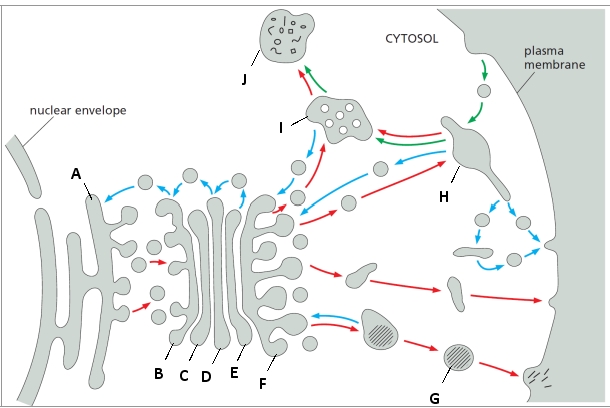 ( ) Early endosome
( ) Late endosome
( ) ER
( ) Lysosome
( ) cis Golgi cisterna
( ) medial Golgi cisterna
( ) trans Golgi cisterna
( ) cis Golgi network (CGN)
( ) trans Golgi network (TGN)
( ) Secretory vesicle
( ) Early endosome
( ) Late endosome
( ) ER
( ) Lysosome
( ) cis Golgi cisterna
( ) medial Golgi cisterna
( ) trans Golgi cisterna
( ) cis Golgi network (CGN)
( ) trans Golgi network (TGN)
( ) Secretory vesicle
(Short Answer)
4.9/5 (75)
(75) Indicate whether each of the following descriptions better applies to COPI- (1), COPII- (2), or clathrin- (3) coated vesicles. Your answer would be a four-digit number composed of digits 1 to 3 only, e.g. 1322.
( ) They are uncoated by an hsp70 family protein, which is stimulated by the binding of auxilin.
( ) They keep their coat proteins for a relatively long time, until they dock onto their target membrane.
( ) Their uncoating depends on activation of an ARF-GAP.
( ) Their uncoating depends in part on activation of a Sar1-GAP.
(Short Answer)
5.0/5 (73)
(73) You are studying the cellular basis of petal coloration in the flowering plant Ipomoea tricolor. These plants have colorful petals due to the presence of pH-sensitive vacuolar anthocyanins that change color from red/purple in acidic pH to blue at neutral pH. You treat petals with either vanadate (a specific inhibitor of P-ATPases) or bafilomycin (a specific inhibitor of V-ATPases) or both and compare the color with that of control petals, obtaining the results shown in the table below. Which of the following conclusions is consistent with these observations? 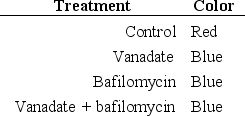
(Multiple Choice)
4.8/5 (80)
(80) Indicate whether each of the following descriptions better applies to N-linked (N) or O-linked (O) glycosylation. Your answer would be a four-letter string composed of letters N and O only, e.g. OONO.
( ) It is abundant in proteoglycans.
( ) It involves the attachment of a preassembled block of oligosaccharide onto a protein.
( ) It is attached to a serine or threonine residue in the protein.
( ) It involves heavily sulfated sugars.
(Short Answer)
4.8/5 (91)
(91) Indicate whether each of the following descriptions better applies to t-SNAREs (T) or v-SNAREs (V). Your answer would be a three-letter string composed of letters T and V only, e.g. TVV.
( ) They are usually located on the target membrane.
( ) They are composed of a single polypeptide chain.
( ) They are usually associated with inhibitory proteins that can be released by Rab proteins.
(Short Answer)
4.8/5 (81)
(81) In the simplified diagram below depicting exocytosis of synaptic vesicles, which components (A to D) correspond to each of the following? Your answer would be a four-letter string composed of letters A to D only, e.g. DBCA.
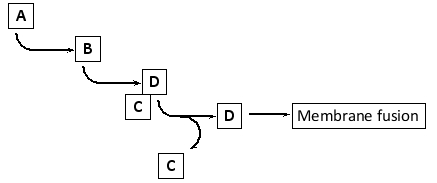 ( ) Ca2+
( ) Complexin
( ) Synaptotagmin
( ) SNARE complex
( ) Ca2+
( ) Complexin
( ) Synaptotagmin
( ) SNARE complex
(Short Answer)
4.8/5 (89)
(89) Adaptor proteins select cargo proteins that will be incorporated into clathrin-coated vesicles. An adaptor protein such as AP2 …
(Multiple Choice)
4.9/5 (83)
(83) By forming over 100 pinocytic vesicles per minute, a macrophage ingests over 10% of its own volume of fluid every half an hour. This is equivalent to ingesting about 100% of the macrophage's plasma membrane. If the average volume of a macrophage is about 450 µm³ and its average surface area is about 750 µm², what is the average diameter of the early pinocytic vesicles in the cell? Assume spherical vesicles. The formulas for the volume (V) and surface area (S) of a sphere of radius r are V = 4/3 × ? × r³, and S = 4 × ? × r², respectively. Write down your answer in nanometers, with no decimals, e.g. 830 nm.
(Short Answer)
4.8/5 (70)
(70) Insulin is a secretory protein made by the β cells in the pancreas. This protein …
(Multiple Choice)
4.9/5 (76)
(76) Consider two N-linked oligosaccharide chains on the same protein. The first chain contains three mannose residues and three negatively charged sialic acid residues, as well as other residues. The second chain contains only two N-acetylglucosamine and eight mannose residues. Which chain seems to have been added to the protein such that it is NOT fully accessible to the processing enzymes in the Golgi apparatus? Which chain is Endo H-sensitive?
(Multiple Choice)
4.7/5 (90)
(90) The cytoplasmic C-terminal KKXX sequence of transmembrane proteins interacts with …
(Multiple Choice)
4.8/5 (81)
(81) In the highly simplified diagram below, the energy landscape of secretory vesicle fusion to the plasma membrane is shown in the presence or absence of appropriate SNARE complexes. Which curve (A or B) do you think corresponds to the presence of SNARE complexes? Write down A or B as your answer. 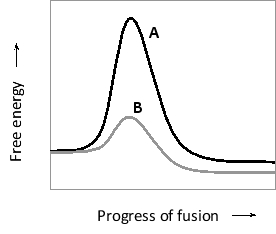
(Short Answer)
4.8/5 (76)
(76) A mitochondrion has just been engulfed by a cup-shaped isolation membrane as it undergoes mitophagy. Before lysosomal fusion, how many membranes separate the cytosol from the matrix of the engulfed mitochondrion?
(Multiple Choice)
4.9/5 (75)
(75) You are viewing a sample of pond water under the microscope. The sample contains a variety of microorganisms, some moving faster than others. You spot a Paramecium that is being followed by a Didinium almost as large as itself; the Paramecium initially swims away and tries to escape, but Didinium, which moves in faster bursts, finally stops it and attaches firmly onto the side of the Paramecium and proceeds to eat it. What type of endocytosis will ensue? Write down the name of the process as your answer. Do not use abbreviations.
(Short Answer)
5.0/5 (76)
(76) The transmembrane protein Tango1 is a packaging protein that helps some secretory proteins leave the endoplasmic reticulum (ER) after synthesis. Knocking down Tango1 by RNA interference impairs the incorporation of collagen VII, but not collagen I, into transport vesicles destined for the Golgi apparatus. The protein contains a lumenal N-terminal SH3 domain and a cytosolic C-terminal proline-rich domain. Which of the following proteins would you expect to interact with the N-terminal and C-terminal domains of Tango1, respectively?
(Multiple Choice)
4.8/5 (76)
(76) Indicate whether each of the following membrane proteins releases its protein ligand (R), remains bound to its protein ligand (B), or is degraded in the lysosome along with its protein ligand (D) following receptor-mediated endocytosis. Your answer would be a three-letter string composed of letters R, B, and D only, e.g. RBD.
( ) LDL receptor
( ) Transferrin receptor
( ) EGF receptor
(Short Answer)
5.0/5 (73)
(73) Sort the following events to reflect the order in which they occur during engulfment of an antibody-coated microorganism by a neutrophil in the blood. Your answer would be a four-letter string composed of letters A to D only, e.g. DACB.
(A) Rho-GEF activation
(B) Activation of Fc receptors
(C) Local PI(4,5)P? production
(D) Local PI(3,4,5)P? production
(Short Answer)
4.9/5 (91)
(91) 
Filters
- Essay(0)
- Multiple Choice(0)
- Short Answer(0)
- True False(0)
- Matching(0)