



 Chat with AI
Exam 11: Membrane Transport of Small Molecules and the Electrical Properties of Membranes

Exam 1: Cells and Genomes34 Questions
Exam 2: Cell Chemistry and Bioenergetics54 Questions
Exam 3: Proteins52 Questions
Exam 4: DNA, Chromosomes, and Genomes57 Questions
Exam 5: DNA Replication, Repair, and Recombination51 Questions
Exam 6: How Cells Read the Genome: From DNA to Protein58 Questions
Exam 7: Control of Gene Expression62 Questions
Exam 8: Analyzing Cells, Molecules, and Systems95 Questions
Exam 9: Visualizing Cells29 Questions
Exam 10: Membrane Structure26 Questions
Exam 11: Membrane Transport of Small Molecules and the Electrical Properties of Membranes46 Questions
Exam 12: Intracellular Compartments and Protein Sorting46 Questions
Exam 13: Intracellular Membrane Traffic54 Questions
Exam 14: Energy Conversion: Mitochondria and Chloroplasts49 Questions
Exam 15: Cell Signaling63 Questions
Exam 16: The Cytoskeleton75 Questions
Exam 17: The Cell Cycle57 Questions
Exam 18: Cell Death12 Questions
Exam 19: Cell Junctions and the Extracellular Matrix56 Questions
Exam 20: Cancer50 Questions
Exam 21: Development of Multicellular Organisms61 Questions
Exam 22: Stem Cells and Tissue Renewal45 Questions
Exam 23: Pathogens and Infection32 Questions
Exam 24: The Innate and Adaptive Immune Systems47 Questions
Select questions type


Which of the following is NOT common between long-term potentiation and long-term depression?
(Multiple Choice)
4.8/5  (85)
(85) Which of the following normally functions to lower the pH of the cytosol?
(Multiple Choice)
4.8/5 (81)
(81) Imagine a small synthetic vesicle made from pure phospholipids enclosing an interior lumen containing 1 mM glucose and 1 mM sodium chloride. If the vesicle is placed in pure water, which of the following happens faster?
(Multiple Choice)
4.9/5 (75)
(75) In a voltage-clamp experiment on a squid giant axon, the membrane potential is clamped at +20 mV, as shown below. Within the same time frame, which of the curves A to D better show qualitatively how the total membrane current changes? A positive value of the current represents an outward flow of cations. 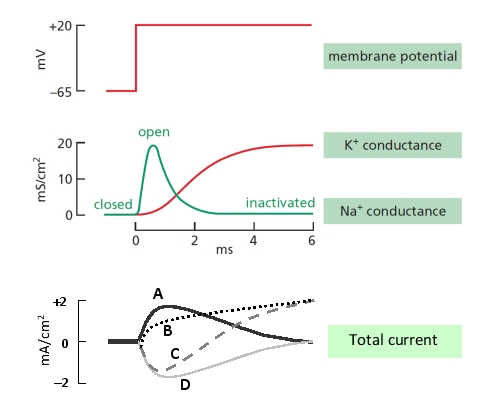
(Short Answer)
4.9/5 (86)
(86) From left to right, indicate whether the transmitter-gated channels for (1) calcium, (2) chloride, (3) potassium, and (4) sodium at a chemical synapse usually open in response to excitatory (E) or inhibitory (I) neurotransmitters. Your answer would be a four-letter string composed of letters E and I only, e.g. EEIE.
(Short Answer)
4.8/5 (78)
(78) Which of the following better represents the process of adaptation mediated by the voltage-gated Ca²⁺ channels and Ca²⁺-activated K⁺ channels? The vertical axis in each graph is the membrane potential in the postsynaptic neuron (in millivolts), while the horizontal axis is the time of constant stimulation (in milliseconds).
(Multiple Choice)
4.7/5 (67)
(67) 
Filters
- Essay(0)
- Multiple Choice(0)
- Short Answer(0)
- True False(0)
- Matching(0)