



 Chat with AI
Exam 7: Control of Gene Expression

Exam 1: Cells and Genomes34 Questions
Exam 2: Cell Chemistry and Bioenergetics54 Questions
Exam 3: Proteins52 Questions
Exam 4: DNA, Chromosomes, and Genomes57 Questions
Exam 5: DNA Replication, Repair, and Recombination51 Questions
Exam 6: How Cells Read the Genome: From DNA to Protein58 Questions
Exam 7: Control of Gene Expression62 Questions
Exam 8: Analyzing Cells, Molecules, and Systems95 Questions
Exam 9: Visualizing Cells29 Questions
Exam 10: Membrane Structure26 Questions
Exam 11: Membrane Transport of Small Molecules and the Electrical Properties of Membranes46 Questions
Exam 12: Intracellular Compartments and Protein Sorting46 Questions
Exam 13: Intracellular Membrane Traffic54 Questions
Exam 14: Energy Conversion: Mitochondria and Chloroplasts49 Questions
Exam 15: Cell Signaling63 Questions
Exam 16: The Cytoskeleton75 Questions
Exam 17: The Cell Cycle57 Questions
Exam 18: Cell Death12 Questions
Exam 19: Cell Junctions and the Extracellular Matrix56 Questions
Exam 20: Cancer50 Questions
Exam 21: Development of Multicellular Organisms61 Questions
Exam 22: Stem Cells and Tissue Renewal45 Questions
Exam 23: Pathogens and Infection32 Questions
Exam 24: The Innate and Adaptive Immune Systems47 Questions
Select questions type


Indicate true (T) and false (F) statements below regarding transcription regulators. Your answer would be a four-letter string composed of letters T and F only, e.g. TTTF.
( ) About 10% of the protein-coding genes in most organisms encode transcription regulators.
( ) The packaging of eukaryotic DNA into chromatin dampens the effect of cooperative binding of transcription regulators.
( ) Some DNA-binding proteins can induce bends or kinks in their target DNA.
( ) Dimerization of transcription regulators increases the chance of binding to nonspecific sequences.
(Short Answer)
4.8/5  (77)
(77) Indicate true (T) and false (F) statements below regarding mRNA stability and degradation. Your answer would be a four-letter string composed of letters T and F only, e.g. TTFT.
( ) Any factor that affects the translation efficiency of an mRNA tends to have the opposite effect on its degradation.
( ) Decapping of mRNA normally occurs after poly-A tail shortening removes the poly-A tail and starts chewing into the 3?-UTR.
( ) Most mRNA decay in the cells generally proceeds via endonucleolytic cleavage.
( ) As a general rule, eukaryotic mRNAs have a shorter half-life compared to bacterial mRNAs.
(Short Answer)
4.8/5 (70)
(70) In the following schematic graph of a hypothetical set of RNA-seq data, the number of reads is plotted for a region of chromosome containing two genes, from samples obtained from two different tissues. Which gene (X or Y) do you think is more likely a "housekeeping" gene? Which region (1 or 2) within gene Y most likely corresponds to an exon? 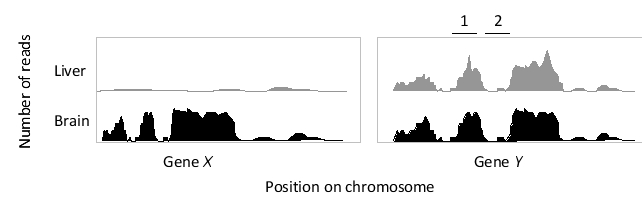
(Multiple Choice)
5.0/5 (83)
(83) Gcn4 is a protein kinase that can phosphorylate and inactivate the initiation factor eIF2. The Gcn4 mRNA contains several short upstream open reading frames (uORFs) that negatively regulate its translation initiation. The phosphorylation of eIF2 by Gcn4, therefore, can control Gcn4 expression …
(Multiple Choice)
4.9/5 (74)
(74) Indicate true (T) and false (F) statements below regarding P-bodies. Your answer would be a four-letter string composed of letters T and F only, e.g. TTFT.
( ) P-bodies are membrane-enclosed organelles scattered throughout the cytoplasm.
( ) mRNAs that are to be degraded are transferred from P-bodies to stress granules containing decapping and exonuclease enzymes.
( ) When translation initiation is blocked, stress granules typically shrink.
( ) mRNAs associated with stress granules are primed for translation.
(Short Answer)
4.8/5 (80)
(80) Studying the expression of a transcription regulatory protein in two cell types, you have performed experiments showing that the mRNA encoding the protein is present at comparable levels in the cytosol of both cell types. However, based on the expression of its target genes, you suspect that the protein activity might be significantly different in the two cell types. Which of the following steps in expression of the gene encoding this protein is more likely to be differentially controlled in these cell types?
(Multiple Choice)
4.9/5 (81)
(81) Transcription regulation has similarities and differences in bacteria and in eukaryotes. Which of the following is correct in this regard?
(Multiple Choice)
4.9/5 (74)
(74) When unfolded proteins accumulate in the lumen of the endoplasmic reticulum due to inefficient folding conditions, a membrane-bound protein kinase is activated and phosphorylates a subunit of the translation initiation factor eIF2. Indicate which of the following events would (Y) or would not (N) occur as a result. Your answer would be a four-letter string composed of letters Y and N only, e.g. YYYY.
( ) eIF2 binds tightly to the ribosome.
( ) Translation initiation is stimulated.
( ) The GDP-bound form of eIF2 accumulates.
( ) eIF2B is activated.
(Short Answer)
4.9/5 (75)
(75) Fill in the blank in the following paragraph regarding X-chromosome inactivation. Do not use abbreviations.
"The presence of two copies of the X chromosome in females but only one in males poses a potential problem for regulation of gene expression: everything else being equal, the higher copy number of the X-linked genes can lead to an imbalanced overproduction of their products in females compared to males. Organisms have evolved different … mechanisms to solve this problem. In mammals, for example, the almost complete inactivation of one of the X chromosomes provides the solution to the dosage problem."
(Short Answer)
4.9/5 (80)
(80) Consider the two feed-forward loops below containing three transcription regulators A, B, and C, where A receives the input signal and C generates the output. In the so-called coherent loop (left), A activates C both directly and indirectly, whereas in an incoherent loop (right), A activates C via one route and inactivates it via the other. Answer the following question(s) based on these network motifs.
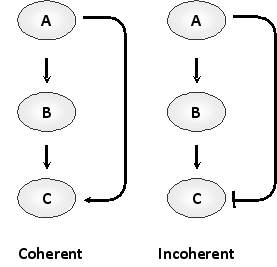 -Considering the two particular feed-forward designs shown, would you expect the coherent (C) or the incoherent (I) loop to have a stable output and respond best to input signals that are above a certain threshold? Write down C or I as your answer.
(Short Answer)
4.8/5 (77)
(77) Indicate which of the following enzymatic activities corresponds to A, B, or C in the following schematic drawing of DNA methylation events in the human genome. Your answer would be a three-letter string composed of letters A, B, and C only, e.g. CBA.
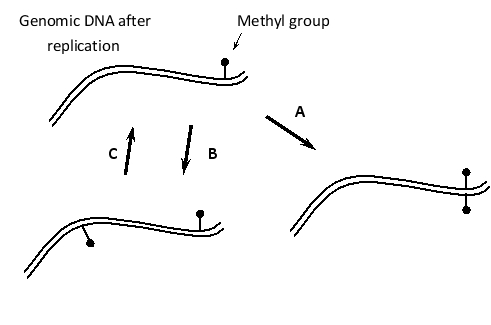 ( ) DNA demethylating enzyme
( ) Maintenance methyl transferase enzyme
( ) De novo methyl transferase enzyme
( ) DNA demethylating enzyme
( ) Maintenance methyl transferase enzyme
( ) De novo methyl transferase enzyme
(Short Answer)
4.7/5 (79)
(79) Indicate true (T) and false (F) statements below regarding RNA editing. Your answer would be a four-letter string composed of letters T and F only, e.g. TTTF.
( ) RNA editing in animal cells mainly takes place through adenine or cytosine deamination.
( ) RNA editing can change the pattern of pre-mRNA splicing.
( ) RNA editing in coding regions can result in changes in the protein sequence.
( ) Retroviruses such as HIV encode RNA-editing components to confront the host defense mechanisms.
(Short Answer)
4.7/5 (85)
(85) Which of the following DNA-binding motifs uses β sheets to recognize DNA bases?
(Multiple Choice)
4.9/5 (81)
(81) Consider a cis-regulatory enhancer sequence in the Escherichia coli chromosome that is located thousands of nucleotide pairs upstream of the gene that it regulates. If the regulatory sequence is mutated to become nonfunctional, the introduction of the wild-type enhancer on a plasmid fails to regulate the gene. This implies that …
(Multiple Choice)
4.9/5 (62)
(62) Two copies of the gene A exist in a diploid mammal. However, only one copy is expressed in every somatic cell. Different somatic cells in the body of each organism have inactivated one or the other allele in a seemingly random fashion, but when they divide, the daughter cells inherit the choice of the inactive allele faithfully. This is an example of …
(Multiple Choice)
4.8/5 (77)
(77) A researcher studying the human immunodeficiency virus (HIV) has infected human T cells with wild-type or Rev-deficient viruses. She extracts cytoplasmic RNA from the cells and separates each isolated RNA mixture by agarose-gel electrophoresis. She then uses northern analysis using HIV-specific probes to identify those bands that contain viral RNA. The results are presented in the following schematic drawing. Which lane (1 or 2) corresponds to cells infected with the Rev?-deficient virus? What is the size of the full-length HIV genome? 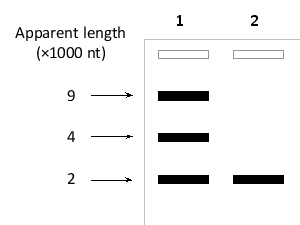
(Multiple Choice)
4.9/5 (75)
(75) A DNA-binding protein binds cooperatively to DNA by fairly weak homodimerization. The binding of this protein to DNA …
(Multiple Choice)
4.8/5 (70)
(70) Which of the following is true regarding genomic imprinting?
(Multiple Choice)
4.9/5 (84)
(84) In the following schematic drawings showing four different network motifs in gene transcription circuits, indicate whether each of the motifs 1 to 4 corresponds to a feed-forward loop (E), flip-flop device (F), negative feedback loop (N), or positive feedback loop (P). Your answer would be a four-letter string composed of letters E, F, N, or P only, e.g. PNEF.
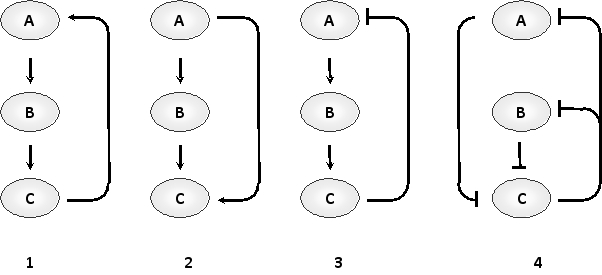
(Short Answer)
5.0/5 (73)
(73) Indicate true (T) and false (F) statements below regarding DNA methylation in humans. Your answer would be a four-letter string composed of letters T and F only, e.g. TTTF.
( ) DNA methylation makes repression of gene expression "leakier."
( ) DNA methylation at the promoter region is usually an indication of active transcription.
( ) CG islands are nonpermissive for RNA polymerase assembly.
( ) The dinucleotide 5?-GC-3? is much more common than 5?-CG-3? in the human genome.
(Short Answer)
4.9/5 (100)
(100) 
Filters
- Essay(0)
- Multiple Choice(0)
- Short Answer(0)
- True False(0)
- Matching(0)