



 Chat with AI
Exam 3: Proteins

Exam 1: Cells and Genomes34 Questions
Exam 2: Cell Chemistry and Bioenergetics54 Questions
Exam 3: Proteins52 Questions
Exam 4: DNA, Chromosomes, and Genomes57 Questions
Exam 5: DNA Replication, Repair, and Recombination51 Questions
Exam 6: How Cells Read the Genome: From DNA to Protein58 Questions
Exam 7: Control of Gene Expression62 Questions
Exam 8: Analyzing Cells, Molecules, and Systems95 Questions
Exam 9: Visualizing Cells29 Questions
Exam 10: Membrane Structure26 Questions
Exam 11: Membrane Transport of Small Molecules and the Electrical Properties of Membranes46 Questions
Exam 12: Intracellular Compartments and Protein Sorting46 Questions
Exam 13: Intracellular Membrane Traffic54 Questions
Exam 14: Energy Conversion: Mitochondria and Chloroplasts49 Questions
Exam 15: Cell Signaling63 Questions
Exam 16: The Cytoskeleton75 Questions
Exam 17: The Cell Cycle57 Questions
Exam 18: Cell Death12 Questions
Exam 19: Cell Junctions and the Extracellular Matrix56 Questions
Exam 20: Cancer50 Questions
Exam 21: Development of Multicellular Organisms61 Questions
Exam 22: Stem Cells and Tissue Renewal45 Questions
Exam 23: Pathogens and Infection32 Questions
Exam 24: The Innate and Adaptive Immune Systems47 Questions
Select questions type


The structural formulas for the 20 naturally occurring amino acid residues are shown in the panel below. Answer the following question(s) with the help of this panel.
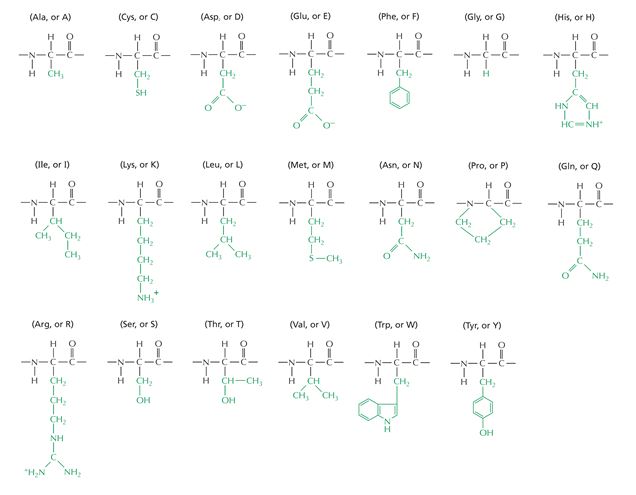 -Which of the amino acids shown above has the most limited combinations of phi (?) and psi (?) angles in its Ramachandran plot? Write down the one-letter abbreviation for it, e.g. A.
(Short Answer)
4.7/5  (82)
(82) Switch proteins that bind and hydrolyze GTP are ubiquitous cell regulators in a wide variety of molecular processes. Which of the following statements is NOT true regarding these proteins?
(Multiple Choice)
5.0/5 (84)
(84) Which of the regulatory interactions 1 to 5 depicted in the following diagram is NOT an example of a negative feedback regulation? 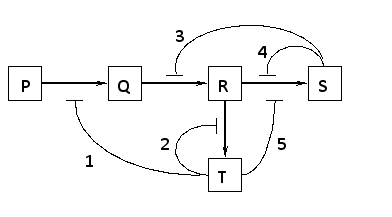
(Multiple Choice)
4.8/5 (88)
(88) Some protein domains are found in many different proteins and have been especially mobile during evolution. A domain of this kind is called a "protein …"
(Short Answer)
4.9/5 (78)
(78) For a simple enzymatic reaction that involves only one substrate and follows Michaelis-Menten kinetics, the changes in the concentrations of substrate, product, free enzyme, and the enzyme-substrate complex over the course of the reaction are depicted by solid curves in the graph below. Which curve (1 to 4) corresponds to [ES]? Write down the number as your answer.

(Short Answer)
4.8/5 (75)
(75) Many macromolecular complexes in the cell contain scaffold proteins. What do these proteins do that benefits the cell?
(Multiple Choice)
5.0/5 (76)
(76) An amino acid residue that is not part of the active site of an enzyme and does not interact with the ligand is nevertheless critical for ligand binding and is highly conserved. How can this be explained?
(Multiple Choice)
4.9/5 (86)
(86) Which of the following is NOT the role of molecular chaperones in the folding of cellular proteins?
(Multiple Choice)
4.7/5 (80)
(80) How do multienzyme complexes in the cell, such as the fatty acid synthase, enhance reaction rates?
(Multiple Choice)
4.9/5 (87)
(87) The structural formulas for the 20 naturally occurring amino acid residues are shown in the panel below. Answer the following question(s) with the help of this panel.
-What is the amino acid sequence of the peptide depicted below? Write down the sequence from the N- to the C-terminus, and use only the one-letter abbreviations, e.g. AGCNT.
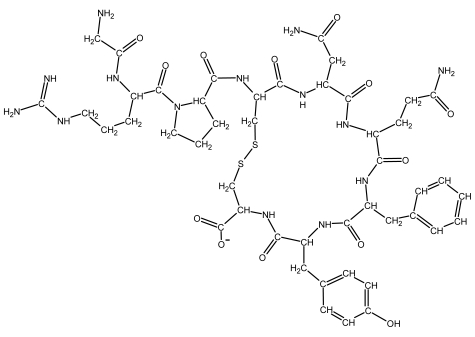
-What is the amino acid sequence of the peptide depicted below? Write down the sequence from the N- to the C-terminus, and use only the one-letter abbreviations, e.g. AGCNT.
(Short Answer)
4.9/5 (74)
(74) Which of the following stretches of amino acid residues would you expect to find in the interior of protein molecules?
(Multiple Choice)
4.8/5 (79)
(79) 
Filters
- Essay(0)
- Multiple Choice(0)
- Short Answer(0)
- True False(0)
- Matching(0)