



 Chat with AI
Exam 7: Unemployment and Inflation

Exam 1: Economics: the World Around You90 Questions
Exam 2: Choice, Opportunity Costs, and Specialization98 Questions
Exam 3: Markets, Demand and Supply, and the Price System99 Questions
Exam 4: The Market System and the Private and Public Sector100 Questions
Exam 5: National Income Accounting104 Questions
Exam 6: An Introduction to the Foreign Exchange Market and the Balance of Payments90 Questions
Exam 7: Unemployment and Inflation130 Questions
Exam 8: Macroeconomic Equilibrium: Aggregate Demand and Supply123 Questions
Exam 9: Aggregate Expenditures120 Questions
Exam 10: Income and Expenditures Equilibrium135 Questions
Exam 11: Fiscal Policy94 Questions
Exam 12: Money and Banking125 Questions
Exam 13: Monetary Policy138 Questions
Exam 14: Macroeconomic Policy: Tradeoffs, Expectations, Credibility, and Sources of Business Cycles117 Questions
Exam 15: Macroeconomic Viewpoints: New Keynesian, Monetarist, and New Classical103 Questions
Exam 16: Economic Growth99 Questions
Exam 17: Development Economics105 Questions
Exam 18: Globalization85 Questions
Exam 19: World Trade Equilibrium112 Questions
Exam 20: International Trade Restrictions109 Questions
Exam 21: Exchange Rates and Financial Links Between Countries132 Questions
Select questions type


Inflation is defined as the sustained increase in relative prices.
(True/False)
4.9/5  (68)
(68) The four phases of a business cycle, in order, are trough, depression, peak, and expansion.
(True/False)
4.9/5 (67)
(67) If increases in total spending are not offset by increases in the supply of goods and services, the average price level will rise. Which of the following factors is responsible for this rise?
(Multiple Choice)
4.7/5 (84)
(84) Which of the following is an example of cyclical unemployment?
(Multiple Choice)
4.8/5 (79)
(79) Which of the following countries experienced hyperinflation in the 1920s?
(Multiple Choice)
4.9/5 (94)
(94) In the 1990s, the unemployment rates in the U.S. were higher than that in the European nations.
(True/False)
4.9/5 (79)
(79) Which if the following is most likely to result if the Congress passes the living wage law?
(Multiple Choice)
4.9/5 (87)
(87) Assume you borrow $1,000 on credit cards at an annual interest rate of 10 percent. If the inflation rate is 12 percent during the year and the debt has to be paid back in 12 months, then:
(Multiple Choice)
4.8/5 (67)
(67) The table given below lists the average price level in a country for four consecutive years.
Table 7.2
Price Data Year Average Price Level 1992 1.000 1993 1.039 1994 1.064 1995 1.093
-Refer to the Table 7.2. How many times more goods and services could be purchased with one dollar in 1992 than in 1995?
(Multiple Choice)
4.8/5 (87)
(87) The figure given below reports the GDP gap experienced by a country for four years in billions of dollars.
Figure 7.2
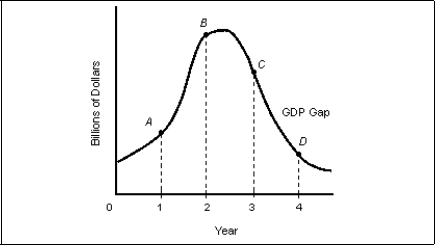 -Refer to Figure 7.2. Which time period is most likely to be associated with an economic expansion?
 (Multiple Choice)
4.8/5 (76)
(76) The table given below reports the consumer price index in a country for four different years.
Table 7.1
Inflation Data Year Consumer Price Index 1976 100.00 1980 110.50 1990 128.50 2003 145.00
-Refer to Table 7.1. If a bicycle used to cost $90 in 1990, what did it cost in 2003 based on the inflation rate (rounded to the first decimal place)?
(Multiple Choice)
4.8/5 (77)
(77) Which of the following statements about the GDP gap is not true?
(Multiple Choice)
4.9/5 (93)
(93) Which of the following statements regarding the unemployment rates in the U.S. between 1971 and 2002 is true?
(Multiple Choice)
4.8/5 (64)
(64) A worker who loses his or her job as a consequence of a decline in aggregate demand in the economy is experiencing:
(Multiple Choice)
4.9/5 (91)
(91) Which of the following is true about workers who experience structural unemployment?
(Multiple Choice)
4.8/5 (75)
(75) he figure given below represents the business cycle of an economy.
Figure 7.1
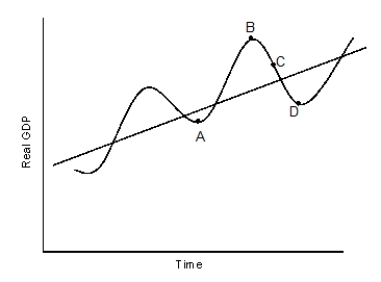 -Refer to Figure 7.1. The overall upward trend in real GDP reflected by this figure implies that:
 (Multiple Choice)
4.8/5 (84)
(84) Which of the following monthly data series are closely observed by the Business Cycle Dating Committee of the NBER?
(Multiple Choice)
4.8/5 (85)
(85) 
Filters
- Essay(0)
- Multiple Choice(0)
- Short Answer(0)
- True False(0)
- Matching(0)