



 Chat with AI
Exam 11: Fiscal Policy

Exam 1: Economics: the World Around You90 Questions
Exam 2: Choice, Opportunity Costs, and Specialization98 Questions
Exam 3: Markets, Demand and Supply, and the Price System99 Questions
Exam 4: The Market System and the Private and Public Sector100 Questions
Exam 5: National Income Accounting104 Questions
Exam 6: An Introduction to the Foreign Exchange Market and the Balance of Payments90 Questions
Exam 7: Unemployment and Inflation130 Questions
Exam 8: Macroeconomic Equilibrium: Aggregate Demand and Supply123 Questions
Exam 9: Aggregate Expenditures120 Questions
Exam 10: Income and Expenditures Equilibrium135 Questions
Exam 11: Fiscal Policy94 Questions
Exam 12: Money and Banking125 Questions
Exam 13: Monetary Policy138 Questions
Exam 14: Macroeconomic Policy: Tradeoffs, Expectations, Credibility, and Sources of Business Cycles117 Questions
Exam 15: Macroeconomic Viewpoints: New Keynesian, Monetarist, and New Classical103 Questions
Exam 16: Economic Growth99 Questions
Exam 17: Development Economics105 Questions
Exam 18: Globalization85 Questions
Exam 19: World Trade Equilibrium112 Questions
Exam 20: International Trade Restrictions109 Questions
Exam 21: Exchange Rates and Financial Links Between Countries132 Questions
Select questions type


Which of the following taxes are more easier to collect in industrial countries than in developing countries?
(Multiple Choice)
4.9/5  (71)
(71) Which of the following is true about automatic stabilizers?
(Multiple Choice)
4.8/5 (86)
(86) An increase in deficit spending tends to raise interest rates, thereby resulting in a multiplier effect that is higher than would be associated with an equivalent increase in consumption spending.
(True/False)
4.8/5 (86)
(86) The sum of the unemployment rate and the inflation rate is known as:
(Multiple Choice)
4.8/5 (75)
(75) Higher taxes affect real GDP indirectly through both the consumption channel and the output supply channel.
(True/False)
4.9/5 (78)
(78) If the price level falls as real GDP decreases, the multiplier effects of any given change in aggregate expenditures are smaller than they would be if the price level remained constant.
(True/False)
4.9/5 (68)
(68) Assume that French budget deficits have raised the French prime interest rate relative to the U.S. T-bill rate. As a result, we would expect the U.S. dollar to depreciate and U.S. net exports to rise.
(True/False)
4.8/5 (79)
(79) Which of the following is an example of a transfer payment by the government?
(Multiple Choice)
4.8/5 (68)
(68) Assume that European interest rates fall as a result of decreased deficit spending by the governments of the European Union. We would expect all of the following, except:
(Multiple Choice)
4.7/5 (62)
(62) Compared to the government in the typical industrial country, the government in the typical developing country:
(Multiple Choice)
4.9/5 (82)
(82) Which of the following would not be considered an indirect tax?
(Multiple Choice)
4.8/5 (59)
(59) If government spending in a country declines by $10 billion and, at the same time, taxes increase by an equal amount, what is the total effect in the economy?
(Multiple Choice)
4.9/5 (83)
(83) When the government uses taxes and spending to affect national economy, it is engaging in:
(Multiple Choice)
4.9/5 (64)
(64) The figure given below depicts the tax revenue for different tax rates applied by the government.
Figure 11.2
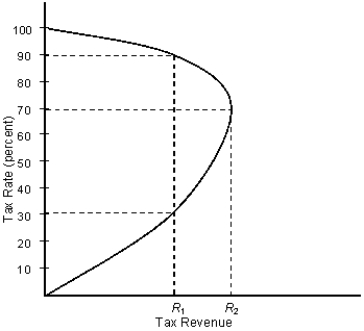 -Refer to Figure 11.2. If you were a member of the Congress that aims to increase tax revenue collections, what would you recommend if the current tax rate were 80 percent?
 (Multiple Choice)
4.8/5 (87)
(87) If fewer businesses offer new bonds to raise investment funds when government borrowing increases interest rates, this would be an example of:
(Multiple Choice)
4.7/5 (82)
(82) Which of the following can be categorized under fiscal policy?
(Multiple Choice)
4.8/5 (85)
(85) Increased domestic imports and higher international trade deficits are possible results of government surpluses.
(True/False)
4.8/5 (75)
(75) _____ refers to the changes in government spending and taxation that are aimed at achieving a policy goal.
(Multiple Choice)
4.8/5 (70)
(70) A U.S. federal budget deficit that raises real interest rates is most likely to:
(Multiple Choice)
4.8/5 (86)
(86) 
Filters
- Essay(0)
- Multiple Choice(0)
- Short Answer(0)
- True False(0)
- Matching(0)