



 Chat with AI
Exam 13: Monetary Policy

Exam 1: Economics: the World Around You90 Questions
Exam 2: Choice, Opportunity Costs, and Specialization98 Questions
Exam 3: Markets, Demand and Supply, and the Price System99 Questions
Exam 4: The Market System and the Private and Public Sector100 Questions
Exam 5: National Income Accounting104 Questions
Exam 6: An Introduction to the Foreign Exchange Market and the Balance of Payments90 Questions
Exam 7: Unemployment and Inflation130 Questions
Exam 8: Macroeconomic Equilibrium: Aggregate Demand and Supply123 Questions
Exam 9: Aggregate Expenditures120 Questions
Exam 10: Income and Expenditures Equilibrium135 Questions
Exam 11: Fiscal Policy94 Questions
Exam 12: Money and Banking125 Questions
Exam 13: Monetary Policy138 Questions
Exam 14: Macroeconomic Policy: Tradeoffs, Expectations, Credibility, and Sources of Business Cycles117 Questions
Exam 15: Macroeconomic Viewpoints: New Keynesian, Monetarist, and New Classical103 Questions
Exam 16: Economic Growth99 Questions
Exam 17: Development Economics105 Questions
Exam 18: Globalization85 Questions
Exam 19: World Trade Equilibrium112 Questions
Exam 20: International Trade Restrictions109 Questions
Exam 21: Exchange Rates and Financial Links Between Countries132 Questions
Select questions type


The process of buying financial assets to stimulate the economy when the central bank target interest rate is near or at zero and the interest rate cannot be lowered further is called:
(Multiple Choice)
5.0/5  (82)
(82) Which of the following is assumed to be constant in the quantity theory of money?
(Multiple Choice)
4.8/5 (74)
(74) The buying and selling of government bonds by the FOMC constitutes:
(Multiple Choice)
4.8/5 (86)
(86) The rate of interest that the Federal Reserve charges on loans to member banks is the:
(Multiple Choice)
4.8/5 (100)
(100) The table given below shows the assets and liabilities of the National Bank. Assume that this is the only bank in the economy.
Table 13.2
Balance Sheet of National Bank Assets Liabilities Vault Cash \ 1,725 Deposits \ 5,450 Deposit in Fed \ 425 Loans \ 3,300 Total Assets \ 5,450 Total Liabilities \ 5,450
-Refer to Table 13.2 and calculate the legal reserves of the bank.
(Multiple Choice)
4.9/5 (74)
(74) Assume that the yen price of one U.S. dollar rises to 80 yen and that the Bank of Japan has a target exchange rate of 75 yen per dollar. As a result, the Bank of Japan will intervene in the foreign exchange market by:
(Multiple Choice)
4.9/5 (92)
(92) All members of the Federal Board of Governors are appointed by the president and confirmed by the Senate.
(True/False)
4.7/5 (74)
(74) The FOMC carries out its policies through directives to the bond-trading desk at the:
(Multiple Choice)
4.9/5 (82)
(82) In the figure given below panel A represents money market equilibrium, panel B represents investment demand, and panel C represents equilibrium real GDP.
Figure 13.3
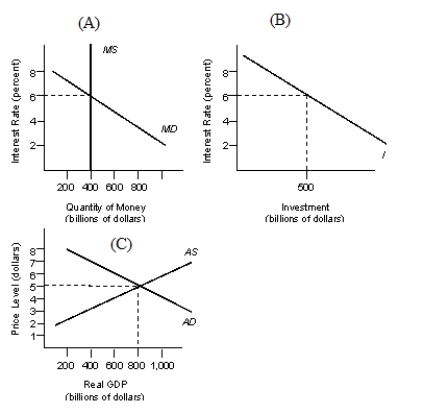 -Refer to Figure 13.3. When this economy is in equilibrium:
 (Multiple Choice)
4.8/5 (69)
(69) The Fed can enhance liquidity in the U.S. economy by increasing the federal funds rate.
(True/False)
4.9/5 (97)
(97) As the velocity of money rises, the amount of money being held by individuals also rises.
(True/False)
4.9/5 (76)
(76) Other things equal, an increase in the general price level causes the money demand function to shift to the left.
(True/False)
4.8/5 (80)
(80) Suppose that the nominal money supply equals $2 billion and nominal GDP is $16 billion. Then, according to the equation of exchange, the velocity of money equals 8.
(True/False)
4.9/5 (84)
(84) Table 13.1
Balance Sheet Assets Liabilities Vault Cash \ 1,150 Checking Accounts \ 11,300 Reserve Deposits \ 1,650 Savings Accounts \ 3,200 Loans \ 11,700 Total Assets \ 14,500 Total Liabilities \ 14,500
Assume that this is the balance sheet of the only bank in this economy and that the money supply is entirely kept by the bank in either a checking or a savings account.
-Refer to Table 13.1. Assume a reserve requirement of 8 percent. What is the maximum potential increase in the money supply from the Fed's purchase of $400 worth of government securities?
(Multiple Choice)
4.9/5 (85)
(85) The use of domestic open market operations to counteract the effects of a foreign exchange market intervention on the domestic money supply is known as:
(Multiple Choice)
4.8/5 (63)
(63) If the aggregate supply curve is positively sloped, an increase in the money supply will result in an increase in both equilibrium national income and the equilibrium price level.
(True/False)
4.8/5 (95)
(95) Assume that a bank holds legal reserves of $800, the required reserves are $400 and total deposit is $4,000. If the government purchases bonds worth $200, excess reserves will increase by _____.
(Multiple Choice)
4.9/5 (83)
(83) Table 13.1
Balance Sheet Assets Liabilities Vault Cash \ 1,150 Checking Accounts \ 11,300 Reserve Deposits \ 1,650 Savings Accounts \ 3,200 Loans \ 11,700 Total Assets \ 14,500 Total Liabilities \ 14,500
Assume that this is the balance sheet of the only bank in this economy and that the money supply is entirely kept by the bank in either a checking or a savings account.
-Refer to Table 13.1. Given a reserve requirement of 8 percent, what is the amount of excess reserves?
(Multiple Choice)
4.7/5 (76)
(76) Assume that the Fed increases the money supply when there is substantial unemployment in the economy. According to the quantity theory of money, if velocity is constant, then:
(Multiple Choice)
4.8/5 (74)
(74) 
Filters
- Essay(0)
- Multiple Choice(0)
- Short Answer(0)
- True False(0)
- Matching(0)