



 Chat with AI
Exam 5: Public Goods, Public Choice, and Government Failure

Exam 2: The Market System and the Circular Flow274 Questions
Exam 3: Demand, Supply, and Market Equilibrium357 Questions
Exam 4: Market Failures Caused by Externalities Asymmetric Information222 Questions
Exam 5: Public Goods, Public Choice, and Government Failure242 Questions
Exam 6: An Introduction to Macroeconomics243 Questions
Exam 7: Measuring Domestic Output and National Income238 Questions
Exam 8: Economic Growth274 Questions
Exam 9: Business Cycles, Unemployment, and Inflation298 Questions
Exam 10: Basic Macroeconomic Relationships233 Questions
Exam 11: The Aggregate Expenditures Model126 Questions
Exam 12: Aggregate Demand and Aggregate Supply320 Questions
Exam 13: Fiscal Policy, Deficits, and Debt401 Questions
Exam 14: Money, Banking, and Financial Institutions265 Questions
Exam 15: Money Creation285 Questions
Exam 16: Interest Rates and Monetary Policy405 Questions
Exam 17: Financial Economics356 Questions
Exam 18: Extending the Analysis of Aggregate Supply268 Questions
Exam 19: Current Issues in Macro Theory and Policy279 Questions
Exam 20: International Trade339 Questions
Exam 21: The Balance of Payments, Exchange Rates, and Trade Deficits315 Questions
Exam 22: The Economics of Developing Countries269 Questions
Select questions type


"Vote for my special local project and I will vote for yours." This political technique
(Multiple Choice)
4.8/5  (96)
(96) What are the two characteristics that differentiate private goods from public goods?
(Multiple Choice)
4.8/5 (81)
(81) A government is considering undertaking a construction project of an increasing scale (ranging from 1, 2, 3, to 4). The estimated marginal costs and marginal bene?ts of each successive scale of the project are given in the
Table below.
Project Marginal Cost (in millions) Marginal Benefit (in millions) 1 \ 8 \ 11 2 11 13 3 18 17 4 28 23 What is the total amount that the government should spend on the construction project to attain maximum net
Bene?ts for the society?
(Multiple Choice)
4.8/5 (81)
(81) The free-rider problem makes a good highly profitable for a private firm to provide.
(True/False)
4.8/5 (79)
(79) Suppose that Steve and Susie each perceive $200 of marginal benefit from a proposed new park, whereas Elizabeth perceives $800. If the proposed tax levied on each for the park would be $300, a majority vote will
(Multiple Choice)
4.9/5 (88)
(88) The so-called pork-barrel politics refers to congressional members
(Multiple Choice)
4.9/5 (66)
(66) When voters have different opinions about an issue, the position that is most likely to be adopted is that of the
(Multiple Choice)
4.7/5 (79)
(79) According to some economists, the private sector is more efficient than the public sector mainly because
(Multiple Choice)
4.9/5 (72)
(72) Why are the public sector and private sector "imperfect institutions"?
(Essay)
4.9/5 (102)
(102) People enjoy outdoor holiday lighting displays and would be willing to pay to see them, but can't be made to pay. Because most people who put up lights are unable to charge others to view them, they don't put up as
Many lights as people would like. This is an example of a
(Multiple Choice)
4.9/5 (77)
(77) Which of the following statements concerning a public good is false?
(Multiple Choice)
4.9/5 (90)
(90)  Refer to the provided table, which shows the ranked preferences of voters for three alternative projects, with "1" being the top preference. This situation illustrates the voting inconsistency where a majority of voters prefer
The
Refer to the provided table, which shows the ranked preferences of voters for three alternative projects, with "1" being the top preference. This situation illustrates the voting inconsistency where a majority of voters prefer
The (Multiple Choice)
4.9/5 (80)
(80)  Refer to the provided table, which shows the ranked preferences of voters for three alternative projects, with "1" being the top preference. In a paired-choice vote between a park and a jail,
 (Multiple Choice)
4.9/5 (75)
(75) Some people argue that the three main television networks all have similar programming. If true, this observation might best be explained by the
(Multiple Choice)
4.7/5 (94)
(94) 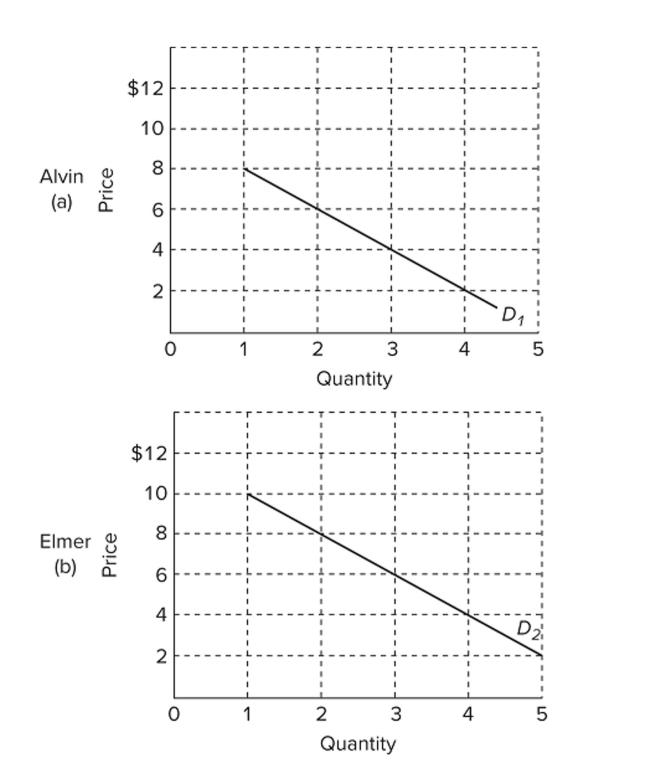 Refer to the graphs which show demand curves reflecting the prices Alvin and Elmer are willing to pay for a public good, rather than do without it. The collective willingness to pay for the first unit of this public good is
 (Multiple Choice)
4.9/5 (69)
(69) The trading of votes to secure favorable outcomes on decisions that would otherwise be defeated is called
(Multiple Choice)
4.8/5 (81)
(81) 
Filters
- Essay(0)
- Multiple Choice(0)
- Short Answer(0)
- True False(0)
- Matching(0)