



 Chat with AI
Exam 8: Economic Growth

Exam 2: The Market System and the Circular Flow274 Questions
Exam 3: Demand, Supply, and Market Equilibrium357 Questions
Exam 4: Market Failures Caused by Externalities Asymmetric Information222 Questions
Exam 5: Public Goods, Public Choice, and Government Failure242 Questions
Exam 6: An Introduction to Macroeconomics243 Questions
Exam 7: Measuring Domestic Output and National Income238 Questions
Exam 8: Economic Growth274 Questions
Exam 9: Business Cycles, Unemployment, and Inflation298 Questions
Exam 10: Basic Macroeconomic Relationships233 Questions
Exam 11: The Aggregate Expenditures Model126 Questions
Exam 12: Aggregate Demand and Aggregate Supply320 Questions
Exam 13: Fiscal Policy, Deficits, and Debt401 Questions
Exam 14: Money, Banking, and Financial Institutions265 Questions
Exam 15: Money Creation285 Questions
Exam 16: Interest Rates and Monetary Policy405 Questions
Exam 17: Financial Economics356 Questions
Exam 18: Extending the Analysis of Aggregate Supply268 Questions
Exam 19: Current Issues in Macro Theory and Policy279 Questions
Exam 20: International Trade339 Questions
Exam 21: The Balance of Payments, Exchange Rates, and Trade Deficits315 Questions
Exam 22: The Economics of Developing Countries269 Questions
Select questions type


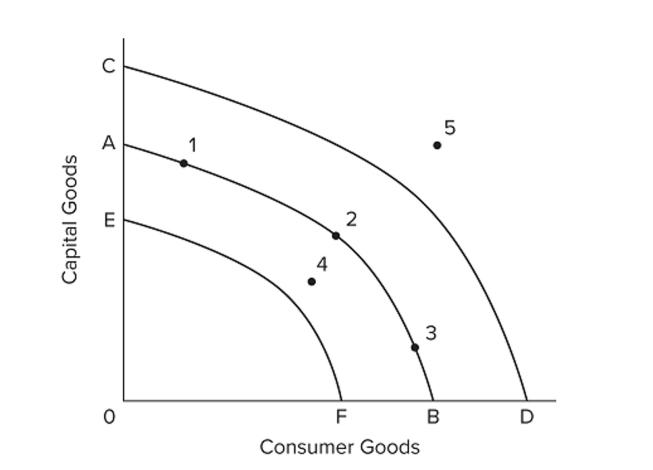 Refer to the accompanying diagram. If the production possibilities of an economy are shown by curve AB but the economy is operating at point 4, the reasons are most likely to be because of
 (Multiple Choice)
4.9/5  (74)
(74) A shift outward in the production possibilities curve is the direct result of improvements in the
efficiency factor of economic growth.
(True/False)
4.9/5 (67)
(67) At what average annual rate have real GDP and real GDP per capita grown from 1950 to 2018?
(Multiple Choice)
4.8/5 (81)
(81) More than half the growth of real GDP in the United States is caused by
(Multiple Choice)
5.0/5 (88)
(88) If the secular trend of labor productivity rises from 2 percent per year to 4 percent, the number of years that it will take for the standard of living to double will decline by about
(Multiple Choice)
4.8/5 (79)
(79) Economic growth can be shown as a movement from a point on one production possibilities curve
to a point on a curve located farther from the origin.
(True/False)
4.8/5 (83)
(83) The movement of workers from lower productivity jobs to higher productivity jobs would be an example of a(n)
(Multiple Choice)
4.7/5 (73)
(73) Which of the following is a measure of economic growth that is most useful for comparing living standards?
(Multiple Choice)
4.9/5 (76)
(76) The rule of 70 is used to find how long it will take an economy to grow by 70 percent.
(True/False)
4.8/5 (75)
(75) A nation's real GDP will increase by increasing the following, except
(Multiple Choice)
4.8/5 (70)
(70) Many economists studying the productivity-growth patterns in the U.S. believe that in the period 1995-2010, the productivity of labor in the nation
(Multiple Choice)
4.9/5 (95)
(95) 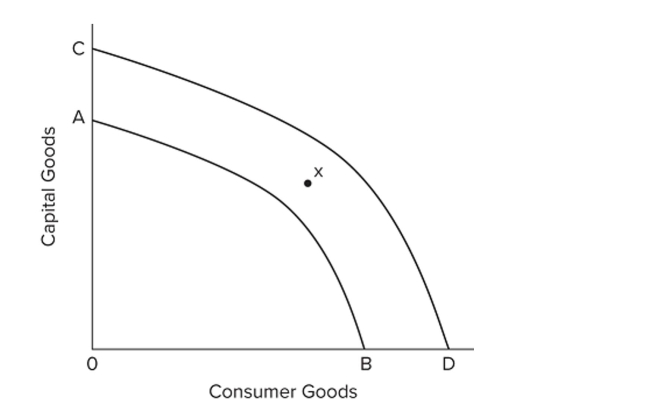 Refer to the accompanying graph. If the production possibilities curve for an economy is at CD but the economy is operating at point X, the reasons are most likely to be because of
 (Multiple Choice)
4.9/5 (73)
(73) If the annual growth in a nation's productivity is 2.8 percent rather than 1.5 percent, then the nation's standard of living will double in about
(Multiple Choice)
4.9/5 (83)
(83) What economic concept would be most closely associated with a situation where an aluminum plant expands its operations and uses extensive computerization in the production line to reduce per-unit
Costs of production?
(Multiple Choice)
4.8/5 (70)
(70) Year Alta (Real GDP) Zorn (Real GDP) Alta (Population) Zorn (Population) 1 \ 2,000 \ 150,000 200 500 2 2,100 152,000 202 505 3 2,200 154,000 210 508 Refer to the table. Between years 1 and 2, real GDP per capita grew by approximately __________ percent in Alta.
(Multiple Choice)
4.8/5 (79)
(79) A nation's real GDP was $250 billion in Year 1 and $265 billion in Year 2. Its population was 120 million in Year 1 and 125 million in Year 2. What is its real GDP growth rate in Year 2?
(Multiple Choice)
4.9/5 (80)
(80) Modern economic growth often results in the following, except
(Multiple Choice)
4.9/5 (76)
(76) The largest contributor to increases in the productivity of American labor is
(Multiple Choice)
4.8/5 (77)
(77) 1. Improvements in technology. 2. Increases in the supply (stock) of capital goods.
3) Purchases of expanding output.
4) Obtaining the optimal combination of goods, each at least-cost production.
5) Increases in the quantity and quality of natural resources.
6) Increases in the quantity and quality of human resources.
Which set of items in the accompanying list would shift an economy's production possibilities curve
Outward?
(Multiple Choice)
4.7/5 (86)
(86) 
Filters
- Essay(0)
- Multiple Choice(0)
- Short Answer(0)
- True False(0)
- Matching(0)