



 Chat with AI
Exam 10: Basic Macroeconomic Relationships

Exam 2: The Market System and the Circular Flow274 Questions
Exam 3: Demand, Supply, and Market Equilibrium357 Questions
Exam 4: Market Failures Caused by Externalities Asymmetric Information222 Questions
Exam 5: Public Goods, Public Choice, and Government Failure242 Questions
Exam 6: An Introduction to Macroeconomics243 Questions
Exam 7: Measuring Domestic Output and National Income238 Questions
Exam 8: Economic Growth274 Questions
Exam 9: Business Cycles, Unemployment, and Inflation298 Questions
Exam 10: Basic Macroeconomic Relationships233 Questions
Exam 11: The Aggregate Expenditures Model126 Questions
Exam 12: Aggregate Demand and Aggregate Supply320 Questions
Exam 13: Fiscal Policy, Deficits, and Debt401 Questions
Exam 14: Money, Banking, and Financial Institutions265 Questions
Exam 15: Money Creation285 Questions
Exam 16: Interest Rates and Monetary Policy405 Questions
Exam 17: Financial Economics356 Questions
Exam 18: Extending the Analysis of Aggregate Supply268 Questions
Exam 19: Current Issues in Macro Theory and Policy279 Questions
Exam 20: International Trade339 Questions
Exam 21: The Balance of Payments, Exchange Rates, and Trade Deficits315 Questions
Exam 22: The Economics of Developing Countries269 Questions
Select questions type


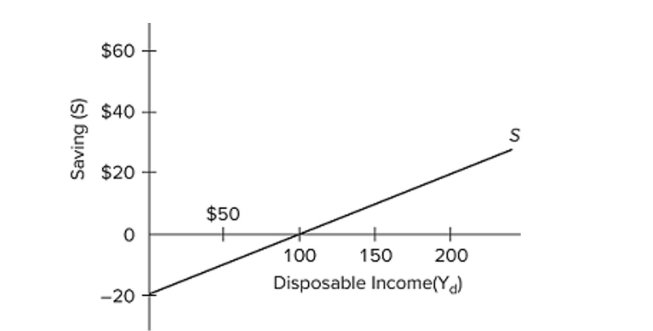 (Advanced analysis) The equation for the given saving schedule is
 (Multiple Choice)
4.8/5  (80)
(80) Investment spending in the United States tends to be unstable because
(Multiple Choice)
4.9/5 (77)
(77) If the marginal propensity to save is 0.2 in an economy, a $20 billion rise in investment spending will increase
(Multiple Choice)
4.9/5 (95)
(95) Assume that for the entire business sector of a private closed economy, there are $0 worth of investment projects that will yield an expected rate of return of 25 percent or more. But there are $15
Worth of investments that will yield an expected rate of return of 20-25 percent, another $15 with an
Expected rate of return of 15-20 percent, and an additional $15 of investment projects in each
Successive rate of return range down to and including the 0-5 percent range. The expected rate of
Return curve
(Multiple Choice)
4.7/5 (74)
(74) If the Hennige family's marginal propensity to consume is 0.70, then it will necessarily consume seven-
tenths of its total income.
(True/False)
4.8/5 (86)
(86)  Refer to the diagram. At disposable income level D, the average propensity to save is equal to
 (Multiple Choice)
4.8/5 (83)
(83) 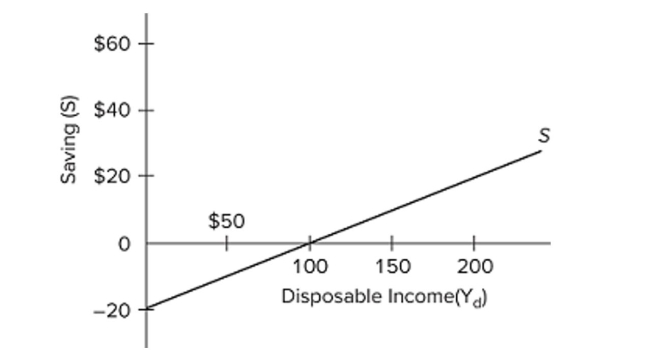 Refer to the diagram. The average propensity to consume
If the slope of the consumption schedule is 0.75, then the slope of the saving schedule
(Multiple Choice)
4.8/5 (75)
(75) If the inflation rate is 10 percent and the real interest rate is 12 percent, the nominal interest rate is
(Multiple Choice)
4.8/5 (88)
(88) If 100 percent of any change in income is spent, the multiplier will be
(Multiple Choice)
4.9/5 (81)
(81) A decline in the real interest rate will shift the investment demand curve to the right.
(True/False)
4.7/5 (85)
(85)  Refer to the given diagram. Consumption will be equal to income at
 (Multiple Choice)
4.9/5 (77)
(77) Which of the following will not cause the consumption schedule to shift?
(Multiple Choice)
4.9/5 (77)
(77) Economists widely agree that the value of the real-world multiplier is 2.5.
(True/False)
4.8/5 (72)
(72) The multiplier shows the relationship between changes in a component of spending, say, investment,
and the consequent changes in real income and output.
(True/False)
4.8/5 (89)
(89) The most important determinant of consumption and saving is the
(Multiple Choice)
4.8/5 (94)
(94) 
Filters
- Essay(0)
- Multiple Choice(0)
- Short Answer(0)
- True False(0)
- Matching(0)