



 Chat with AI
Exam 19: Current Issues in Macro Theory and Policy

Exam 2: The Market System and the Circular Flow274 Questions
Exam 3: Demand, Supply, and Market Equilibrium357 Questions
Exam 4: Market Failures Caused by Externalities Asymmetric Information222 Questions
Exam 5: Public Goods, Public Choice, and Government Failure242 Questions
Exam 6: An Introduction to Macroeconomics243 Questions
Exam 7: Measuring Domestic Output and National Income238 Questions
Exam 8: Economic Growth274 Questions
Exam 9: Business Cycles, Unemployment, and Inflation298 Questions
Exam 10: Basic Macroeconomic Relationships233 Questions
Exam 11: The Aggregate Expenditures Model126 Questions
Exam 12: Aggregate Demand and Aggregate Supply320 Questions
Exam 13: Fiscal Policy, Deficits, and Debt401 Questions
Exam 14: Money, Banking, and Financial Institutions265 Questions
Exam 15: Money Creation285 Questions
Exam 16: Interest Rates and Monetary Policy405 Questions
Exam 17: Financial Economics356 Questions
Exam 18: Extending the Analysis of Aggregate Supply268 Questions
Exam 19: Current Issues in Macro Theory and Policy279 Questions
Exam 20: International Trade339 Questions
Exam 21: The Balance of Payments, Exchange Rates, and Trade Deficits315 Questions
Exam 22: The Economics of Developing Countries269 Questions
Select questions type


Monetarists argue that government policy interference in the economy is the primary cause of
macroeconomic instability.
(True/False)
4.9/5  (91)
(91) New classical economists say that an unanticipated decrease in aggregate demand first
(Multiple Choice)
4.9/5 (80)
(80) To stabilize the economy, monetarists and rational expectations economists
(Multiple Choice)
4.8/5 (83)
(83) The average number of times per year that a dollar bill is used to pay for final goods and services is the
(Multiple Choice)
4.9/5 (79)
(79) In real-business-cycle theory, real output can change without a change in the price level.
(True/False)
4.9/5 (75)
(75) 
An idea from monetarism that has been absorbed into mainstream macroeconomics would be the
(Multiple Choice)
4.9/5 (72)
(72) (Consider This) In the mainstream view, the severe recession of 2007-2009 was caused by
(Multiple Choice)
4.9/5 (75)
(75) Monetarists argue that when expansionary fiscal policy is financed through borrowing,
(Multiple Choice)
4.8/5 (77)
(77) 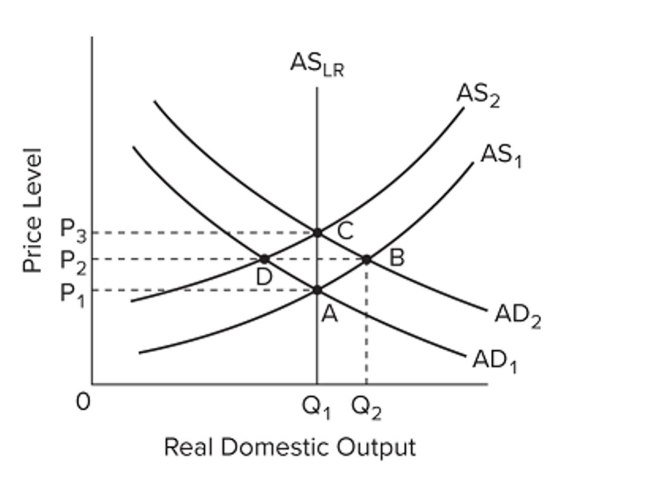 Refer to the graph. Assume that the economy is in initial equilibrium where AD intersects A
. If
There is an anticipated increase in aggregate demand to AD
, then, according to the rational
Expectations economists, the path for adjustment runs from point
Refer to the graph. Assume that the economy is in initial equilibrium where AD intersects A
. If
There is an anticipated increase in aggregate demand to AD
, then, according to the rational
Expectations economists, the path for adjustment runs from point (Multiple Choice)
4.8/5 (68)
(68) How do new classical economists view the importance of policy rules and discretion in
macroeconomic policy?
(Essay)
4.8/5 (86)
(86) In the theory of coordination failures, shifts of the nation's long-run aggregate supply curve are the
main cause of business cycles.
(True/False)
4.9/5 (85)
(85) What have been the changes or modifications in thinking about monetary rules in recent decades?
(Essay)
4.8/5 (66)
(66) The real-business-cycle theorists say that business cycles are caused by real factors affecting
aggregate supply.
(True/False)
4.8/5 (89)
(89) In the new classical theory, a fully anticipated change in aggregate demand and the price level will
temporarily change real output, but an unanticipated change will not.
(True/False)
4.9/5 (82)
(82) In the strict monetarist view, a large increase in the money supply will have
(Multiple Choice)
4.8/5 (74)
(74) 
Filters
- Essay(0)
- Multiple Choice(0)
- Short Answer(0)
- True False(0)
- Matching(0)