



 Chat with AI
Exam 6: The Roman Republic: City-State to World Empire

Exam 1: The Ancient Near East: the First Civilizations87 Questions
Exam 2: The Hebrews: a New View of God and the Individual92 Questions
Exam 3: The Greek City-State: Democratic Politics78 Questions
Exam 4: Greek Thought: From Myth to Reason77 Questions
Exam 5: The Hellenistic Age: Cultural Diffusion79 Questions
Exam 6: The Roman Republic: City-State to World Empire76 Questions
Exam 7: The Roman Empire: a World-State91 Questions
Exam 8: Early Christianity: a World Religion79 Questions
Exam 9: The Heirs of Rome: Byzantium, Islam, and Latin Christendom97 Questions
Exam 10: The High Middle Ages: Vitality and Renewal83 Questions
Exam 11: The Flowering of Medieval Culture: the Christian Synthesis78 Questions
Exam 12: The Late Middle Ages: Crisis and Dissolution77 Questions
Exam 13: The Renaissance: Transition to the Modern Age89 Questions
Exam 14: The Reformation: the Shattering of Christian Unity85 Questions
Exam 15: European Expansion: Economic and Social Transformations89 Questions
Exam 16: The Rise of Sovereignty: Transition to the Modern State85 Questions
Exam 17: The Scientific Revolution: the Universe Seen As a Mechanism85 Questions
Exam 18: The Age of Enlightenment: Reason and Reform89 Questions
Select questions type


Instructions: Please define the following key terms.Show Who? What? Where? When? Why Important?
-Gracchan Revolution
(Essay)
4.8/5  (80)
(80) Instructions: Please write a thorough, well-organized essay to answer each question.
-Explain the dissatisfaction of the lower classes of Rome in the first century B.C.Does this period hold particular lessons for the modern world?
(Essay)
4.9/5 (70)
(70) Instructions: Please write a thorough, well-organized essay to answer each question.
-Trace the main developments of the Roman constitution.Compare the way the Roman constitution developed with the Greek attitude toward law as expressed by Solon.
(Essay)
4.8/5 (83)
(83) The patron-client relationship that existed between patrician and plebeian in early Rome involved
(Multiple Choice)
5.0/5 (75)
(75) Instructions: Please use this outline map of Europe to answer the question(s). 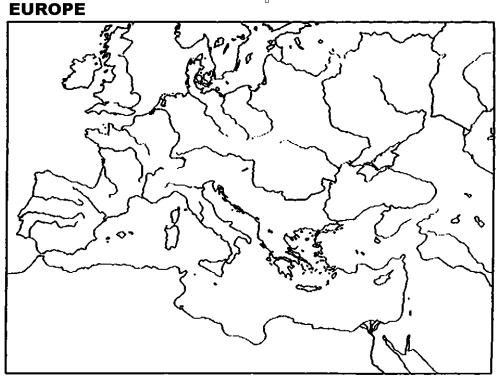 -Locate and clearly mark the extent of the Roman Empire at the end of the Republic (post battle of Actium, 31 B.C.).
 (Short Answer)
4.7/5 (66)
(66) By 264 B.C., Rome had achieved each of the following except
(Multiple Choice)
4.8/5 (77)
(77) Instructions: Please write a thorough, well-organized essay to answer each question.
-Explain how the Roman Republic acquired an empire.
(Essay)
4.8/5 (89)
(89) Instructions: Please write a thorough, well-organized essay to answer each question.
-Contemporary Western opinion holds that the military and political spheres must remain separate.Explain how the history of the Roman Republic could be used to support this view.
(Essay)
4.8/5 (89)
(89) When Rome's army had been decimated by Hannibal and the Carthaginians stood poised to attack the city, Rome was able to win the war by
(Multiple Choice)
4.8/5 (81)
(81) Which of the following would be an inaccurate statement about the office of consul in the first centuries of the Republic?
(Multiple Choice)
4.8/5 (77)
(77) Which of the following was not a consequence of Rome's conquest of the eastern Mediterranean in the second century B.C.?
(Multiple Choice)
4.7/5 (78)
(78) 
Filters
- Essay(0)
- Multiple Choice(0)
- Short Answer(0)
- True False(0)
- Matching(0)