



 Chat with AI
Exam 17: The Scientific Revolution: the Universe Seen As a Mechanism

Exam 1: The Ancient Near East: the First Civilizations87 Questions
Exam 2: The Hebrews: a New View of God and the Individual92 Questions
Exam 3: The Greek City-State: Democratic Politics78 Questions
Exam 4: Greek Thought: From Myth to Reason77 Questions
Exam 5: The Hellenistic Age: Cultural Diffusion79 Questions
Exam 6: The Roman Republic: City-State to World Empire76 Questions
Exam 7: The Roman Empire: a World-State91 Questions
Exam 8: Early Christianity: a World Religion79 Questions
Exam 9: The Heirs of Rome: Byzantium, Islam, and Latin Christendom97 Questions
Exam 10: The High Middle Ages: Vitality and Renewal83 Questions
Exam 11: The Flowering of Medieval Culture: the Christian Synthesis78 Questions
Exam 12: The Late Middle Ages: Crisis and Dissolution77 Questions
Exam 13: The Renaissance: Transition to the Modern Age89 Questions
Exam 14: The Reformation: the Shattering of Christian Unity85 Questions
Exam 15: European Expansion: Economic and Social Transformations89 Questions
Exam 16: The Rise of Sovereignty: Transition to the Modern State85 Questions
Exam 17: The Scientific Revolution: the Universe Seen As a Mechanism85 Questions
Exam 18: The Age of Enlightenment: Reason and Reform89 Questions
Select questions type


Instructions: Please define the following key terms.Show Who? What? Where? When? Why Important?
-spinozism
(Short Answer)
4.9/5  (74)
(74) Instructions: Please define the following key terms.Show Who? What? Where? When? Why Important?
-cosmology
(Short Answer)
4.9/5 (81)
(81) Instructions: Please write a thorough, well-organized essay to answer each question.
-Central to the practice of modern science is the experimental method of investigation and testing scientific theories.Who were some of the pioneers of experimental method in the Scientific Revolution and what were their achievements?
(Essay)
4.9/5 (80)
(80) Newton's synthesis was revolutionary for all the following reasons except
(Multiple Choice)
4.9/5 (68)
(68) The language of the new science -and of the universe it sought to understand - was
(Multiple Choice)
4.8/5 (70)
(70) Copernicus initiated studies that led to his revolutionary theories because
(Multiple Choice)
4.9/5 (72)
(72) Instructions: Please write a thorough, well-organized essay to answer each question.
-Explain the source of medical concepts in the sixteenth and seventeenth centuries.How might new medical ideas threaten the traditional medical practitioner? Discuss whether the reaction of the medical elite of that day holds lessons for the present.
(Essay)
5.0/5 (75)
(75) Which of the following is not consistent with Aristotle's ideas?
(Multiple Choice)
4.8/5 (94)
(94) Copernicus' model of the universe as expounded in On the Revolutions of the Heavenly Spheres
(Multiple Choice)
4.8/5 (75)
(75) Who used the mechanistic view of the world to state that the heart was a mechanical pump?
(Multiple Choice)
4.9/5 (89)
(89) Instructions: Please use this outline map of Europe to answer the question(s). 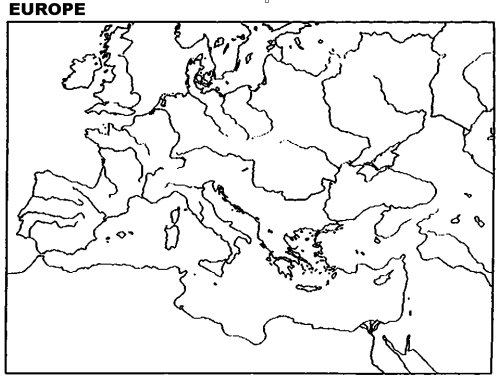 -Show where the following individuals worked: Bacon, Brahe, Copernicus, Descartes, Galileo, Kepler, Newton, Paracelsus, Spinoza, and Versalius
 (Essay)
4.8/5 (75)
(75) All of the following can be attributed to Francis Bacon except
(Multiple Choice)
5.0/5 (90)
(90) 
Filters
- Essay(0)
- Multiple Choice(0)
- Short Answer(0)
- True False(0)
- Matching(0)