



 Chat with AI
Exam 17: The Scientific Revolution: the Universe Seen As a Mechanism

Exam 1: The Ancient Near East: the First Civilizations87 Questions
Exam 2: The Hebrews: a New View of God and the Individual92 Questions
Exam 3: The Greek City-State: Democratic Politics78 Questions
Exam 4: Greek Thought: From Myth to Reason77 Questions
Exam 5: The Hellenistic Age: Cultural Diffusion79 Questions
Exam 6: The Roman Republic: City-State to World Empire76 Questions
Exam 7: The Roman Empire: a World-State91 Questions
Exam 8: Early Christianity: a World Religion79 Questions
Exam 9: The Heirs of Rome: Byzantium, Islam, and Latin Christendom97 Questions
Exam 10: The High Middle Ages: Vitality and Renewal83 Questions
Exam 11: The Flowering of Medieval Culture: the Christian Synthesis78 Questions
Exam 12: The Late Middle Ages: Crisis and Dissolution77 Questions
Exam 13: The Renaissance: Transition to the Modern Age89 Questions
Exam 14: The Reformation: the Shattering of Christian Unity85 Questions
Exam 15: European Expansion: Economic and Social Transformations89 Questions
Exam 16: The Rise of Sovereignty: Transition to the Modern State85 Questions
Exam 17: The Scientific Revolution: the Universe Seen As a Mechanism85 Questions
Exam 18: The Age of Enlightenment: Reason and Reform89 Questions
Select questions type


Instructions: Please write a thorough, well-organized essay to answer each question.
-For students who took the first half of Western Civilization: explain the connections between ancient Greco-Roman culture and the Scientific Revolution.
(Essay)
4.8/5  (84)
(84) Instructions: Please use this outline map of Europe to answer the question(s). 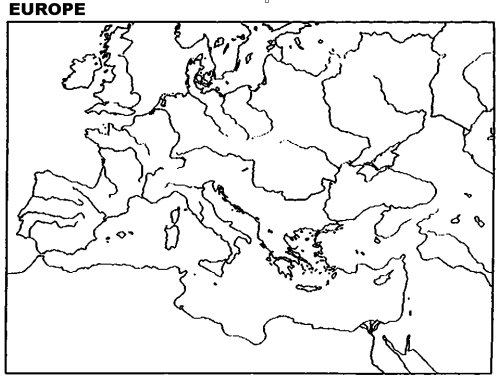 -Locate and label the main center of scholasticism and the center of Renaissance Neo-Platonism.
 (Essay)
4.8/5 (87)
(87) Instructions: Please write a thorough, well-organized essay to answer each question.
-What is Alchemy? What influence did it have the new scientific approaches to nature and knowledge?
(Essay)
4.8/5 (78)
(78) Instructions: Please write a thorough, well-organized essay to answer each question.
-Comment upon the medieval perception of matter and explain its relationship to new scientific studies of the seventeenth century.
(Essay)
4.8/5 (74)
(74) Instructions: Please define the following key terms.Show Who? What? Where? When? Why Important?
-epicycles
(Essay)
4.8/5 (74)
(74) Newton published his Principia Mathematica under the sponsorship of the
(Multiple Choice)
4.7/5 (79)
(79) Instructions: Please write a thorough, well-organized essay to answer each question.
-What prepared Europe for the Scientific Revolution?
(Essay)
4.7/5 (66)
(66) Among Galileo's experiment observations were all of the following except
(Multiple Choice)
4.9/5 (79)
(79) Which of the following statements best describes the Scientific Revolution?
(Multiple Choice)
4.8/5 (89)
(89) Instructions: Please write a thorough, well-organized essay to answer each question.
-Explain why the endeavors of Sir Isaac Newton have been referred to as a synthesis.What were his major works? Did his achievements lead to difficulties with the clerical hierarchy of the Church of England?
(Essay)
4.8/5 (78)
(78) Instructions: Please define the following key terms.Show Who? What? Where? When? Why Important?
-elliptical orbits
(Short Answer)
4.8/5 (81)
(81) Which of the following was not part of Newton's theory of natural laws?
(Multiple Choice)
4.9/5 (75)
(75) Instructions: Please define the following key terms.Show Who? What? Where? When? Why Important?
-Newtonian synthesis
(Essay)
4.9/5 (84)
(84) The first scientific society in the world for women was established in
(Multiple Choice)
4.8/5 (75)
(75) Instructions: Please write a thorough, well-organized essay to answer each question.
-Explain in detail the Aristotelian-Ptolemaic system.
(Essay)
4.8/5 (73)
(73) The Ptolemaic model of the universe troubled Copernicus mainly because
(Multiple Choice)
4.8/5 (64)
(64) 
Filters
- Essay(0)
- Multiple Choice(0)
- Short Answer(0)
- True False(0)
- Matching(0)