



 Chat with AI
Exam 16: Animal Evolution

Exam 1: Invitation to Biology99 Questions
Exam 2: Molecules of Life98 Questions
Exam 3: Cell Structure101 Questions
Exam 4: Energy and Metabolism95 Questions
Exam 5: Photosynthesis93 Questions
Exam 6: Releasing Chemical Energy77 Questions
Exam 7: Dna Structure and Function99 Questions
Exam 8: Gene Expression and Control96 Questions
Exam 9: How Cells Reproduce99 Questions
Exam 10: Patterns of Inheritance88 Questions
Exam 11: Biotechnology100 Questions
Exam 12: Evidence of Evolution85 Questions
Exam 13: Processes of Evolution99 Questions
Exam 14: Prokaryotes, Protists, and Viruses95 Questions
Exam 15: Plants and Fungi100 Questions
Exam 16: Animal Evolution100 Questions
Exam 17: Population Ecology94 Questions
Exam 18: Communities and Ecosystems100 Questions
Exam 19: The Biosphere and Human Effects100 Questions
Exam 20: Animal Tissues and Organs97 Questions
Exam 21: How Animals Move100 Questions
Exam 22: Circulation and Respiration100 Questions
Exam 23: Immunity100 Questions
Exam 24: Digestion and Excretion100 Questions
Exam 25: Neural Control and the Senses100 Questions
Exam 26: Endocrine Control100 Questions
Exam 27: Animal Reproduction and Development101 Questions
Exam 28: Plant Form and Function100 Questions
Exam 29: Life Cycles of Flowering Plants100 Questions
Select questions type


Which animal lacks symmetry, has no embryonic tissues, and has intracellular digestion?
(Multiple Choice)
4.8/5  (83)
(83) Which of the following invertebrates is most closely related to vertebrates?
(Multiple Choice)
5.0/5 (72)
(72) Examine the figure below and match each term with the letter to which it best corresponds. 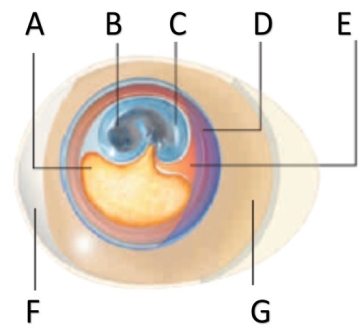 -yolk sac
 (Multiple Choice)
4.9/5 (79)
(79) Examine the figure below and match each term with the letter to which it best corresponds.
-hardened shell
-hardened shell (Multiple Choice)
4.8/5 (81)
(81) Many primate adaptations were responses to living in ____.
(Multiple Choice)
4.9/5 (77)
(77) Which organ present in crocodiles is most like that of birds?
(Multiple Choice)
4.9/5 (68)
(68) Examine the figure below and match each term with the letter to which it best corresponds.Not all choices will be used. 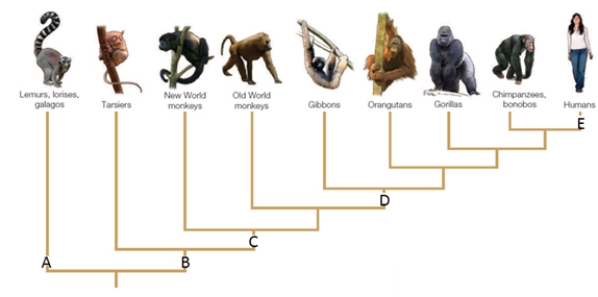 -hominins
 (Multiple Choice)
4.9/5 (92)
(92) Matching
Examine the figure below and match each term with the letter to which it best corresponds. 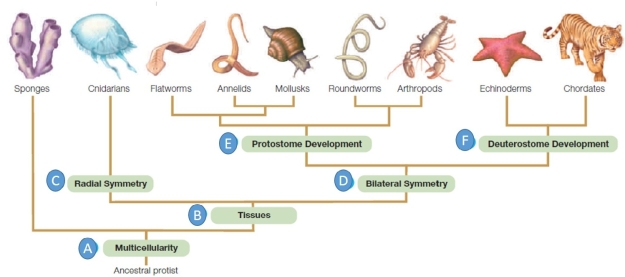 -having parts arranged around a central axis
 (Multiple Choice)
4.7/5 (67)
(67) The colonial theory of animal origins states that animals ____.
(Multiple Choice)
4.9/5 (83)
(83) Reef-building polyps get their sugars from mutualistic ____.
(Multiple Choice)
4.7/5 (77)
(77) Which of the organisms below give support for the colonial theory of animal origins?
(Multiple Choice)
4.8/5 (79)
(79) 
Filters
- Essay(0)
- Multiple Choice(0)
- Short Answer(0)
- True False(0)
- Matching(0)