



 Chat with AI
Exam 17: Population Ecology

Exam 1: Invitation to Biology99 Questions
Exam 2: Molecules of Life98 Questions
Exam 3: Cell Structure101 Questions
Exam 4: Energy and Metabolism95 Questions
Exam 5: Photosynthesis93 Questions
Exam 6: Releasing Chemical Energy77 Questions
Exam 7: Dna Structure and Function99 Questions
Exam 8: Gene Expression and Control96 Questions
Exam 9: How Cells Reproduce99 Questions
Exam 10: Patterns of Inheritance88 Questions
Exam 11: Biotechnology100 Questions
Exam 12: Evidence of Evolution85 Questions
Exam 13: Processes of Evolution99 Questions
Exam 14: Prokaryotes, Protists, and Viruses95 Questions
Exam 15: Plants and Fungi100 Questions
Exam 16: Animal Evolution100 Questions
Exam 17: Population Ecology94 Questions
Exam 18: Communities and Ecosystems100 Questions
Exam 19: The Biosphere and Human Effects100 Questions
Exam 20: Animal Tissues and Organs97 Questions
Exam 21: How Animals Move100 Questions
Exam 22: Circulation and Respiration100 Questions
Exam 23: Immunity100 Questions
Exam 24: Digestion and Excretion100 Questions
Exam 25: Neural Control and the Senses100 Questions
Exam 26: Endocrine Control100 Questions
Exam 27: Animal Reproduction and Development101 Questions
Exam 28: Plant Form and Function100 Questions
Exam 29: Life Cycles of Flowering Plants100 Questions
Select questions type


On Easter Island in the Pacific Ocean, the population rose to 3,000 people from the original population of 100. In time, the entire island was cultivated, and eventually, the soils became so overcultivated that crops could no longer be grown. People started dying from starvation and disease. This Easter Island population had exceeded its ____.
(Multiple Choice)
4.7/5  (76)
(76) Match the following terms with the most appropriate statement.
-the number of individuals in some specified area or volume of a habitat
A)population size
B)population density
C)population distribution
D)demographics
E)ecology
F)per capita growth rate
G)exponential
H)mark-recapture
I)sample
(Short Answer)
4.9/5 (83)
(83) The number of individuals of the same species in some specified area or volume of habitat is the ____.
(Multiple Choice)
4.9/5 (70)
(70) What invention about 11,000 years ago led to a boom in the human population?
(Multiple Choice)
4.9/5 (82)
(82) Density-independent controls over population growth include ____.
(Multiple Choice)
5.0/5 (76)
(76) Which important discovery in the early 1900s enhanced food production, thus increasing human population growth?
(Multiple Choice)
4.8/5 (85)
(85) The number of individuals that make up a population's gene pool is the ____.
(Multiple Choice)
4.8/5 (90)
(90) In which type of population distribution would plot sampling be most accurate?
(Multiple Choice)
4.8/5 (75)
(75) Match the following terms with the most appropriate statement.
-development of penicillin
A)Africa
B)11,000 years ago
C)eighteenth century
D)Mid-1300s
E)1800s
F)1940s
(Short Answer)
5.0/5 (88)
(88) Matching
Match the following figures with the most appropriate statement.
a. 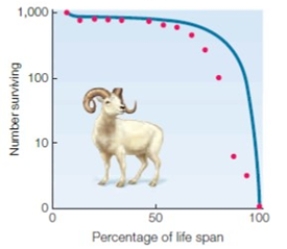 C.
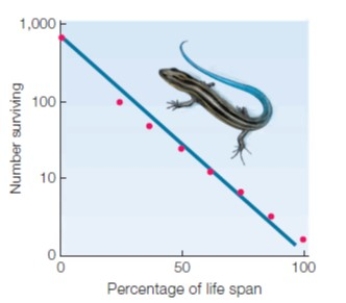 D.
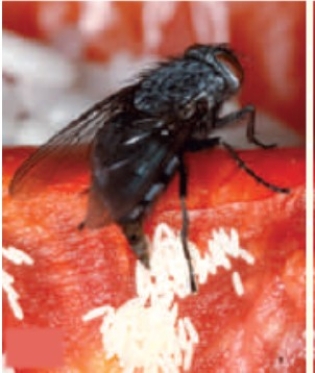 B.
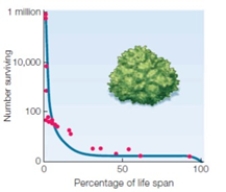 E.

a.A
b.B
c.C
d.D
e.E
-survivorship curve; mortality does not vary with age
C. D. B. E.
a.A
b.B
c.C
d.D
e.E
-survivorship curve; mortality does not vary with age (Short Answer)
5.0/5 (63)
(63) Match the terms with the most appropriate statement.
-this describes a population that grows slowly at first and then increases rapidly until it reaches carrying capacity
A)density-dependent factor
B)demographic transitional stage
C)type I survivorship
D)r-selected species
E)biotic potential
F)density-independent factor
G)logistic growth
(Short Answer)
4.9/5 (63)
(63) Match the following terms with the most appropriate statement.
-model for population growth when resources are unlimited
A)population size
B)population density
C)population distribution
D)demographics
E)ecology
F)per capita growth rate
G)exponential
H)mark-recapture
I)sample
(Short Answer)
4.8/5 (74)
(74) Matching
Match the following figures with the most appropriate statement.
a. C. D. B. E.
a.A
b.B
c.C
d.D
e.E
-equilibrial life history
C. D. B. E.
a.A
b.B
c.C
d.D
e.E
-equilibrial life history (Short Answer)
5.0/5 (69)
(69) Match the following terms with the most appropriate statement.
-invention of agriculture
A)Africa
B)11,000 years ago
C)eighteenth century
D)Mid-1300s
E)1800s
F)1940s
(Short Answer)
4.7/5 (77)
(77) 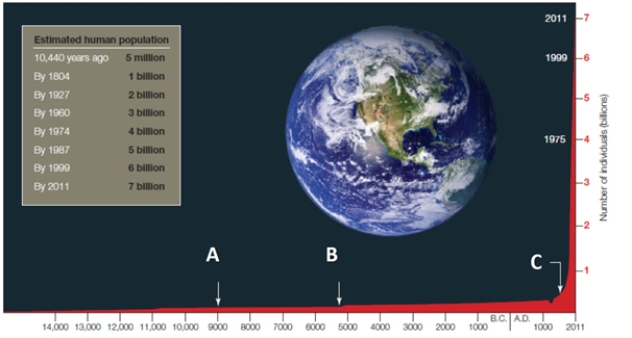 The steep increase in human population at point "C" indicates the beginning of the ____.
 (Multiple Choice)
4.9/5 (82)
(82) Match the terms with the most appropriate statement.
-death rate drops fast; birth rate declines slowly
A)density-dependent factor
B)demographic transitional stage
C)type I survivorship
D)r-selected species
E)biotic potential
F)density-independent factor
G)logistic growth
(Short Answer)
4.8/5 (78)
(78) 
Filters
- Essay(0)
- Multiple Choice(0)
- Short Answer(0)
- True False(0)
- Matching(0)