



 Chat with AI
Exam 21: How Animals Move

Exam 1: Invitation to Biology99 Questions
Exam 2: Molecules of Life98 Questions
Exam 3: Cell Structure101 Questions
Exam 4: Energy and Metabolism95 Questions
Exam 5: Photosynthesis93 Questions
Exam 6: Releasing Chemical Energy77 Questions
Exam 7: Dna Structure and Function99 Questions
Exam 8: Gene Expression and Control96 Questions
Exam 9: How Cells Reproduce99 Questions
Exam 10: Patterns of Inheritance88 Questions
Exam 11: Biotechnology100 Questions
Exam 12: Evidence of Evolution85 Questions
Exam 13: Processes of Evolution99 Questions
Exam 14: Prokaryotes, Protists, and Viruses95 Questions
Exam 15: Plants and Fungi100 Questions
Exam 16: Animal Evolution100 Questions
Exam 17: Population Ecology94 Questions
Exam 18: Communities and Ecosystems100 Questions
Exam 19: The Biosphere and Human Effects100 Questions
Exam 20: Animal Tissues and Organs97 Questions
Exam 21: How Animals Move100 Questions
Exam 22: Circulation and Respiration100 Questions
Exam 23: Immunity100 Questions
Exam 24: Digestion and Excretion100 Questions
Exam 25: Neural Control and the Senses100 Questions
Exam 26: Endocrine Control100 Questions
Exam 27: Animal Reproduction and Development101 Questions
Exam 28: Plant Form and Function100 Questions
Exam 29: Life Cycles of Flowering Plants100 Questions
Select questions type


The following statements describe characteristics associated with bones and bone marrow. For each one, select the structure to which each best corresponds. Some choices may be used more than once.
-large amounts of bony tissue found at end of long bones
A)compact bone
B)spongy bone
C)both spongy bone and compact bone
D)neither spongy bone nor compact bone
E)yellow marrow
F)red marrow
(Short Answer)
4.9/5  (77)
(77) 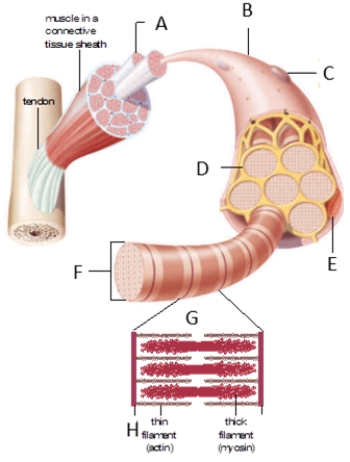
-In the accompanying figure, the structure labeled "D" is the ____.
-In the accompanying figure, the structure labeled "D" is the ____. (Multiple Choice)
4.8/5 (70)
(70) The following statements describe characteristics associated with bones and bone marrow. For each one, select the structure to which each best corresponds. Some choices may be used more than once.
-marrow that produces blood cells
A)compact bone
B)spongy bone
C)both spongy bone and compact bone
D)neither spongy bone nor compact bone
E)yellow marrow
F)red marrow
(Short Answer)
5.0/5 (78)
(78) Relaxed muscles, such as those generated by prolonged sitting, ____, resulting in ____.
(Multiple Choice)
5.0/5 (86)
(86) Osteoarthritis is more common in older adults due to ____.
(Multiple Choice)
4.9/5 (83)
(83) Synthetic versions of muscle-building hormones are also known as ____ hormones.
(Multiple Choice)
4.7/5 (69)
(69) Matching
The following statements describe the various types of animal skeletons. For each one, select the best choice to which each corresponds. Some choices may be used more than once.
-skeleton of clams
A)hydrostatic skeleton
B)exoskeleton
C)endoskeleton
(Short Answer)
4.9/5 (90)
(90) Match characteristics associated with muscle fibers to the type of muscle fiber to which they correspond. Some choices may be used more than once.
-common in cheetahs
A)white fibers
B)fast red fibers
C)slow red fibers
(Short Answer)
4.7/5 (79)
(79) Match characteristics associated with muscle fibers to the type of muscle fiber to which they correspond. Some choices may be used more than once.
-rely mainly on anaerobic respiration
A)white fibers
B)fast red fibers
C)slow red fibers
(Short Answer)
4.7/5 (70)
(70) In a contracted muscle, the Z lines of a sarcomere are ____.
(Multiple Choice)
4.7/5 (77)
(77) Gibbons are able to swing through the trees by their arms thanks to ____ joints.
(Multiple Choice)
4.9/5 (83)
(83) The joint between vertebrae is an example of a ____ joint.
(Multiple Choice)
4.8/5 (74)
(74) Matching
The following statements describe the various types of animal skeletons. For each one, select the best choice to which each corresponds. Some choices may be used more than once.
-soft-bodied invertebrates have this type of skeleton
A)hydrostatic skeleton
B)exoskeleton
C)endoskeleton
(Short Answer)
4.9/5 (85)
(85)
-In the accompanying figure, the structure labeled "B" is a ____.
-In the accompanying figure, the structure labeled "B" is a ____. (Multiple Choice)
4.8/5 (70)
(70) The ____ bones protect the organs and support the weight of the upper body while standing.
(Multiple Choice)
4.8/5 (84)
(84) Match characteristics associated with muscle fibers to the type of muscle fiber to which they correspond. Some choices may be used more than once.
-the majority of fibers in the muscles of slow-moving primates
A)white fibers
B)fast red fibers
C)slow red fibers
(Short Answer)
4.8/5 (86)
(86) 
Filters
- Essay(0)
- Multiple Choice(0)
- Short Answer(0)
- True False(0)
- Matching(0)