



 Chat with AI
Exam 29: Population Ecology

Exam 1: Light and Life109 Questions
Exam 2: The Cell: an Overview155 Questions
Exam 3: Energy and Enzymes66 Questions
Exam 4: Cell Membranes and Signaling81 Questions
Exam 5: Cellular Respiration61 Questions
Exam 6: Photosynthesis95 Questions
Exam 7: Cell Cycles93 Questions
Exam 8: Genetic Recombination88 Questions
Exam 9: The Chromosomal Basis of Mendelian Inheritance86 Questions
Exam 10: Genetic Linkage, Sex-Linkage, and Other Non-Mendelian Inheritance Mechanisms73 Questions
Exam 11: DNA Structure, Replication, and Repair57 Questions
Exam 12: Gene Structure Expression, and Mutation106 Questions
Exam 13: Regulation of Gene Expression91 Questions
Exam 14: Dna Technologies91 Questions
Exam 15: Genomes53 Questions
Exam 16: Evolution: the Development of the Theory66 Questions
Exam 17: Microevolution: Changes Within Populations83 Questions
Exam 18: Speciation and Macroevolution64 Questions
Exam 19: Systematics and Phylogenetics: Revealing the Tree of Life68 Questions
Exam 20: Humans and Evolution54 Questions
Exam 21: Defining Life and Its Origins55 Questions
Exam 22: Viruses, Viroids, and Prions: Infectious Biological Particles38 Questions
Exam 23: Bacteria and Archaea78 Questions
Exam 24: Protists98 Questions
Exam 25: Fungi81 Questions
Exam 26: Plants80 Questions
Exam 27: Animals171 Questions
Exam 28: Conservation of Biodiversity41 Questions
Exam 29: Population Ecology65 Questions
Exam 30: Species Interactions and Community Ecology70 Questions
Exam 31: Ecosystems68 Questions
Exam 32: Animal Behaviour120 Questions
Exam 33: Organization of the Plant Body69 Questions
Exam 34: Transport in Plants80 Questions
Exam 35: Reproduction and Development in Flowering Plants70 Questions
Exam 36: Plant Nutrition97 Questions
Exam 37: Plant Signals and Responses to the Environment93 Questions
Exam 38: Introduction to Animal Organization and Physiology65 Questions
Exam 39: Animal Nutrition98 Questions
Exam 40: Gas Exchange: the Respiratory System56 Questions
Exam 41: Internal Transport: the Circulatory System72 Questions
Exam 42: Regulation of the Internal Environment: Water, Solutes, and Temperature75 Questions
Exam 43: Control of Animal Processes: Endocrine Control80 Questions
Exam 44: Animal Reproduction168 Questions
Exam 45: Control of Animal Processes: Neural Control253 Questions
Exam 46: Muscles, Skeletons, and Body Movements71 Questions
Select questions type


Categorize each trait as belonging predominantly to an r-selected species or a K-selected species.
-low mortality rate
(Multiple Choice)
4.8/5  (80)
(80) Malaria is a disease that is spread by mosquito bites. What causes it?
(Multiple Choice)
4.8/5 (76)
(76) Categorize each trait as belonging predominantly to an r-selected species or a K-selected species.
-long life span
(Multiple Choice)
4.9/5 (80)
(80) Which of the following regions will experience a huge increase in their population growth rates over the next 20 or 25 years?
(Multiple Choice)
4.8/5 (74)
(74) What are some density-dependent factors that affect humans at higher population densities, and how have these been addressed in industrial societies?
(Essay)
4.7/5 (81)
(81) Suppose that you are studying generation time in a population. Which of the following are you most likely studying?
(Multiple Choice)
4.8/5 (76)
(76) What does the allocation of resources for survival, growth, and maximal reproduction determine?
(Multiple Choice)
4.8/5 (73)
(73) Which of the following is descriptive of a population experiencing exponential population growth?
(Multiple Choice)
4.7/5 (92)
(92) Categorize each trait as belonging predominantly to an r-selected species or a K-selected species.
-early timing of first reproduction
(Multiple Choice)
4.7/5 (79)
(79) "Humans have two options for limiting population growth: we can make a global effort to limit our own population, or we can wait until the environment does it for us." Briefly address each scenario. What methods would result in a successful global decline in birth rate? What environmental events are the alternatives?
(Essay)
4.9/5 (80)
(80) Parasitism is a density-independent factor of population control.
(True/False)
4.8/5 (84)
(84) What characteristics are consistent with a K-selected species? Where do humans fall on the r through K continuum?
(Essay)
4.9/5 (85)
(85) Match each statement with the most appropriate survivorship curve.
-constant rate of mortality in all age classes
(Multiple Choice)
4.8/5 (70)
(70) What would a human population living without medical care in Third World conditions probably have?
(Multiple Choice)
4.8/5 (71)
(71) Use the list of terms to identify each lettered part of the illustration. 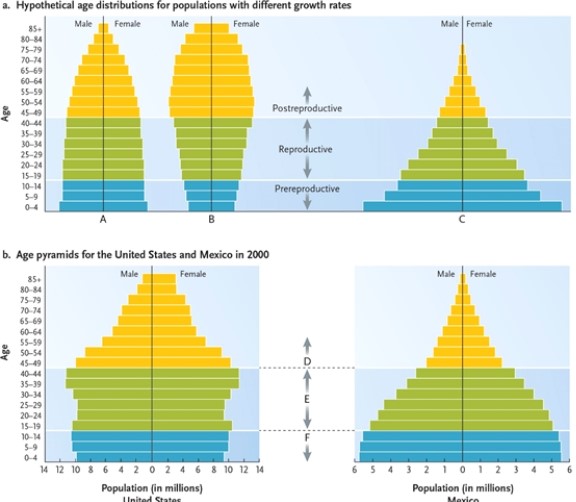 -negative growth
 (Short Answer)
5.0/5 (79)
(79) Categorize each trait as belonging predominantly to an r-selected species or a K-selected species.
-little or no parental care
(Multiple Choice)
4.9/5 (83)
(83) At which stage of a country's demographic transition do birth rates generally reach their highest point?
(Multiple Choice)
4.7/5 (67)
(67) Match each term with its definition.
-exponential population growth
(Multiple Choice)
4.8/5 (79)
(79) Categorize each trait as belonging predominantly to an r-selected species or a K-selected species.
-small clutch or brood size
(Multiple Choice)
4.9/5 (79)
(79) 
Filters
- Essay(0)
- Multiple Choice(0)
- Short Answer(0)
- True False(0)
- Matching(0)