



 Chat with AI
Exam 2: The Cell: an Overview

Exam 1: Light and Life109 Questions
Exam 2: The Cell: an Overview155 Questions
Exam 3: Energy and Enzymes66 Questions
Exam 4: Cell Membranes and Signaling81 Questions
Exam 5: Cellular Respiration61 Questions
Exam 6: Photosynthesis95 Questions
Exam 7: Cell Cycles93 Questions
Exam 8: Genetic Recombination88 Questions
Exam 9: The Chromosomal Basis of Mendelian Inheritance86 Questions
Exam 10: Genetic Linkage, Sex-Linkage, and Other Non-Mendelian Inheritance Mechanisms73 Questions
Exam 11: DNA Structure, Replication, and Repair57 Questions
Exam 12: Gene Structure Expression, and Mutation106 Questions
Exam 13: Regulation of Gene Expression91 Questions
Exam 14: Dna Technologies91 Questions
Exam 15: Genomes53 Questions
Exam 16: Evolution: the Development of the Theory66 Questions
Exam 17: Microevolution: Changes Within Populations83 Questions
Exam 18: Speciation and Macroevolution64 Questions
Exam 19: Systematics and Phylogenetics: Revealing the Tree of Life68 Questions
Exam 20: Humans and Evolution54 Questions
Exam 21: Defining Life and Its Origins55 Questions
Exam 22: Viruses, Viroids, and Prions: Infectious Biological Particles38 Questions
Exam 23: Bacteria and Archaea78 Questions
Exam 24: Protists98 Questions
Exam 25: Fungi81 Questions
Exam 26: Plants80 Questions
Exam 27: Animals171 Questions
Exam 28: Conservation of Biodiversity41 Questions
Exam 29: Population Ecology65 Questions
Exam 30: Species Interactions and Community Ecology70 Questions
Exam 31: Ecosystems68 Questions
Exam 32: Animal Behaviour120 Questions
Exam 33: Organization of the Plant Body69 Questions
Exam 34: Transport in Plants80 Questions
Exam 35: Reproduction and Development in Flowering Plants70 Questions
Exam 36: Plant Nutrition97 Questions
Exam 37: Plant Signals and Responses to the Environment93 Questions
Exam 38: Introduction to Animal Organization and Physiology65 Questions
Exam 39: Animal Nutrition98 Questions
Exam 40: Gas Exchange: the Respiratory System56 Questions
Exam 41: Internal Transport: the Circulatory System72 Questions
Exam 42: Regulation of the Internal Environment: Water, Solutes, and Temperature75 Questions
Exam 43: Control of Animal Processes: Endocrine Control80 Questions
Exam 44: Animal Reproduction168 Questions
Exam 45: Control of Animal Processes: Neural Control253 Questions
Exam 46: Muscles, Skeletons, and Body Movements71 Questions
Select questions type


If a cell contains intermediate filaments, to which organism must the cell then belong?
(Multiple Choice)
4.8/5  (78)
(78) At one point in human development, tissue that connected the fingers and the hand appeared to be "webbed." Enzymes eventually destroy the cells of the webbing and the fingers separate. Where are these enzymes probably liberated from?
(Multiple Choice)
4.9/5 (86)
(86) If a cell wall is analogous to the plant cell, which of the following is analogous to the animal cell?
(Multiple Choice)
4.9/5 (86)
(86) In this drawing of a eukaryotic animal cell, identify the cellular structures indicated. 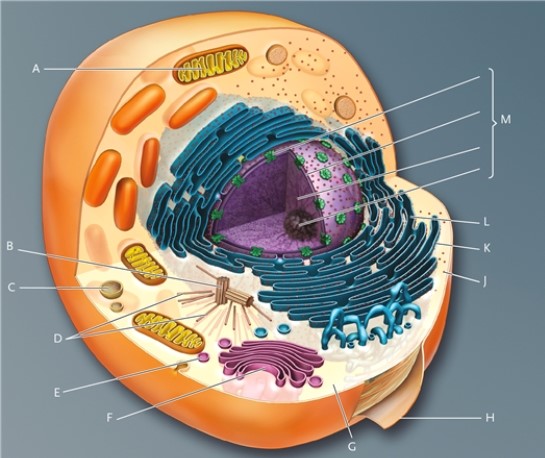 -Golgi complex
 (Short Answer)
4.9/5 (72)
(72) In this drawing of a mitochondrion, identify the structures indicated. 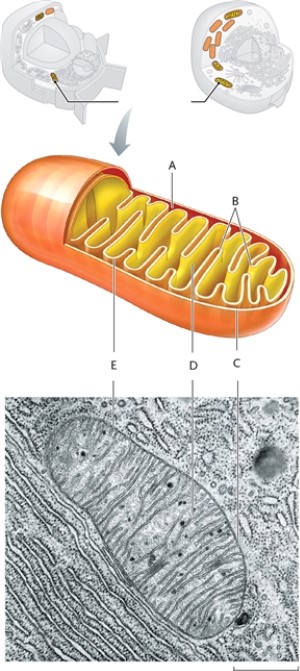 -cristae
 (Short Answer)
4.8/5 (72)
(72) In this drawing of a eukaryotic plant cell, identify the cellular structures indicated. 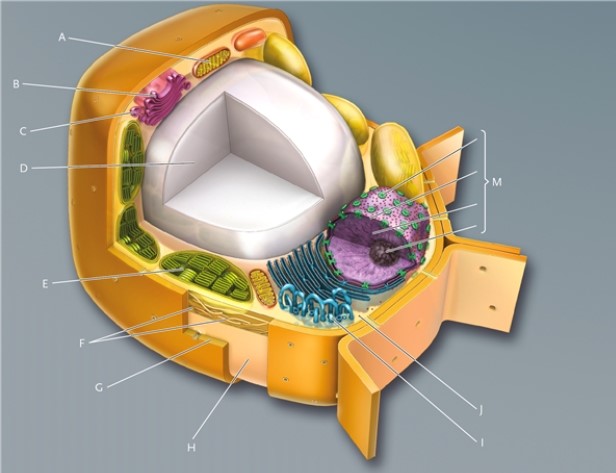 -cell wall
 (Short Answer)
4.8/5 (82)
(82) Plant cells permit ions and small molecules to move between adjacent cells by means of cytoplasmic channels in their cell walls. What are these channels called?
(Multiple Choice)
4.9/5 (86)
(86) What is the semi-liquid substance within the nucleus called?
(Multiple Choice)
4.9/5 (69)
(69) In this drawing of a eukaryotic animal cell, identify the cellular structures indicated.
-vesicle
-vesicle (Short Answer)
4.9/5 (72)
(72) In this drawing of a eukaryotic animal cell, identify the cellular structures indicated.
-microtubules
-microtubules (Short Answer)
4.9/5 (79)
(79) A human egg is approximately 100 µm in size. What is this equal to?
(Multiple Choice)
4.9/5 (77)
(77) Match each description with the cellular structure that best corresponds.
-central vacuole
(Multiple Choice)
4.8/5 (83)
(83) Match each description with the cellular structure that best corresponds.
-rough ER
(Multiple Choice)
4.7/5 (69)
(69) In what way are lysosomes and plant vacuoles similar to each other?
(Multiple Choice)
4.7/5 (102)
(102) 
Filters
- Essay(0)
- Multiple Choice(0)
- Short Answer(0)
- True False(0)
- Matching(0)