



 Chat with AI
Exam 43: Control of Animal Processes: Endocrine Control

Exam 1: Light and Life109 Questions
Exam 2: The Cell: an Overview155 Questions
Exam 3: Energy and Enzymes66 Questions
Exam 4: Cell Membranes and Signaling81 Questions
Exam 5: Cellular Respiration61 Questions
Exam 6: Photosynthesis95 Questions
Exam 7: Cell Cycles93 Questions
Exam 8: Genetic Recombination88 Questions
Exam 9: The Chromosomal Basis of Mendelian Inheritance86 Questions
Exam 10: Genetic Linkage, Sex-Linkage, and Other Non-Mendelian Inheritance Mechanisms73 Questions
Exam 11: DNA Structure, Replication, and Repair57 Questions
Exam 12: Gene Structure Expression, and Mutation106 Questions
Exam 13: Regulation of Gene Expression91 Questions
Exam 14: Dna Technologies91 Questions
Exam 15: Genomes53 Questions
Exam 16: Evolution: the Development of the Theory66 Questions
Exam 17: Microevolution: Changes Within Populations83 Questions
Exam 18: Speciation and Macroevolution64 Questions
Exam 19: Systematics and Phylogenetics: Revealing the Tree of Life68 Questions
Exam 20: Humans and Evolution54 Questions
Exam 21: Defining Life and Its Origins55 Questions
Exam 22: Viruses, Viroids, and Prions: Infectious Biological Particles38 Questions
Exam 23: Bacteria and Archaea78 Questions
Exam 24: Protists98 Questions
Exam 25: Fungi81 Questions
Exam 26: Plants80 Questions
Exam 27: Animals171 Questions
Exam 28: Conservation of Biodiversity41 Questions
Exam 29: Population Ecology65 Questions
Exam 30: Species Interactions and Community Ecology70 Questions
Exam 31: Ecosystems68 Questions
Exam 32: Animal Behaviour120 Questions
Exam 33: Organization of the Plant Body69 Questions
Exam 34: Transport in Plants80 Questions
Exam 35: Reproduction and Development in Flowering Plants70 Questions
Exam 36: Plant Nutrition97 Questions
Exam 37: Plant Signals and Responses to the Environment93 Questions
Exam 38: Introduction to Animal Organization and Physiology65 Questions
Exam 39: Animal Nutrition98 Questions
Exam 40: Gas Exchange: the Respiratory System56 Questions
Exam 41: Internal Transport: the Circulatory System72 Questions
Exam 42: Regulation of the Internal Environment: Water, Solutes, and Temperature75 Questions
Exam 43: Control of Animal Processes: Endocrine Control80 Questions
Exam 44: Animal Reproduction168 Questions
Exam 45: Control of Animal Processes: Neural Control253 Questions
Exam 46: Muscles, Skeletons, and Body Movements71 Questions
Select questions type


Suppose that hormone A binds to intracellular receptors in its target tissue. Also suppose that as a result of hormone A, the target tissue is now sensitive to or responsive to hormone B. What was the action of hormone A?
(Multiple Choice)
4.9/5  (81)
(81) Which of the following occurs when the moult-inhibiting hormone is prevented from being secreted?
(Multiple Choice)
4.8/5 (74)
(74) Match each concept with the most appropriate description.
-prostaglandins
(Multiple Choice)
4.8/5 (74)
(74) Select a term or phrase from the numbered list to correspond to each labelled endocrine gland in the illustration. The terms and phrases in the numbered list may be used more than once. 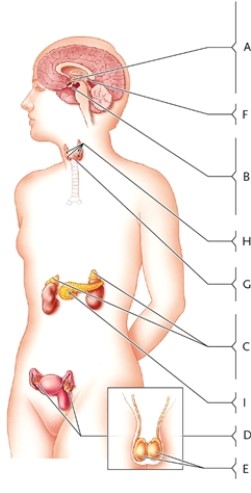 -a portion of this gland reinforces the sympathetic nervous system in responding to stress
 (Short Answer)
4.9/5 (89)
(89) What term refers to the joint actions of insulin and glucagon?
(Multiple Choice)
4.8/5 (81)
(81) Which hormones does the hypothalamus produce, and which specific pituitary gland is affected?
(Multiple Choice)
4.9/5 (79)
(79) If a hormone caused an increase in protein kinase activity, predict the type of hormone responsible and the intracellular signalling mechanism of its action.
(Essay)
4.9/5 (84)
(84) Select a term or phrase from the numbered list to correspond to each labelled endocrine gland in the illustration. The terms and phrases in the numbered list may be used more than once.
-site of release of oxytocin
-site of release of oxytocin (Short Answer)
4.9/5 (81)
(81) Which hormone of the anterior pituitary gland has a generalized effect, and has receptors on almost every cell in the body?
(Multiple Choice)
4.9/5 (70)
(70) Explain negative feedback control using thyroid hormones as an example.
(Essay)
4.9/5 (89)
(89) Match each concept with the most appropriate description.
-amplification
(Multiple Choice)
4.9/5 (78)
(78) Match each concept with the most appropriate description.
-thyroxine
(Multiple Choice)
4.9/5 (84)
(84) Select a term or phrase from the numbered list to correspond to each labelled endocrine gland in the illustration. The terms and phrases in the numbered list may be used more than once.
-production site of hormone involved in milk production
-production site of hormone involved in milk production (Short Answer)
4.9/5 (74)
(74) Select a term or phrase from the numbered list to correspond to each labelled endocrine gland in the illustration. The terms and phrases in the numbered list may be used more than once.
-gland that controls biological rhythms
-gland that controls biological rhythms (Short Answer)
4.8/5 (75)
(75) A hormone is hydrophobic and binds to membrane receptors. What type of molecule is this hormone most likely to be?
(Multiple Choice)
4.8/5 (78)
(78) Which of the following affects the pituitary gland most directly?
(Multiple Choice)
4.8/5 (74)
(74) Small quantities of hormones can typically produce profound effects in cells and body functions due to magnification.
(True/False)
4.8/5 (88)
(88) Which sequence presents hormone action in the correct order?
(Multiple Choice)
4.7/5 (80)
(80) Suppose that your job is to determine if a steroid hormone is having an effect on its target tissue. What would be an indication of activation of the target tissue by the hormone in question?
(Multiple Choice)
5.0/5 (82)
(82) 
Filters
- Essay(0)
- Multiple Choice(0)
- Short Answer(0)
- True False(0)
- Matching(0)