



 Chat with AI
Exam 45: Control of Animal Processes: Neural Control

Exam 1: Light and Life109 Questions
Exam 2: The Cell: an Overview155 Questions
Exam 3: Energy and Enzymes66 Questions
Exam 4: Cell Membranes and Signaling81 Questions
Exam 5: Cellular Respiration61 Questions
Exam 6: Photosynthesis95 Questions
Exam 7: Cell Cycles93 Questions
Exam 8: Genetic Recombination88 Questions
Exam 9: The Chromosomal Basis of Mendelian Inheritance86 Questions
Exam 10: Genetic Linkage, Sex-Linkage, and Other Non-Mendelian Inheritance Mechanisms73 Questions
Exam 11: DNA Structure, Replication, and Repair57 Questions
Exam 12: Gene Structure Expression, and Mutation106 Questions
Exam 13: Regulation of Gene Expression91 Questions
Exam 14: Dna Technologies91 Questions
Exam 15: Genomes53 Questions
Exam 16: Evolution: the Development of the Theory66 Questions
Exam 17: Microevolution: Changes Within Populations83 Questions
Exam 18: Speciation and Macroevolution64 Questions
Exam 19: Systematics and Phylogenetics: Revealing the Tree of Life68 Questions
Exam 20: Humans and Evolution54 Questions
Exam 21: Defining Life and Its Origins55 Questions
Exam 22: Viruses, Viroids, and Prions: Infectious Biological Particles38 Questions
Exam 23: Bacteria and Archaea78 Questions
Exam 24: Protists98 Questions
Exam 25: Fungi81 Questions
Exam 26: Plants80 Questions
Exam 27: Animals171 Questions
Exam 28: Conservation of Biodiversity41 Questions
Exam 29: Population Ecology65 Questions
Exam 30: Species Interactions and Community Ecology70 Questions
Exam 31: Ecosystems68 Questions
Exam 32: Animal Behaviour120 Questions
Exam 33: Organization of the Plant Body69 Questions
Exam 34: Transport in Plants80 Questions
Exam 35: Reproduction and Development in Flowering Plants70 Questions
Exam 36: Plant Nutrition97 Questions
Exam 37: Plant Signals and Responses to the Environment93 Questions
Exam 38: Introduction to Animal Organization and Physiology65 Questions
Exam 39: Animal Nutrition98 Questions
Exam 40: Gas Exchange: the Respiratory System56 Questions
Exam 41: Internal Transport: the Circulatory System72 Questions
Exam 42: Regulation of the Internal Environment: Water, Solutes, and Temperature75 Questions
Exam 43: Control of Animal Processes: Endocrine Control80 Questions
Exam 44: Animal Reproduction168 Questions
Exam 45: Control of Animal Processes: Neural Control253 Questions
Exam 46: Muscles, Skeletons, and Body Movements71 Questions
Select questions type


Which of the following happens as the action potential reaches its peak?
(Multiple Choice)
4.8/5  (81)
(81) Which of the following assist and nourish cells that transmit electrical signals?
(Multiple Choice)
4.7/5 (86)
(86) Rods and cones both have four segments, and each segment has a specialized function.
(True/False)
4.7/5 (85)
(85) All animals perceive light using different forms of a pigment called retinal.
(True/False)
4.9/5 (84)
(84) Figure 45-3 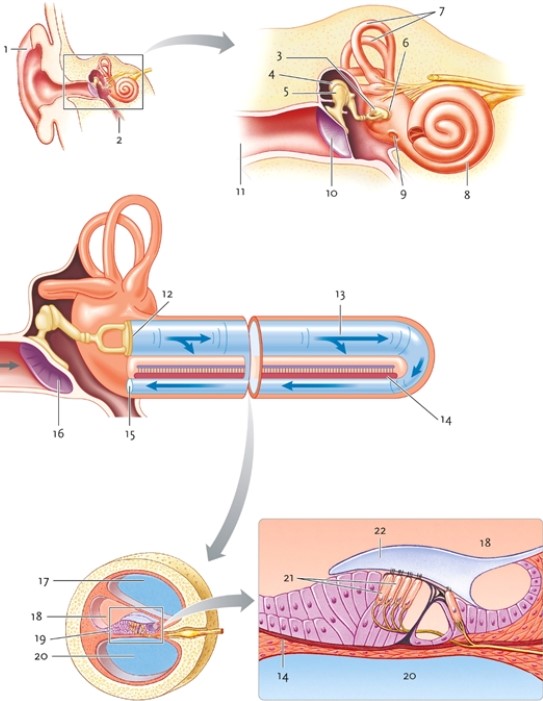 -In Figure 45-3, which number identifies the organ that detects vibrations?
 (Multiple Choice)
5.0/5 (78)
(78) Chronic pain is due in part to the adapting nature of pain receptors that diminishes the frequency of action potentials over time.
(True/False)
4.7/5 (70)
(70) Match each descriptive phrase to a receptor type. Receptor types may be used more than once.
-detect specific molecules, such as glucose
(Multiple Choice)
4.8/5 (76)
(76) Which of the following refers to a graded, subthreshold change in the postsynaptic membrane potential that moves toward threshold?
(Multiple Choice)
4.8/5 (80)
(80) Which of these actions will be caused in the postsynaptic membrane by the binding of a neurotransmitter to ligand-gated K+ channels?
(Multiple Choice)
5.0/5 (72)
(72) Figure 45-3
-In Figure 45-3, which number identifies the structure that initiates action potentials?
-In Figure 45-3, which number identifies the structure that initiates action potentials? (Multiple Choice)
4.9/5 (77)
(77) Identify each lettered part of the vestibular apparatus shown. 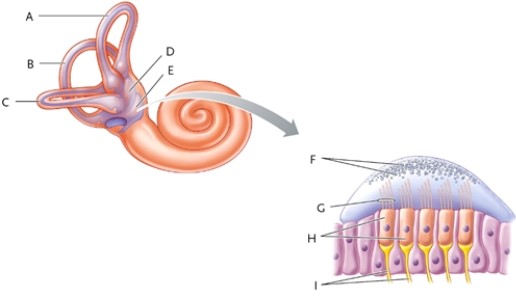 -lateral semicircular canal
 (Short Answer)
4.9/5 (81)
(81) According to the text, which of the following is indicated by current knowledge on memory?
(Multiple Choice)
4.9/5 (78)
(78) Which of these statements explains how the two cerebral hemispheres can function separately?
(Multiple Choice)
4.8/5 (79)
(79) Identify each lettered cell in the human eye shown. 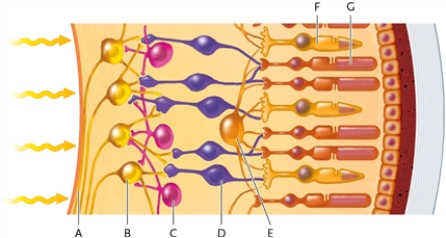 -optic nerve
 (Short Answer)
4.7/5 (64)
(64) How is the active retinal state returned to the inactive state?
(Multiple Choice)
4.9/5 (88)
(88) 
Filters
- Essay(0)
- Multiple Choice(0)
- Short Answer(0)
- True False(0)
- Matching(0)