



 Chat with AI
Exam 6: Photosynthesis

Exam 1: Light and Life109 Questions
Exam 2: The Cell: an Overview155 Questions
Exam 3: Energy and Enzymes66 Questions
Exam 4: Cell Membranes and Signaling81 Questions
Exam 5: Cellular Respiration61 Questions
Exam 6: Photosynthesis95 Questions
Exam 7: Cell Cycles93 Questions
Exam 8: Genetic Recombination88 Questions
Exam 9: The Chromosomal Basis of Mendelian Inheritance86 Questions
Exam 10: Genetic Linkage, Sex-Linkage, and Other Non-Mendelian Inheritance Mechanisms73 Questions
Exam 11: DNA Structure, Replication, and Repair57 Questions
Exam 12: Gene Structure Expression, and Mutation106 Questions
Exam 13: Regulation of Gene Expression91 Questions
Exam 14: Dna Technologies91 Questions
Exam 15: Genomes53 Questions
Exam 16: Evolution: the Development of the Theory66 Questions
Exam 17: Microevolution: Changes Within Populations83 Questions
Exam 18: Speciation and Macroevolution64 Questions
Exam 19: Systematics and Phylogenetics: Revealing the Tree of Life68 Questions
Exam 20: Humans and Evolution54 Questions
Exam 21: Defining Life and Its Origins55 Questions
Exam 22: Viruses, Viroids, and Prions: Infectious Biological Particles38 Questions
Exam 23: Bacteria and Archaea78 Questions
Exam 24: Protists98 Questions
Exam 25: Fungi81 Questions
Exam 26: Plants80 Questions
Exam 27: Animals171 Questions
Exam 28: Conservation of Biodiversity41 Questions
Exam 29: Population Ecology65 Questions
Exam 30: Species Interactions and Community Ecology70 Questions
Exam 31: Ecosystems68 Questions
Exam 32: Animal Behaviour120 Questions
Exam 33: Organization of the Plant Body69 Questions
Exam 34: Transport in Plants80 Questions
Exam 35: Reproduction and Development in Flowering Plants70 Questions
Exam 36: Plant Nutrition97 Questions
Exam 37: Plant Signals and Responses to the Environment93 Questions
Exam 38: Introduction to Animal Organization and Physiology65 Questions
Exam 39: Animal Nutrition98 Questions
Exam 40: Gas Exchange: the Respiratory System56 Questions
Exam 41: Internal Transport: the Circulatory System72 Questions
Exam 42: Regulation of the Internal Environment: Water, Solutes, and Temperature75 Questions
Exam 43: Control of Animal Processes: Endocrine Control80 Questions
Exam 44: Animal Reproduction168 Questions
Exam 45: Control of Animal Processes: Neural Control253 Questions
Exam 46: Muscles, Skeletons, and Body Movements71 Questions
Select questions type


The arrangement of photosystems I and II in the thylakoid membrane is exactly like that drawn in the Z-pathway of most textbooks.
(True/False)
4.8/5  (77)
(77) Match the name of the process to its description.
-The process which produces both ATP and NADPH.
(Multiple Choice)
4.8/5 (78)
(78) Which thylakoid membrane component oxidizes when photosystem I absorbs light energy?
(Multiple Choice)
4.7/5 (82)
(82) If the Calvin cycle could proceed without light reactions, choose the most appropriate process for each of the two reactions.
-occurs only during the daytime
(Multiple Choice)
4.7/5 (75)
(75) What are the reactants and products that link the light reactions to the Calvin cycle?
(Multiple Choice)
4.9/5 (82)
(82) Match the terms and descriptions with the correct labelled part in the fllowing illustration. A labelled part may be used once, more than once, or not at all. 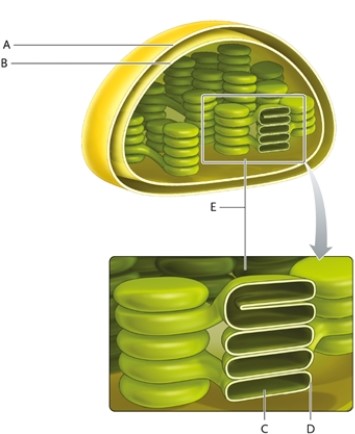 -place to find carotenoids
 (Short Answer)
4.8/5 (87)
(87) Not all plants can use the C4 pathway to avoid photorespiration.
(True/False)
4.9/5 (89)
(89) To which thylakoid membrane does photosystem II first donate the electrons it acquires from water?
(Multiple Choice)
5.0/5 (91)
(91) Photosynthesis is a process by which chemical energy is converted into light energy.
(True/False)
4.9/5 (81)
(81) Which molecule associated with photorespiration is toxic to plant cells?
(Multiple Choice)
4.8/5 (83)
(83) If the Calvin cycle could proceed without light reactions, choose the most appropriate process for each of the two reactions.
-produces ATP
(Multiple Choice)
4.8/5 (81)
(81) If the Calvin cycle could proceed without light reactions, choose the most appropriate process for each of the two reactions.
-requires ATP
(Multiple Choice)
4.9/5 (76)
(76) Match the terms and descriptions with the correct labelled part in the fllowing illustration. A labelled part may be used once, more than once, or not at all.
-site of light reactions
-site of light reactions (Short Answer)
4.9/5 (79)
(79) If the Calvin cycle could proceed without light reactions, choose the most appropriate process for each of the two reactions.
-produces ADP
(Multiple Choice)
4.9/5 (83)
(83) Which of the following absorb the photons of light in photosynthesis?
(Multiple Choice)
4.7/5 (80)
(80) 
Filters
- Essay(0)
- Multiple Choice(0)
- Short Answer(0)
- True False(0)
- Matching(0)