



 Chat with AI
Exam 7: Cell Cycles

Exam 1: Light and Life109 Questions
Exam 2: The Cell: an Overview155 Questions
Exam 3: Energy and Enzymes66 Questions
Exam 4: Cell Membranes and Signaling81 Questions
Exam 5: Cellular Respiration61 Questions
Exam 6: Photosynthesis95 Questions
Exam 7: Cell Cycles93 Questions
Exam 8: Genetic Recombination88 Questions
Exam 9: The Chromosomal Basis of Mendelian Inheritance86 Questions
Exam 10: Genetic Linkage, Sex-Linkage, and Other Non-Mendelian Inheritance Mechanisms73 Questions
Exam 11: DNA Structure, Replication, and Repair57 Questions
Exam 12: Gene Structure Expression, and Mutation106 Questions
Exam 13: Regulation of Gene Expression91 Questions
Exam 14: Dna Technologies91 Questions
Exam 15: Genomes53 Questions
Exam 16: Evolution: the Development of the Theory66 Questions
Exam 17: Microevolution: Changes Within Populations83 Questions
Exam 18: Speciation and Macroevolution64 Questions
Exam 19: Systematics and Phylogenetics: Revealing the Tree of Life68 Questions
Exam 20: Humans and Evolution54 Questions
Exam 21: Defining Life and Its Origins55 Questions
Exam 22: Viruses, Viroids, and Prions: Infectious Biological Particles38 Questions
Exam 23: Bacteria and Archaea78 Questions
Exam 24: Protists98 Questions
Exam 25: Fungi81 Questions
Exam 26: Plants80 Questions
Exam 27: Animals171 Questions
Exam 28: Conservation of Biodiversity41 Questions
Exam 29: Population Ecology65 Questions
Exam 30: Species Interactions and Community Ecology70 Questions
Exam 31: Ecosystems68 Questions
Exam 32: Animal Behaviour120 Questions
Exam 33: Organization of the Plant Body69 Questions
Exam 34: Transport in Plants80 Questions
Exam 35: Reproduction and Development in Flowering Plants70 Questions
Exam 36: Plant Nutrition97 Questions
Exam 37: Plant Signals and Responses to the Environment93 Questions
Exam 38: Introduction to Animal Organization and Physiology65 Questions
Exam 39: Animal Nutrition98 Questions
Exam 40: Gas Exchange: the Respiratory System56 Questions
Exam 41: Internal Transport: the Circulatory System72 Questions
Exam 42: Regulation of the Internal Environment: Water, Solutes, and Temperature75 Questions
Exam 43: Control of Animal Processes: Endocrine Control80 Questions
Exam 44: Animal Reproduction168 Questions
Exam 45: Control of Animal Processes: Neural Control253 Questions
Exam 46: Muscles, Skeletons, and Body Movements71 Questions
Select questions type


Which term represents two identical copies of a chromosome?
(Multiple Choice)
4.9/5  (73)
(73) Certain cell types in humans, such as skeletal muscle cells, have several nuclei per cell. Based on what we know about mitosis, how could this happen?
(Multiple Choice)
4.8/5 (76)
(76) Which of the following best compares prokaryotic cells with eukaryotic cells with respect to their chromosomes?
(Multiple Choice)
4.8/5 (77)
(77) How is cell cytokinesis in plant cells different than cytokinesis in animal cells? Explain both.
(Essay)
4.9/5 (73)
(73) In which phase do human nerve cells remain once they become mature?
(Multiple Choice)
4.9/5 (79)
(79) Suppose that a somatic cell divides to form two genetically identical daughter cells during mitosis. Prior to mitosis occurring, which of the following must occur?
(Multiple Choice)
4.7/5 (89)
(89) Figure 7-1 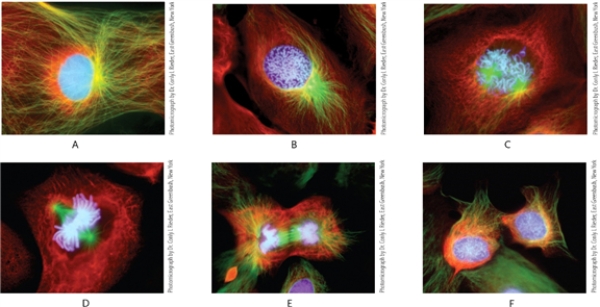 Photomicrograph by Dr. Conly L. Rieder, East Greenbush, New York
-Which stage of mitosis is depicted in photo A in Figure 7-1?
Photomicrograph by Dr. Conly L. Rieder, East Greenbush, New York
-Which stage of mitosis is depicted in photo A in Figure 7-1? (Multiple Choice)
4.9/5 (87)
(87) Identify the stage of mitosis in which each activity occurs.
-RNA synthesis shuts down.
(Multiple Choice)
4.9/5 (79)
(79) In which type of cell do duplicated centrioles move to opposite poles, and during which part of the cell cycle does this occur?
(Multiple Choice)
4.8/5 (94)
(94) Which of the following terms is synonymous with restriction point?
(Multiple Choice)
4.8/5 (72)
(72) Suppose that, at the beginning of interphase in G1, a cell has 36 chromosomes. How many chromosomes would be found in that same cell in G2 of interphase?
(Multiple Choice)
4.9/5 (72)
(72) Which of the following is the reason why blooms may be harmful?
(Multiple Choice)
4.7/5 (75)
(75) Embryonic development begins with a single egg being fertilized by a single sperm, thus forming a zygote; the zygote then undergoes mitosis. How many cells would be present at the conclusion of four mitotic divisions?
(Multiple Choice)
4.9/5 (77)
(77) Which term refers to the mechanism of prokaryotic growth, DNA replication, and cell division that results in two identical daughter cells?
(Multiple Choice)
4.8/5 (79)
(79) Which term refers to duplication of the complete set of chromosomes in an organism's cell, followed by the separation of the duplicated chromosomes into two new cells?
(Multiple Choice)
4.9/5 (77)
(77) Figure 7-1 Photomicrograph by Dr. Conly L. Rieder, East Greenbush, New York
-Which stage of mitosis is shown in photo B in Figure 7-1?
Photomicrograph by Dr. Conly L. Rieder, East Greenbush, New York
-Which stage of mitosis is shown in photo B in Figure 7-1? (Multiple Choice)
4.9/5 (88)
(88) Figure 7-1 Photomicrograph by Dr. Conly L. Rieder, East Greenbush, New York
-Which stage of mitosis is shown in photo D in Figure 7-1?
Photomicrograph by Dr. Conly L. Rieder, East Greenbush, New York
-Which stage of mitosis is shown in photo D in Figure 7-1? (Multiple Choice)
4.9/5 (93)
(93) During which phases of mitosis are chromosomes composed of two sister chromatids?
(Multiple Choice)
4.8/5 (74)
(74) What is the primary function of centrioles in animal cells?
(Multiple Choice)
4.8/5 (60)
(60) 
Filters
- Essay(0)
- Multiple Choice(0)
- Short Answer(0)
- True False(0)
- Matching(0)