



 Chat with AI
Exam 2: The Economic Problem

Exam 1: What Is Economics483 Questions
Exam 2: The Economic Problem443 Questions
Exam 3: Demand and Supply515 Questions
Exam 4: Measuring Gdp and Economic Growth395 Questions
Exam 5: Monitoring Jobs and Inflation409 Questions
Exam 6: Economic Growth352 Questions
Exam 7: Finance, Saving, and Investment227 Questions
Exam 8: Money, the Price Level, and Inflation578 Questions
Exam 9: The Exchange Rate and the Balance of Payments489 Questions
Exam 10: Aggregate Supply and Aggregate Demand426 Questions
Exam 11: Expenditure Multipliers469 Questions
Exam 12: The Business Cycle, Inflation, and Deflation409 Questions
Exam 13: Fiscal Policy263 Questions
Exam 14: Monetary Policy229 Questions
Exam 15: International Trade Policy208 Questions
Select questions type


Increasing opportunity cost occurs along a production possibilities frontier because
(Multiple Choice)
4.7/5  (77)
(77) Suppose that a typical German factory can produce 20 cameras or 1 computer in an hour, and that a typical American factory can produce 10 cameras or one computer in an hour. Germany wishes to purchase computers from the United States in exchange for cameras. What is the maximum number of cameras per computer that Germany would be willing to pay the United States?
(Multiple Choice)
5.0/5 (70)
(70) A society that is producing on its production possibilities frontier is
(Multiple Choice)
5.0/5 (75)
(75) The opportunity cost of producing one ton of wheat for Country Gamma is 4 tons of corn. The opportunity cost of producing one ton of wheat for Country Beta is 8 tons of corn. Which country has the comparative advantage in the production of wheat?
(Multiple Choice)
4.8/5 (76)
(76) Mary takes 4 minutes to make a sandwich and 6 minutes to mix a cocktail. Her sister Ash takes 4 minutes to make a sandwich and 4 minutes to mix a cocktail. Calculate each sister's opportunity cost. Which of the two sisters has an absolute advantage in making sandwiches? In mixing cocktails? Which of the two has a comparative advantage in making sandwiches? In mixing cocktails?
(Essay)
4.9/5 (72)
(72) Households are buyers in factor markets and sellers in goods markets.
(True/False)
4.9/5 (81)
(81) 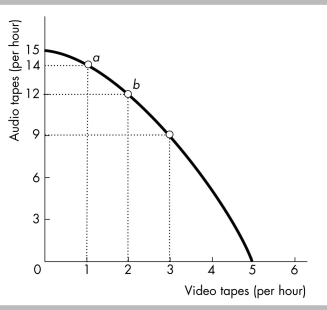 -In the above figure, at point b what is the opportunity cost of producing 2 more audio tapes?
 (Multiple Choice)
4.9/5 (86)
(86) The principle of decreasing marginal benefit means that as the quantity of a good consumed
(Multiple Choice)
4.8/5 (80)
(80) Consider a PPF for tapes and soda. If the opportunity cost of a tape increases as the quantity of tapes produced increases and also the opportunity cost of a soda increases as the quantity of soda produced increases, then the PPF between the two goods will be
(Multiple Choice)
4.9/5 (84)
(84)  -The table above lists six points on the production possibilities frontier for grain and cars. From this information you can conclude that production is inefficient if this economy produces
 (Multiple Choice)
4.9/5 (71)
(71) 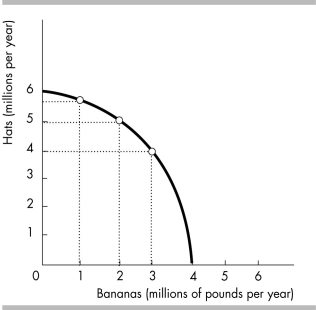 -Jane produces only corn, measured in tons, and cloth, measured in bolts. For her, the opportunity cost of one more ton of corn is
 (Multiple Choice)
4.9/5 (79)
(79) Missouri can produce 10,000 tons of pecans per year or 5,000 tons of pears per year. Washington can produce 12,000 tons of pecans per year or 48,000 tons of pears per year. Which of the following statements is TRUE?
(Multiple Choice)
4.9/5 (81)
(81) Considering a PPF with health care services on the vertical axis and other goods and services on the horizontal axis, the increasing production of health care services in the United States as a result of the aging population represents
(Multiple Choice)
4.8/5 (90)
(90) 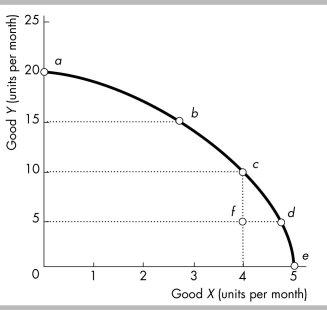 -The above figure illustrates Mary's production possibilities frontier. If Mary wants to move from point d to point c, she must
 (Multiple Choice)
4.7/5 (89)
(89) In order to achieve the maximum gains from trade, people should specialize according to
(Multiple Choice)
4.9/5 (74)
(74) 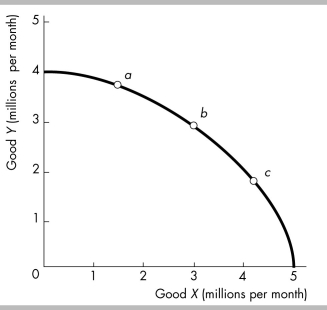 -Refer to the production possibilities frontier in the figure above. More of good X must be given up per unit of good Y gained when moving from point b to point a than when moving from point c to point b. This fact
 (Multiple Choice)
4.8/5 (83)
(83) 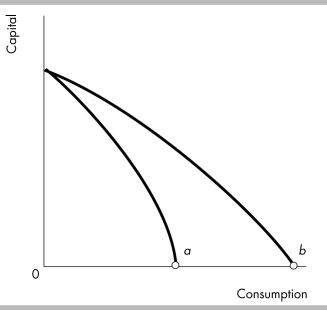 -The opportunity cost of producing a unit of consumption at point b in the figure ________ point a.
 (Multiple Choice)
4.8/5 (73)
(73) 
Filters
- Essay(0)
- Multiple Choice(0)
- Short Answer(0)
- True False(0)
- Matching(0)