



 Chat with AI
Exam 36: The International Monetary System: Order or Disorder?

Exam 1: What Is Economics?227 Questions
Exam 2: The Economy: Myth and Reality150 Questions
Exam 3: The Fundamental Economic Problem: Scarcity and Choice250 Questions
Exam 4: Supply and Demand: An Initial Look308 Questions
Exam 5: Consumer Choice: Individual and Market Demand202 Questions
Exam 6: Demand and Elasticity209 Questions
Exam 7: Production, Inputs, and Cost: Building Blocks for Supply Analysis216 Questions
Exam 8: Output, Price, and Profit: The Importance of Marginal Analysis189 Questions
Exam 9: Securities: Business Finance, and the Economy: The Tail that Wags the Dog?198 Questions
Exam 10: The Firm and the Industry under Perfect Competition208 Questions
Exam 11: Monopoly203 Questions
Exam 12: Between Competition and Monopoly225 Questions
Exam 13: Limiting Market Power: Regulation and Antitrust152 Questions
Exam 14: The Case for Free Markets I: The Price System220 Questions
Exam 15: The Shortcomings of Free Markets212 Questions
Exam 16: The Market's Prime Achievement: Innovation and Growth110 Questions
Exam 17: Externalities, the Environment, and Natural Resources217 Questions
Exam 18: Taxation and Resource Allocation219 Questions
Exam 19: Pricing the Factors of Production228 Questions
Exam 20: Labor and Entrepreneurship: The Human Inputs223 Questions
Exam 21: Poverty, Inequality, and Discrimination167 Questions
Exam 22: An Introduction to Macroeconomics211 Questions
Exam 23: The Goals of Macroeconomic Policy207 Questions
Exam 24: Economic Growth: Theory and Policy223 Questions
Exam 25: Aggregate Demand and the Powerful Consumer214 Questions
Exam 26: Demand-Side Equilibrium: Unemployment or Inflation?210 Questions
Exam 27: Bringing in the Supply Side: Unemployment and Inflation?223 Questions
Exam 28: Managing Aggregate Demand: Fiscal Policy205 Questions
Exam 29: Money and the Banking System219 Questions
Exam 30: Monetary Policy: Conventional and Unconventional205 Questions
Exam 31: The Financial Crisis and the Great Recession61 Questions
Exam 32: The Debate over Monetary and Fiscal Policy214 Questions
Exam 33: Budget Deficits in the Short and Long Run210 Questions
Exam 34: The Trade-Off between Inflation and Unemployment214 Questions
Exam 35: International Trade and Comparative Advantage226 Questions
Exam 36: The International Monetary System: Order or Disorder?213 Questions
Exam 37: Exchange Rates and the Macroeconomy214 Questions
Select questions type


Because central banks intervene in currency markets, the term ____ has been used to describe the system.
(Multiple Choice)
4.8/5  (79)
(79) One major reason why the purchasing power parity theory does not always predict exchange rates accurately is that the theory focuses on trade in
(Multiple Choice)
4.8/5 (81)
(81) If Japanese tourists visit Yellowstone Park, what is the effect in the foreign exchange market?
(Multiple Choice)
4.9/5 (82)
(82) A federal deficit that raises interest rates will, everything else being equal,
(Multiple Choice)
4.7/5 (80)
(80) One method for a deficit country to correct the situation under a fixed exchange rate system is to
(Multiple Choice)
4.8/5 (78)
(78) Figure 19-1
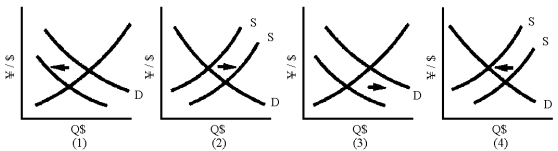 -Of the graphs in Figure 19-1, which one shows that an expansion of the Japanese economy leads to a depreciation of the yen?
 (Multiple Choice)
4.7/5 (78)
(78) If the exchange rate of the Swiss franc is 1.61 francs per dollar, then the Swiss franc is worth about
(Multiple Choice)
4.8/5 (80)
(80) An economic boom in the United States will tend to cause booms in other countries because as U.S.GDP rises, U.S.
(Multiple Choice)
4.8/5 (98)
(98) On May 12, 2011 the U.S.dollar was worth 0.70 euros.How many dollars did it take to buy one euro?
(Multiple Choice)
4.8/5 (86)
(86) The currency value of Agraria is set by government decree.Which of the following happens when the government alters the exchange rate so that its currency can buy more units of foreign currency?
(Multiple Choice)
4.8/5 (73)
(73) In the current international monetary system, what is the role for gold?
(Multiple Choice)
4.8/5 (79)
(79) Speculation in exchange markets is often thought of as conducive to wild fluctuations in exchange rates.In practice it appears that speculators
(Multiple Choice)
5.0/5 (77)
(77) As the U.S.dollar's foreign exchange value falls, we should expect to see
(Multiple Choice)
4.8/5 (87)
(87) According to the purchasing power parity theory, which of the following is most likely to affect exchange rates?
(Multiple Choice)
5.0/5 (91)
(91) 
Filters
- Essay(0)
- Multiple Choice(0)
- Short Answer(0)
- True False(0)
- Matching(0)