



 Chat with AI
Exam 34: The Trade-Off between Inflation and Unemployment

Exam 1: What Is Economics?227 Questions
Exam 2: The Economy: Myth and Reality150 Questions
Exam 3: The Fundamental Economic Problem: Scarcity and Choice250 Questions
Exam 4: Supply and Demand: An Initial Look308 Questions
Exam 5: Consumer Choice: Individual and Market Demand202 Questions
Exam 6: Demand and Elasticity209 Questions
Exam 7: Production, Inputs, and Cost: Building Blocks for Supply Analysis216 Questions
Exam 8: Output, Price, and Profit: The Importance of Marginal Analysis189 Questions
Exam 9: Securities: Business Finance, and the Economy: The Tail that Wags the Dog?198 Questions
Exam 10: The Firm and the Industry under Perfect Competition208 Questions
Exam 11: Monopoly203 Questions
Exam 12: Between Competition and Monopoly225 Questions
Exam 13: Limiting Market Power: Regulation and Antitrust152 Questions
Exam 14: The Case for Free Markets I: The Price System220 Questions
Exam 15: The Shortcomings of Free Markets212 Questions
Exam 16: The Market's Prime Achievement: Innovation and Growth110 Questions
Exam 17: Externalities, the Environment, and Natural Resources217 Questions
Exam 18: Taxation and Resource Allocation219 Questions
Exam 19: Pricing the Factors of Production228 Questions
Exam 20: Labor and Entrepreneurship: The Human Inputs223 Questions
Exam 21: Poverty, Inequality, and Discrimination167 Questions
Exam 22: An Introduction to Macroeconomics211 Questions
Exam 23: The Goals of Macroeconomic Policy207 Questions
Exam 24: Economic Growth: Theory and Policy223 Questions
Exam 25: Aggregate Demand and the Powerful Consumer214 Questions
Exam 26: Demand-Side Equilibrium: Unemployment or Inflation?210 Questions
Exam 27: Bringing in the Supply Side: Unemployment and Inflation?223 Questions
Exam 28: Managing Aggregate Demand: Fiscal Policy205 Questions
Exam 29: Money and the Banking System219 Questions
Exam 30: Monetary Policy: Conventional and Unconventional205 Questions
Exam 31: The Financial Crisis and the Great Recession61 Questions
Exam 32: The Debate over Monetary and Fiscal Policy214 Questions
Exam 33: Budget Deficits in the Short and Long Run210 Questions
Exam 34: The Trade-Off between Inflation and Unemployment214 Questions
Exam 35: International Trade and Comparative Advantage226 Questions
Exam 36: The International Monetary System: Order or Disorder?213 Questions
Exam 37: Exchange Rates and the Macroeconomy214 Questions
Select questions type


To make rational forecasts, your predictions do not have to be correct all of the time.
(True/False)
4.8/5  (83)
(83) Fighting inflation by slowing the growth of aggregate demand is
(Multiple Choice)
4.8/5 (81)
(81) Figure 17-5
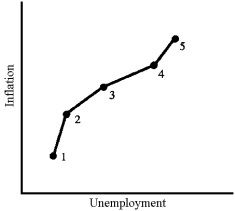 -The data illustrated in Figure 17-5 would be most representative of which decade?
 (Multiple Choice)
4.8/5 (77)
(77) Figure 17-8
 -In Figure 17-8, policy makers can choose any of the following points as sustainable inflation-unemployment combinations:
 (Multiple Choice)
4.9/5 (71)
(71) Fiscal and monetary policy can reduce unemployment with no negative side effects.
(True/False)
4.8/5 (74)
(74) Figure 17-4
 -Figure 17-4 shows four movements of the inflation rate and the unemployment rate.Which panel shows the movement associated with a "supply shock" like those of the 1970s?
 (Multiple Choice)
4.9/5 (86)
(86) Figure 17-8
-In Figure 17-8, which of the following movements illustrates the response of the economy to a stimulation of aggregate demand when workers systematically underpredict inflation?
-In Figure 17-8, which of the following movements illustrates the response of the economy to a stimulation of aggregate demand when workers systematically underpredict inflation? (Multiple Choice)
4.8/5 (88)
(88) If expectations are "rational," can the Fed control unemployment?
(Multiple Choice)
4.8/5 (80)
(80) Which of the following could trigger demand-side inflation?
(Multiple Choice)
4.8/5 (90)
(90) When the Phillips curve was first formulated (late 1960s), many economists thought that it showed a
(Multiple Choice)
4.9/5 (83)
(83) According to the theory of rational expectations, errors in predicting inflation will
(Multiple Choice)
4.9/5 (69)
(69) In 2010 the U.S.economy's inflation rate was higher than its unemployment rate.
(True/False)
4.7/5 (84)
(84) Who gains if inflation turns out to be higher than expected: the lender or borrower? What happens if inflation turns out to be lower than expected?
(Essay)
5.0/5 (91)
(91) If the economy in 34-6 (b) is experiencing an inflationary gap (point g), the economy's self-correcting process will move unemployment to ____ and inflation to ____.
(Multiple Choice)
4.8/5 (82)
(82) Most economists think that the economy's self-correcting mechanism is
(Multiple Choice)
4.7/5 (72)
(72) When deciding on an appropriate course of action to counter a recessionary gap, which of the following do policy makers consider?
(Multiple Choice)
4.7/5 (79)
(79) One way in which the Phillips curve is misinterpreted is to think of it as
(Multiple Choice)
4.8/5 (79)
(79) The rational expectations hypothesis is impeccably logical, but inconsistent with the facts.
(True/False)
4.8/5 (72)
(72) Most economists believe that the theory of rational expectations is
(Multiple Choice)
4.7/5 (86)
(86) 
Filters
- Essay(0)
- Multiple Choice(0)
- Short Answer(0)
- True False(0)
- Matching(0)