



 Chat with AI
Exam 15: Forensic Serology

Exam 1: Introduction109 Questions
Exam 2: The Crime Scene136 Questions
Exam 3: Physical Evidence80 Questions
Exam 4: Crime Scene Reconstruction: Blood Stain Pattern Analysis96 Questions
Exam 5: Death Investigation118 Questions
Exam 6: Fingerprints115 Questions
Exam 7: Forensic Biometrics92 Questions
Exam 8: The Microscope101 Questions
Exam 9: Firearms, Tool Marks, and Other Impressions95 Questions
Exam 10: Matter, Light, and Glass Examination110 Questions
Exam 11: Hairs and Fibers120 Questions
Exam 12: Drugs141 Questions
Exam 13: Forensic Toxicology104 Questions
Exam 14: Metals, Paint, and Soil91 Questions
Exam 15: Forensic Serology91 Questions
Exam 16: DNA: The Indispensable Forensic Science Tool105 Questions
Exam 17: Forensic Aspects of Fire and Explosion Investigation142 Questions
Exam 18: Document Examination67 Questions
Exam 19: Computer Forensics109 Questions
Exam 20: Mobile Device Forensics77 Questions
Select questions type


Polyclonal antibodies are more useful than monoclonal antibodies for the forensic scientist.
(True/False)
4.7/5  (72)
(72) One of the most frequent uses of the EMIT technique in forensic laboratories has been for screening the urine of suspected marijuana smokers.
(True/False)
4.9/5 (74)
(74) Match the word in Column 1 to its definition in Column 2. Each answer can only be used once.
A)A protein that destroys or inactivates a specific antigen
B)An abnormally low sperm count
C)The liquid that separates from the blood when a clot is formed
D)The physical manifestation of a genetic trait such as shape, color, and blood type
E)A structure in the cell nucleus composed of DNA, along which the genes are located
F)A substance that stimulates the body to produce antibodies against it
G)The basic unit of heredity, consisting of a DNA segment located on a chromosome
H)The clumping together of red blood cells by the action of an antibody
I)The male sex chromosome
J)An enzyme found in high concentration in semen
K)The female sex chromosome
L)The fluid portion of unclotted blood
M)Any of several alternative forms of a gene located at the same point on a particular pair of chromosomes
N)The absence of sperm cells in semen
O)The particular combination of genes present in the cells of an individual
-Agglutination
(Essay)
4.9/5 (68)
(68) Match the word in Column 1 to its definition in Column 2. Each answer can only be used once.
A)A protein that destroys or inactivates a specific antigen
B)An abnormally low sperm count
C)The liquid that separates from the blood when a clot is formed
D)The physical manifestation of a genetic trait such as shape, color, and blood type
E)A structure in the cell nucleus composed of DNA, along which the genes are located
F)A substance that stimulates the body to produce antibodies against it
G)The basic unit of heredity, consisting of a DNA segment located on a chromosome
H)The clumping together of red blood cells by the action of an antibody
I)The male sex chromosome
J)An enzyme found in high concentration in semen
K)The female sex chromosome
L)The fluid portion of unclotted blood
M)Any of several alternative forms of a gene located at the same point on a particular pair of chromosomes
N)The absence of sperm cells in semen
O)The particular combination of genes present in the cells of an individual
-X chromosome
(Essay)
4.9/5 (80)
(80) Paternity testing is done involving a woman with type AB blood who has accused a man with type B blood of fathering her child who has tested AB. What can be determined in this case?
(Multiple Choice)
4.8/5 (69)
(69) ________ transport oxygen from the lungs to the body tissues and carry carbon dioxide back to the lungs.
(Multiple Choice)
4.8/5 (85)
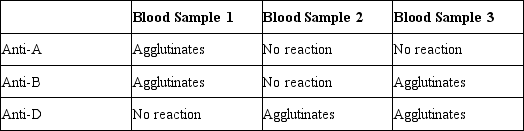
(85) Three blood samples are exposed to the antiserums shown below with the given reactions. Based on these results, determine the ABO/Rh blood type of each sample.
(Essay)
4.8/5 (81)
(81) If blood is found to have both A and B antigens, it is typed as:
(Multiple Choice)
4.8/5 (68)
(68) The presence of prostate specific antigen (PSA)or p30 is useful for identifying a sample stain containing semen.
(True/False)
5.0/5 (84)
(84) Match the word in Column 1 to its definition in Column 2. Each answer can only be used once.
A)A protein that destroys or inactivates a specific antigen
B)An abnormally low sperm count
C)The liquid that separates from the blood when a clot is formed
D)The physical manifestation of a genetic trait such as shape, color, and blood type
E)A structure in the cell nucleus composed of DNA, along which the genes are located
F)A substance that stimulates the body to produce antibodies against it
G)The basic unit of heredity, consisting of a DNA segment located on a chromosome
H)The clumping together of red blood cells by the action of an antibody
I)The male sex chromosome
J)An enzyme found in high concentration in semen
K)The female sex chromosome
L)The fluid portion of unclotted blood
M)Any of several alternative forms of a gene located at the same point on a particular pair of chromosomes
N)The absence of sperm cells in semen
O)The particular combination of genes present in the cells of an individual
-Serum
(Essay)
4.9/5 (94)
(94) The sensitivity of the Takayama and Teichmann crystal tests for the identification of bloodstains is ________ the sensitivity of the Kastle-Meyer color test for bloodstain identification.
(Multiple Choice)
4.8/5 (83)
(83) Match the word in Column 1 to its definition in Column 2. Each answer can only be used once.
A)A protein that destroys or inactivates a specific antigen
B)An abnormally low sperm count
C)The liquid that separates from the blood when a clot is formed
D)The physical manifestation of a genetic trait such as shape, color, and blood type
E)A structure in the cell nucleus composed of DNA, along which the genes are located
F)A substance that stimulates the body to produce antibodies against it
G)The basic unit of heredity, consisting of a DNA segment located on a chromosome
H)The clumping together of red blood cells by the action of an antibody
I)The male sex chromosome
J)An enzyme found in high concentration in semen
K)The female sex chromosome
L)The fluid portion of unclotted blood
M)Any of several alternative forms of a gene located at the same point on a particular pair of chromosomes
N)The absence of sperm cells in semen
O)The particular combination of genes present in the cells of an individual
-Oligospermia
(Essay)
4.8/5 (64)
(64) The clumping together of red blood cells by the action of an antibody is known as:
(Multiple Choice)
4.8/5 (96)
(96) Match the word in Column 1 to its definition in Column 2. Each answer can only be used once.
A)A protein that destroys or inactivates a specific antigen
B)An abnormally low sperm count
C)The liquid that separates from the blood when a clot is formed
D)The physical manifestation of a genetic trait such as shape, color, and blood type
E)A structure in the cell nucleus composed of DNA, along which the genes are located
F)A substance that stimulates the body to produce antibodies against it
G)The basic unit of heredity, consisting of a DNA segment located on a chromosome
H)The clumping together of red blood cells by the action of an antibody
I)The male sex chromosome
J)An enzyme found in high concentration in semen
K)The female sex chromosome
L)The fluid portion of unclotted blood
M)Any of several alternative forms of a gene located at the same point on a particular pair of chromosomes
N)The absence of sperm cells in semen
O)The particular combination of genes present in the cells of an individual
-Y chromosome
(Essay)
4.8/5 (80)
(80) The presence or absence of how many antigens determines an individual's blood type in the A-B-O system?
(Multiple Choice)
4.9/5 (86)
(86) 
Filters
- Essay(0)
- Multiple Choice(0)
- Short Answer(0)
- True False(0)
- Matching(0)