



 Chat with AI
Exam 21: Poverty, Inequality, and Discrimination

Exam 1: What Is Economics?227 Questions
Exam 2: The Economy: Myth and Reality150 Questions
Exam 3: The Fundamental Economic Problem: Scarcity and Choice250 Questions
Exam 4: Supply and Demand: An Initial Look308 Questions
Exam 5: Consumer Choice: Individual and Market Demand202 Questions
Exam 6: Demand and Elasticity209 Questions
Exam 7: Production, Inputs, and Cost: Building Blocks for Supply Analysis216 Questions
Exam 8: Output, Price, and Profit: The Importance of Marginal Analysis189 Questions
Exam 9: Securities: Business Finance, and the Economy: The Tail that Wags the Dog?198 Questions
Exam 10: The Firm and the Industry under Perfect Competition208 Questions
Exam 11: Monopoly203 Questions
Exam 12: Between Competition and Monopoly225 Questions
Exam 13: Limiting Market Power: Regulation and Antitrust152 Questions
Exam 14: The Case for Free Markets I: The Price System220 Questions
Exam 15: The Shortcomings of Free Markets212 Questions
Exam 16: The Market's Prime Achievement: Innovation and Growth110 Questions
Exam 17: Externalities, the Environment, and Natural Resources217 Questions
Exam 18: Taxation and Resource Allocation219 Questions
Exam 19: Pricing the Factors of Production228 Questions
Exam 20: Labor and Entrepreneurship: The Human Inputs223 Questions
Exam 21: Poverty, Inequality, and Discrimination167 Questions
Exam 22: An Introduction to Macroeconomics211 Questions
Exam 23: The Goals of Macroeconomic Policy207 Questions
Exam 24: Economic Growth: Theory and Policy223 Questions
Exam 25: Aggregate Demand and the Powerful Consumer214 Questions
Exam 26: Demand-Side Equilibrium: Unemployment or Inflation?210 Questions
Exam 27: Bringing in the Supply Side: Unemployment and Inflation?223 Questions
Exam 28: Managing Aggregate Demand: Fiscal Policy205 Questions
Exam 29: Money and the Banking System219 Questions
Exam 30: Monetary Policy: Conventional and Unconventional205 Questions
Exam 31: The Financial Crisis and the Great Recession61 Questions
Exam 32: The Debate over Monetary and Fiscal Policy214 Questions
Exam 33: Budget Deficits in the Short and Long Run210 Questions
Exam 34: The Trade-Off between Inflation and Unemployment214 Questions
Exam 35: International Trade and Comparative Advantage226 Questions
Exam 36: The International Monetary System: Order or Disorder?213 Questions
Exam 37: Exchange Rates and the Macroeconomy214 Questions
Select questions type


The "War on Poverty" was declared by President Ronald Reagan in 1982.
(True/False)
4.9/5  (83)
(83) With a negative income tax, the larger the difference between the break-even income level and the guaranteed level,
(Multiple Choice)
4.8/5 (79)
(79) Taken as a whole, antipoverty programs may actually put a poor family in a position in which the family becomes worse off if its earnings rise.
(True/False)
4.7/5 (77)
(77) Figure 21-1
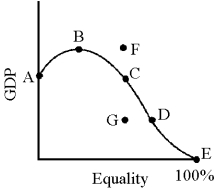 -In Figure 21-1, a reform in the distribution system that achieves the same distribution with less damage to work incentives is represented by a move from which points?
 (Multiple Choice)
4.7/5 (79)
(79) The economic theory of discrimination suggests that the practice of apartheid in South Africa should have
(Multiple Choice)
4.9/5 (81)
(81) Programs that reduce the incentive to work make income redistribution inefficient.
(True/False)
4.9/5 (80)
(80) The basic problem with the government setting an absolute poverty line is that it is
(Multiple Choice)
4.7/5 (81)
(81) The lowest-income fifth of the population ordinarily earns about 20 percent of the income in the United States.
(True/False)
4.9/5 (72)
(72) Which of the following situations is the most common? Men and women
(Multiple Choice)
4.9/5 (81)
(81) Define the following terms and explain their importance to the study of economics.
a.poverty line
b.economic discrimination
c.optimal inequality
d.negative income tax
(Essay)
4.8/5 (84)
(84) Which of the following is a source of inequality in incomes?
(Multiple Choice)
4.9/5 (78)
(78) Which of the following observations concerning the absolute definition of poverty is true?
(Multiple Choice)
4.8/5 (85)
(85) Competition reduces some but not all discrimination.Where can one expect competition to reduce discrimination, and where is discrimination likely to go on even if there is competition?
(Essay)
4.8/5 (85)
(85) Large income differences will be eradicated if the market mechanism is working well.
(True/False)
4.8/5 (97)
(97) Table 21-1
Share of Lowest fifth 6 Second fifth 9 Third fifth 17 Fourth fffth 19 Highest ffth 49
-Consider the economy described by the income distribution in Table 21-1.From this table, we can conclude that the poorest 60 percent of the population earns
(Multiple Choice)
4.9/5 (71)
(71) A minority candidate may not have the same chances as a white candidate for a job simply based on an employer's misconceptions about minorities.
(True/False)
4.9/5 (78)
(78) In their 1994 book, The Bell Curve, Murray and Herrnstein presented evidence that IQ is an important determinant of economic success.
(True/False)
4.8/5 (59)
(59) Discuss the controversy surrounding affirmative action.How does this controversy illustrate the trade-off between equality and efficiency?
(Essay)
4.7/5 (87)
(87) The fundamental criticism from the efficiency perspective of AFDC and other antipoverty programs is that
(Multiple Choice)
4.7/5 (90)
(90) 
Filters
- Essay(0)
- Multiple Choice(0)
- Short Answer(0)
- True False(0)
- Matching(0)