



 Chat with AI
Exam 18: Taxation and Resource Allocation

Exam 1: What Is Economics?227 Questions
Exam 2: The Economy: Myth and Reality150 Questions
Exam 3: The Fundamental Economic Problem: Scarcity and Choice250 Questions
Exam 4: Supply and Demand: An Initial Look308 Questions
Exam 5: Consumer Choice: Individual and Market Demand202 Questions
Exam 6: Demand and Elasticity209 Questions
Exam 7: Production, Inputs, and Cost: Building Blocks for Supply Analysis216 Questions
Exam 8: Output, Price, and Profit: The Importance of Marginal Analysis189 Questions
Exam 9: Securities: Business Finance, and the Economy: The Tail that Wags the Dog?198 Questions
Exam 10: The Firm and the Industry under Perfect Competition208 Questions
Exam 11: Monopoly203 Questions
Exam 12: Between Competition and Monopoly225 Questions
Exam 13: Limiting Market Power: Regulation and Antitrust152 Questions
Exam 14: The Case for Free Markets I: The Price System220 Questions
Exam 15: The Shortcomings of Free Markets212 Questions
Exam 16: The Market's Prime Achievement: Innovation and Growth110 Questions
Exam 17: Externalities, the Environment, and Natural Resources217 Questions
Exam 18: Taxation and Resource Allocation219 Questions
Exam 19: Pricing the Factors of Production228 Questions
Exam 20: Labor and Entrepreneurship: The Human Inputs223 Questions
Exam 21: Poverty, Inequality, and Discrimination167 Questions
Exam 22: An Introduction to Macroeconomics211 Questions
Exam 23: The Goals of Macroeconomic Policy207 Questions
Exam 24: Economic Growth: Theory and Policy223 Questions
Exam 25: Aggregate Demand and the Powerful Consumer214 Questions
Exam 26: Demand-Side Equilibrium: Unemployment or Inflation?210 Questions
Exam 27: Bringing in the Supply Side: Unemployment and Inflation?223 Questions
Exam 28: Managing Aggregate Demand: Fiscal Policy205 Questions
Exam 29: Money and the Banking System219 Questions
Exam 30: Monetary Policy: Conventional and Unconventional205 Questions
Exam 31: The Financial Crisis and the Great Recession61 Questions
Exam 32: The Debate over Monetary and Fiscal Policy214 Questions
Exam 33: Budget Deficits in the Short and Long Run210 Questions
Exam 34: The Trade-Off between Inflation and Unemployment214 Questions
Exam 35: International Trade and Comparative Advantage226 Questions
Exam 36: The International Monetary System: Order or Disorder?213 Questions
Exam 37: Exchange Rates and the Macroeconomy214 Questions
Select questions type


The federal government of the United States relies heavily on value-added taxes.
(True/False)
4.7/5  (76)
(76) Figure 18-1
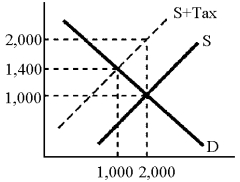 -According to the graph in Figure 18-1, the increase in the amount that consumers pay as a result of the tax is
 (Multiple Choice)
4.7/5 (72)
(72) Briefly and concisely define the following terms:
a.fiscal federalism
b.horizontal equity
c.vertical equity
d.benefits principle of taxation
(Essay)
4.7/5 (78)
(78) If two families are identical with respect to size, income, general expenses, etc., and are taxed equally, we say that there is
(Multiple Choice)
4.8/5 (81)
(81) The money for Social Security payments to current retirees comes from
(Multiple Choice)
4.9/5 (75)
(75) If demand is more elastic, the portion of an excise tax borne by a buyer will
(Multiple Choice)
4.9/5 (80)
(80) The concept that describes the situation where the economy has used every available opportunity to make someone better off without making someone else worse off is
(Multiple Choice)
4.7/5 (82)
(82) When a tax is imposed on an item, it can generally be said that the incidence of the tax is
(Multiple Choice)
4.8/5 (87)
(87) Define the following terms and explain their importance to the study of economics:
a.regressive tax
b.proportional tax
c.progressive tax
d.direct tax
e.indirect tax
(Essay)
4.8/5 (85)
(85) If Linda' annual income is $160,000 and she pays $35,000 in taxes and Paul's annual income is $100,000 and he pays $25,000 in taxes, the tax system is
(Multiple Choice)
4.9/5 (61)
(61) In the spring of 1993, President Clinton proposed an energy tax.At one point in the congressional review of the proposal there was discussion of various exemptions for farmers, truckers, etc.One plan was to dye fuel different colors to better track the appropriate tax on the user of the fuel.Economists would label these exemptions
(Multiple Choice)
4.9/5 (89)
(89) State and local governments receive money from sales taxes, property taxes, and the federal government.
(True/False)
4.8/5 (70)
(70) Figure 18-1
-According to the graph in Figure 18-1, tax collections will be which of the following?
-According to the graph in Figure 18-1, tax collections will be which of the following? (Multiple Choice)
4.9/5 (76)
(76) 
Filters
- Essay(0)
- Multiple Choice(0)
- Short Answer(0)
- True False(0)
- Matching(0)