



 Chat with AI
Exam 1: What Is Economics?

Exam 1: What Is Economics?227 Questions
Exam 2: The Economy: Myth and Reality150 Questions
Exam 3: The Fundamental Economic Problem: Scarcity and Choice250 Questions
Exam 4: Supply and Demand: An Initial Look308 Questions
Exam 5: Consumer Choice: Individual and Market Demand202 Questions
Exam 6: Demand and Elasticity209 Questions
Exam 7: Production, Inputs, and Cost: Building Blocks for Supply Analysis216 Questions
Exam 8: Output, Price, and Profit: The Importance of Marginal Analysis189 Questions
Exam 9: Securities: Business Finance, and the Economy: The Tail that Wags the Dog?198 Questions
Exam 10: The Firm and the Industry under Perfect Competition208 Questions
Exam 11: Monopoly203 Questions
Exam 12: Between Competition and Monopoly225 Questions
Exam 13: Limiting Market Power: Regulation and Antitrust152 Questions
Exam 14: The Case for Free Markets I: The Price System220 Questions
Exam 15: The Shortcomings of Free Markets212 Questions
Exam 16: The Market's Prime Achievement: Innovation and Growth110 Questions
Exam 17: Externalities, the Environment, and Natural Resources217 Questions
Exam 18: Taxation and Resource Allocation219 Questions
Exam 19: Pricing the Factors of Production228 Questions
Exam 20: Labor and Entrepreneurship: The Human Inputs223 Questions
Exam 21: Poverty, Inequality, and Discrimination167 Questions
Exam 22: An Introduction to Macroeconomics211 Questions
Exam 23: The Goals of Macroeconomic Policy207 Questions
Exam 24: Economic Growth: Theory and Policy223 Questions
Exam 25: Aggregate Demand and the Powerful Consumer214 Questions
Exam 26: Demand-Side Equilibrium: Unemployment or Inflation?210 Questions
Exam 27: Bringing in the Supply Side: Unemployment and Inflation?223 Questions
Exam 28: Managing Aggregate Demand: Fiscal Policy205 Questions
Exam 29: Money and the Banking System219 Questions
Exam 30: Monetary Policy: Conventional and Unconventional205 Questions
Exam 31: The Financial Crisis and the Great Recession61 Questions
Exam 32: The Debate over Monetary and Fiscal Policy214 Questions
Exam 33: Budget Deficits in the Short and Long Run210 Questions
Exam 34: The Trade-Off between Inflation and Unemployment214 Questions
Exam 35: International Trade and Comparative Advantage226 Questions
Exam 36: The International Monetary System: Order or Disorder?213 Questions
Exam 37: Exchange Rates and the Macroeconomy214 Questions
Select questions type


Which person has the highest opportunity cost of obtaining a college degree (assuming that attending college requires giving up his or her current position)?
(Multiple Choice)
4.9/5  (82)
(82) All two-dimensional graphs must have an origin, a horizontal axis, and a vertical axis.
(True/False)
4.9/5 (80)
(80) Carefully define the following terms, and explain their importance in economics.
a.opportunity cost
b.abstraction
c.theory
d.model
e.marginal analysis
(Essay)
4.8/5 (74)
(74) The optimal degree of abstraction depends on the objective of the analysis.
(True/False)
4.9/5 (92)
(92) An economist might be hired to answer which of the following questions?
(Multiple Choice)
4.8/5 (80)
(80) Why might well-educated economists disagree on appropriate public policy in some situations?
(Essay)
5.0/5 (83)
(83) Which of the following mathematical expressions represents the equation of a straight line with a slope of zero at all points on a graph with Y on the vertical axis and X on the horizontal axis?
(Multiple Choice)
4.7/5 (71)
(71) In both the 1970s and the 1990s, extreme economic events caused unemployment to move in the same direction as inflation.
(True/False)
4.9/5 (85)
(85) How does the United States differ from the European Union in how it balances the competing claims of equality and efficiency?
(Essay)
4.9/5 (85)
(85) The word "theory" means the same to the scientist as it does to the man on the street.
(True/False)
4.8/5 (74)
(74) Which of the following is an example of an undesirable side effect of the operation of the market mechanism?
(Multiple Choice)
4.8/5 (85)
(85) A theory is a deliberate simplification or abstraction of factual relationships.
(True/False)
4.9/5 (76)
(76) A small increase in productivity growth can have a huge impact on a country's standard of living.
(True/False)
4.7/5 (68)
(68) A contour map illustrates a cause and effect relationship among three variables.
(True/False)
4.9/5 (82)
(82) 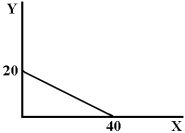 -The slope of the line in Figure 1-1 is

Filters
- Essay(0)
- Multiple Choice(0)
- Short Answer(0)
- True False(0)
- Matching(0)