



 Chat with AI
Exam 3: The Marketing Environment

Exam 1: An Overview of Strategic Marketing181 Questions
Exam 2: Planning, Implementing, and Evaluating Marketing Strategies152 Questions
Exam 3: The Marketing Environment209 Questions
Exam 4: Social Responsibility and Ethics in Marketing182 Questions
Exam 5: Marketing Research and Information Systems203 Questions
Exam 6: Target Markets, Segmentation and Evaluation213 Questions
Exam 7: Consumer Buying Behavior232 Questions
Exam 8: Business Markets and Buying Behavior189 Questions
Exam 9: Reaching Global Markets184 Questions
Exam 10: Digital Marketing and Social Networking175 Questions
Exam 11: Product Concepts, Branding, and Packaging376 Questions
Exam 12: Developing and Managing Products184 Questions
Exam 13: Services Marketing206 Questions
Exam 14: Marketing Channels and Supply Chain Management277 Questions
Exam 15: Retailing, Direct Marketing and Wholesaling257 Questions
Exam 16: Integrated Marketing Communications235 Questions
Exam 17: Advertising and Public Relations216 Questions
Exam 18: Personal Selling and Sales Promotion217 Questions
Exam 19: Pricing Concepts212 Questions
Exam 20: Setting Prices192 Questions
Select questions type


Which of the following acts was enacted to prevent businesses from restraining trade and monopolizing markets?
(Multiple Choice)
4.8/5  (77)
(77) Under the terms of the trade agreement CAFTA-DR, the state-run telephone system in Costa Rica was opened up for competition. Now four main companies dominate the telecommunications industry for mobile phones and Internet. The telecommunications industry in Costa Rica went from being a(n) ___________ to a(n) _______________.
(Multiple Choice)
4.9/5 (78)
(78) Technological developments have a direct impact on creating and maintaining a marketing mix.
(True/False)
5.0/5 (88)
(88) Marketers who view political forces as being beyond their control are taking a(n) ____ response toward these forces.
(Multiple Choice)
4.8/5 (69)
(69) Based on data from the Federal Reserve Bank of St. Louis, the Civilian Labor Force Participation Rates for men and women in the United States were as follows from 1994 through 2014: 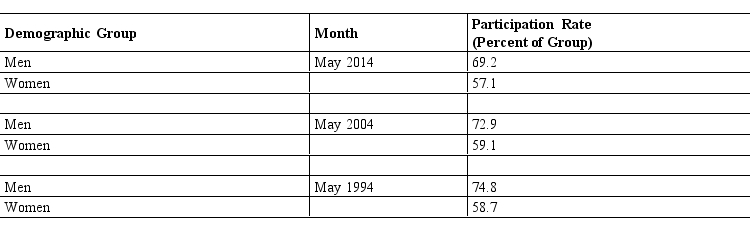
(Multiple Choice)
4.8/5 (87)
(87) In 2009 the Coca-Cola Company introduced the "Freestyler," a new freestanding soda dispenser where consumers can chose from over 120 different types of soda and customize their drinks. Freestylers would take the place of typical dispensers where there are only a few different types of soda brands available. In order to develop the new dispenser, Coca-Cola collected information on the soda-drinking habits of individuals in several different age groups, as well as information about new technologies for dispensing liquids from vending machines and the sales of its "fountain" syrup for national restaurant chains to use in their soda machines. Coca-Cola's collection of this information is an example of _____ while the assessment of its impact on the potential for the new "Freestyler" is an example of _________
(Multiple Choice)
4.8/5 (93)
(93) The Food and Drug Administration influences marketing activities the most.
(True/False)
4.7/5 (91)
(91) The Federal Trade Commission would be the most likely regulatory agency to curb false advertising.
(True/False)
4.8/5 (77)
(77) Which of the following are the most frequently sentenced organizational crimes?
(Multiple Choice)
4.8/5 (79)
(79) During which stage of the business cycle is unemployment low and total income relatively high?
(Multiple Choice)
4.9/5 (75)
(75) ____ competitors are those that compete in the same product class, but their products have different features, benefits, and prices.
(Multiple Choice)
4.9/5 (66)
(66) Changes Salon is part of the hair and personal care service industry. In what type of competitive environment is Changes Salon most likely operating?
(Multiple Choice)
4.7/5 (80)
(80) Which of the following provides protection for and regulates brand names, brand marks, trade names, and trademarks?
(Multiple Choice)
4.8/5 (100)
(100) Scenario 3.2 Use the following to answer the questions.
Clayton Homes, a mobile home manufacturer since 1934, introduced its new i-House in 2007. The i-House is one of the first of its kind, designed as an updated, modern version of the modular home, offered as a base home plus add-ons known as "pods." The base home is a one-bedroom, one-bath, 734-square-foot version at a price of around $80,000. There is also a 1,000-square-foot version for around $100,000. All versions may add on the additional one-room pods, which are shipped to your location and constructed on site. The homes offer galvanized metal roofing, corrugated steel siding, VOC-free paints, and a "butterfly" roof that collects rainwater. The i-House uses 30% less energy than a similar square-foot home and offers "green" characteristics of solar panels, tankless water heaters, and low-flow faucets. In addition, it comes with bamboo flooring, a renewable resource. The modular, prefabricated design offers endless options for creating the customer's home, and its engineered building system cuts down on construction waste. Due to the "green effects" of the i-House, the state governments have given it a tax abatement for any sales taxes.
Refer to Scenario 3.2. The income a consumer would use to purchase an i-House is considered ____ income.
(Multiple Choice)
5.0/5 (73)
(73) Product competitors market products with similar features and benefits to the same customers at similar prices.
(True/False)
4.9/5 (80)
(80) A recession is characterized by extremely high unemployment, very low wages, minimal total disposable income, and lack of consumer confidence in the economy.
(True/False)
5.0/5 (73)
(73) Of all the federal regulatory units, the ____ most heavily influences marketing activities.
(Multiple Choice)
4.9/5 (75)
(75) 
Filters
- Essay(0)
- Multiple Choice(0)
- Short Answer(0)
- True False(0)
- Matching(0)