



 Chat with AI
Exam 5: Integration

Exam 1: Preparation for Calculus125 Questions
Exam 2: Limits and Their Properties85 Questions
Exam 3: Differentiation193 Questions
Exam 4: Applications of Differentiation154 Questions
Exam 5: Integration184 Questions
Exam 6: Differential Equations93 Questions
Exam 7: Applications of Integration119 Questions
Exam 8: Integration Techniques and Improper Integrals130 Questions
Exam 9: Infinite Series181 Questions
Exam 10: Conics, Parametric Equations, and Polar Coordinates114 Questions
Exam 11: Vectors and the Geometry of Space130 Questions
Exam 12: Vector-Valued Functions85 Questions
Exam 13: Functions of Several Variables173 Questions
Exam 14: Multiple Integration143 Questions
Exam 15: Vector Anal142 Questions
Select questions type


The height above the ground of an object thrown upward from a point  feet above the ground with an initial velocity of
 feet per second is given by the function
 . A balloon, rising vertically with a velocity of 32 feet per second, releases a sandbag at the instant it is 28 feet above the ground. How many seconds after its release will the bag strike the ground? Round your answer to three decimal places.
feet above the ground with an initial velocity of feet per second is given by the function . A balloon, rising vertically with a velocity of 32 feet per second, releases a sandbag at the instant it is 28 feet above the ground. How many seconds after its release will the bag strike the ground? Round your answer to three decimal places. (Multiple Choice)
4.7/5  (89)
(89) Suppose a population of bacteria is changing at a rate of  where t is the time in days. The initial population (when
 ) is 1,000. Identify an equation that gives the population at any time t and use it to find the population when
 days. Round your answer to the nearest integer.
where t is the time in days. The initial population (when ) is 1,000. Identify an equation that gives the population at any time t and use it to find the population when days. Round your answer to the nearest integer. (Multiple Choice)
4.8/5 (70)
(70) Use the differential equation 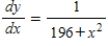 and the initial condition
 to find y.
and the initial condition to find y. (Multiple Choice)
5.0/5 (72)
(72)  .
 .


 using L'Hopital's Rule if necessary.

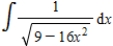
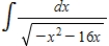
Find the indefinite integral of the following function and check the result by differentiation. 
(Multiple Choice)
4.8/5 (82)
(82) 
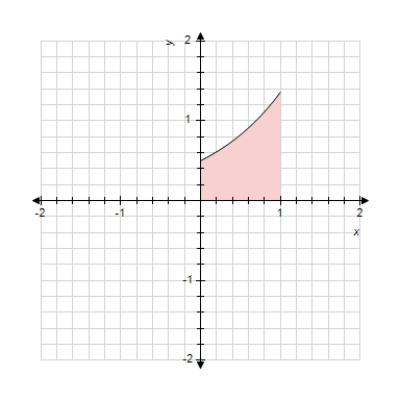
The graph of the function  is given below. Which of the following definite integrals yields the area of the shaded region?

is given below. Which of the following definite integrals yields the area of the shaded region? (Multiple Choice)
4.9/5 (80)
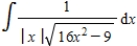
(80) 
 .
Evaluate the following definite integral by the limit definition. 
(Multiple Choice)
4.8/5 (81)
(81)  using L'Hopital's Rule if necessary.
 using L'Hôpital's Rule if necessary.
 .
 given
 .

Filters
- Essay(0)
- Multiple Choice(0)
- Short Answer(0)
- True False(0)
- Matching(0)