



 Chat with AI
Exam 11: S Corporations

Exam 1: Business Income, Deductions, and Accounting Methods99 Questions
Exam 2: Property Acquisition and Cost Recovery109 Questions
Exam 3: Property Dispositions110 Questions
Exam 4: Entities Overview80 Questions
Exam 5: Corporate Operations109 Questions
Exam 6: Accounting for Income Taxes100 Questions
Exam 7: Corporate Taxation: Nonliquidating Distributions100 Questions
Exam 8: Corporate Formation, Reorganization, and Liquidation100 Questions
Exam 9: Forming and Operating Partnerships106 Questions
Exam 10: Dispositions of Partnership Interests and Partnership Distributions100 Questions
Exam 11: S Corporations134 Questions
Exam 12: State and Local Taxes117 Questions
Exam 13: The U.S. Taxation of Multinational Transactions89 Questions
Exam 14: Transfer Taxes and Wealth Planning123 Questions
Select questions type


Suppose Clampett, Inc. terminated its S election on August 28, 2018. At the end of the S corporation's short tax year ending on August 28, J. D.'s stock basis and at-risk amounts were both zero (he has never had debt basis), and he had a suspended loss of $20,000. In 2019, J. D. made additional capital contributions of $5,000 on March 15 and $12,000 on September 20. How much loss may J. D. deduct in 2019?
(Multiple Choice)
4.9/5  (88)
(88) The specific identification method is a method an S corporation may use to allocate its income across short tax years that result from an involuntary S election termination.
(True/False)
4.8/5 (66)
(66) The S corporation rules are less complex for S corporations that have earnings and profits from prior C corporation years than for S corporations that do not have earnings and profits from prior C corporation years.
(True/False)
4.8/5 (70)
(70) ABC was formed as a calendar-year S corporation with Alan, Brenda and Conner as equal shareholders. On May 1, 2018, ABC's S election was terminated after Conner sold his ABC shares (one-third of all shares) to his solely owned C corporation Conner, Inc. ABC reported business income for 2018 as follows (assume that there are 365 days in the year):
 If ABC uses the specific identification method to allocate income, how much will it allocate to the S corporation short year and C corporation short year?
 (Essay)
4.9/5 (75)
(75) RGD Corporation was a C corporation from its inception in 2014 through 2017. However, it elected S corporation status effective January 1, 2018. RGD had $50,000 of earnings and profits at the end of 2017. RGD reported the following information for its 2018 tax year.
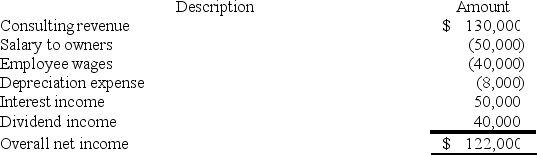 What amount of excess net passive income tax is RGD liable for in 2018? (Round your answer for excess net passive income to the nearest thousand).
 (Essay)
4.9/5 (86)
(86) For an S corporation shareholder to deduct it, a loss must clear three separate tax-provision hurdles: (1) tax basis, (2) at-risk amount, and (3) tax-shelter rules.
(True/False)
4.9/5 (78)
(78) C corporations that elect S corporation status and use the FIFO inventory method are subject to the FIFO recapture tax.
(True/False)
4.9/5 (83)
(83) During 2018, CDE Corporation (an S corporation since its inception in 2016) liquidates this year by distributing a parcel of land to its sole shareholder Clark. The fair market value of the land at the time of the distribution was $100,000 and CDE's tax basis in the property was $30,000. Before considering the effects of the distribution, Clark's basis in his CDE stock was $40,000. What amount of gain (loss), if any, does CDE recognize on the distribution? What amount of income or loss, if any, does Clark recognize on the distribution and what is his basis in the land?
(Essay)
4.8/5 (72)
(72) Unlike partnerships, adjustments that decrease an S corporation shareholder's basis may reduce it below zero.
(True/False)
4.8/5 (83)
(83) The same exact requirements for forming and contributing property govern S corporations and partnerships.
(True/False)
4.7/5 (67)
(67) Lamont is a 100% owner of JKL Corporation. JKL has been an S corporation since its inception in 2018. During 2019, JKL distributed $20,000 to Lamont. During 2019, JKL reported $5,000 of business income and no separately stated items. What is the amount and character of the gain on the distribution, if any, Lamont must recognize in each of the following alternative scenarios? Also, what is Lamont's stock basis at the end of 2019 in each of the following scenarios?
a. Lamont's stock basis at the beginning of 2019 was $30,000.
b. Lamont's stock basis at the beginning of 2019 was $4,000.
(Essay)
4.7/5 (79)
(79) XYZ Corporation (an S corporation) is owned by Jane and Rebecca who are each 50% shareholders. At the beginning of the year, Jane's basis in her XYZ stock was $40,000. XYZ reported the following tax information for 2018.
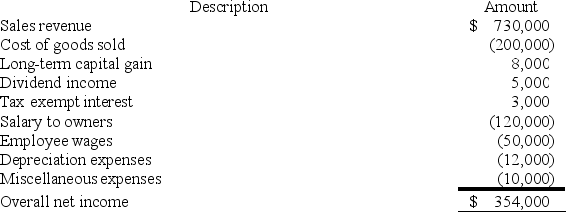 Required:
a. What amount of ordinary business income is allocated to Jane?
b. What is the amount and character of separately stated items allocated to Jane?
c. What is Jane's basis in her XYZ corp. stock at the end of the year?
Required:
a. What amount of ordinary business income is allocated to Jane?
b. What is the amount and character of separately stated items allocated to Jane?
c. What is Jane's basis in her XYZ corp. stock at the end of the year? (Essay)
4.8/5 (70)
(70) During the post-termination transition period, property distributions are tax-free to shareholders to the extent they do not exceed the S corporation's AAA balance and the individual shareholder's basis in the stock.
(True/False)
4.9/5 (88)
(88) Which of the following statements is correct regarding S corporation estimated taxes?
(Multiple Choice)
4.8/5 (78)
(78) Assume Joe Harry sells his 25% interest in Joe's S Corp., Inc. to Tyrone on January 29. Using the daily allocation method, how much income does Joe Harry report if Joe's S Corp., Inc. earned $200,000 from January 1 to January 29 and a total of $1,460,000 from January 1 through December 31 (365 days)?
(Multiple Choice)
4.7/5 (87)
(87) Separately stated items are tax items that are treated similarly for tax purposes as a shareholder's share of ordinary business income (loss).
(True/False)
4.8/5 (68)
(68) At the beginning of the year, Clampett, Inc. had $100,000 in its AAA, $60,000 of earnings and profits from prior C corporation years. During the year, Clampett, Inc.
Earned $50,000 of ordinary income and paid $200,000 in distributions to its shareholders. Assume that J. D. owns 25% of Clampett, Inc., his basis in Clampett, Inc. at the beginning of the year is $10,000, and his share of the distribution was $50,000. How much, if any, of the distribution is taxable as a capital gain?
(Multiple Choice)
4.8/5 (67)
(67) During 2018, CDE Corporation (an S corporation since its inception in 2016) distributed a parcel of land to its sole shareholder Clark. The fair market value of the land at the time of the distribution was $80,000 and CDE's tax basis in the property was $30,000. Before considering the effects of the distribution, Clark's basis in his CDE stock was $10,000. What amount of gain, if any, does CDE recognize on the distribution? What amount of income, if any, does Clark recognize on the distribution and what is Clark's basis in his CDE stock after accounting for the distribution?
(Essay)
4.9/5 (76)
(76) 
Filters
- Essay(0)
- Multiple Choice(0)
- Short Answer(0)
- True False(0)
- Matching(0)