



 Chat with AI
Exam 12: Compensation

Exam 1: An Introduction to Tax113 Questions
Exam 2: Tax Compliance, the IRS, and Tax Authorities112 Questions
Exam 3: Tax Planning Strategies and Related Limitations115 Questions
Exam 4: Individual Income Tax Overview, Dependents, and Filing Status125 Questions
Exam 5: Gross Income and Exclusions130 Questions
Exam 6: Individual Deductions98 Questions
Exam 7: Investments74 Questions
Exam 8: Individual Income Tax Computation and Tax Credits156 Questions
Exam 9: Business Income, Deductions, and Accounting Methods99 Questions
Exam 10: Property Acquisition and Cost Recovery109 Questions
Exam 11: Property Dispositions110 Questions
Exam 12: Compensation101 Questions
Exam 13: Retirement Savings and Deferred Compensation115 Questions
Exam 14: Tax Consequences of Home Ownership119 Questions
Select questions type


An employee's income with respect to restricted stock is the fair market value on the vesting date.
(True/False)
4.9/5  (73)
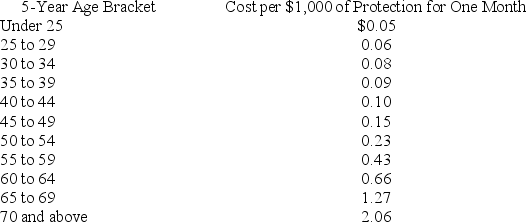
(73) Grace's employer is now offering group-term life insurance. The company will provide each employee with $200,000 of group-term life insurance. It costs Grace's employer $700 to provide this amount of insurance to Grace each year. Assuming that Grace is 43 years old, use the table to determine the monthly premium that Grace must include in income as a result of receiving the group-term life benefit.
EXHIBIT 12-08 Uniform Premiums for $1,000 of Group-Term Life Insurance Protection
(Multiple Choice)
4.8/5 (92)
(92) Employers computing taxable income under the accrual method to unrelated taxpayers may deduct wages accrued as compensation expense in one year and paid in the subsequent year, as long as the company makes the payment within 2½ months after the employer's year-end.
(True/False)
4.8/5 (78)
(78) Employer's expense for stock options is typically recognized earlier for book than tax purposes.
(True/False)
4.7/5 (84)
(84) When a publicly traded CEO's salary exceeds $1,000,000, the employee ________ taxed on the entire amount, and the employer ________ allowed a deduction on the entire amount.
(Multiple Choice)
4.9/5 (73)
(73) When stock options are exercised they are converted into actual employer stock.
(True/False)
4.9/5 (80)
(80) Stock options will always provide employees with future compensation.
(True/False)
4.8/5 (65)
(65) Stevie recently received 1,000 shares of restricted stock from her employer, Nicks Corporation, when the share price was $8 per share. Stevie's restricted shares vested three years later when the market price was $11. Stevie held the shares for a little more than a year and sold them when the market price was $16. What is the amount of Stevie's ordinary income with respect to the restricted stock?
(Multiple Choice)
5.0/5 (79)
(79) The use of restricted stock is increasing relative to the use of stock options.
(True/False)
4.9/5 (73)
(73) Which of the following is False regarding dependent care expenses?
(Multiple Choice)
4.8/5 (81)
(81) The date on which stock options are no longer subject to forfeiture is called the vesting date.
(True/False)
4.9/5 (84)
(84) Which of the following statements regarding restricted stock is False?
(Multiple Choice)
4.7/5 (85)
(85) Taxable fringe benefits include automobile allowances, gym memberships, and personal use tickets to the theatre or sporting events.
(True/False)
4.9/5 (79)
(79) On Form W-4, an employee can only claim one allowance for each personal or dependency exemption that will be claimed on the employee's income tax return.
(True/False)
4.9/5 (76)
(76) Which of the following statements regarding income tax withholding is incorrect?
(Multiple Choice)
4.8/5 (83)
(83) Kaijsa received 20 NQOs (each option gives her the right to purchase 30 shares of stock for $8 per share) from her employer at the time she started working when the stock price was $9 per share. Now that the share price is $18 per share, she intends to exercise all of her options. If Kaijsa holds the shares for two years and sells them when the market price is $25, what is the amount of the deduction and tax savings her employer will receive (assume the employer's marginal tax rate is 21 percent)?
(Essay)
4.7/5 (72)
(72) A cafeteria plan provides employees discounted meals at a company sponsored dining room.
(True/False)
4.8/5 (95)
(95) Up to $10,000 of dependent care expenses can be excluded from an employee's compensation.
(True/False)
4.7/5 (84)
(84) One primary purpose of equity compensation is to motivate employees.
(True/False)
4.8/5 (74)
(74) 
Filters
- Essay(0)
- Multiple Choice(0)
- Short Answer(0)
- True False(0)
- Matching(0)