



 Chat with AI
Exam 8: Individual Income Tax Computation and Tax Credits

Exam 1: An Introduction to Tax113 Questions
Exam 2: Tax Compliance, the IRS, and Tax Authorities112 Questions
Exam 3: Tax Planning Strategies and Related Limitations115 Questions
Exam 4: Individual Income Tax Overview, Dependents, and Filing Status125 Questions
Exam 5: Gross Income and Exclusions130 Questions
Exam 6: Individual Deductions98 Questions
Exam 7: Investments74 Questions
Exam 8: Individual Income Tax Computation and Tax Credits156 Questions
Exam 9: Business Income, Deductions, and Accounting Methods99 Questions
Exam 10: Property Acquisition and Cost Recovery109 Questions
Exam 11: Property Dispositions110 Questions
Exam 12: Compensation101 Questions
Exam 13: Retirement Savings and Deferred Compensation115 Questions
Exam 14: Tax Consequences of Home Ownership119 Questions
Select questions type


Which of the following statements regarding credits is correct?
(Multiple Choice)
4.9/5  (70)
(70) Self-employed taxpayers are allowed to deduct the full amount of the self-employment taxes they pay.
(True/False)
4.9/5 (85)
(85) Which of the following statements regarding the AMT exemption amounts is not True?
(Multiple Choice)
4.8/5 (77)
(77) Hester (age 17) is claimed as a dependent by his parents, Charlton and Abigail. In 2018, Hester received $10,000 of qualified dividends and he received $11,800 from a part time job. What is his taxable income for 2018?
(Multiple Choice)
5.0/5 (88)
(88) Tax credits reduce a taxpayer's taxable income dollar for dollar.
(True/False)
4.8/5 (81)
(81) Which of the following is not a barrier to income shifting among family members?
(Multiple Choice)
4.8/5 (72)
(72) Candace is claimed as a dependent on her parent's tax return. In 2018, Candace received $5,000 of interest income from corporate bonds she obtained several years ago. This is her only source of income. She is 15 years old at year-end. What is her gross tax liability?
(Essay)
5.0/5 (76)
(76) Alton reported net income from his sole proprietorship of $90,000. To determine his self-employment tax, he would multiply $90,000 by the self-employment tax rate.
(True/False)
4.8/5 (92)
(92) Cassy reports a gross tax liability of $1,000. She also claims $400 of nonrefundable personal credits, $700 of refundable personal credits, and $200 of business credits. What is Cassy's tax refund or tax liability due after applying the credits?
(Multiple Choice)
4.8/5 (82)
(82) Which of the following statements concerning tax credits is True?
(Multiple Choice)
4.8/5 (80)
(80) Sam is 30 years old. In 2018, he reported an AGI of $12,000, all from his job as a server at the local café. He is single and has no dependents. What amount of earned income credit may he claim in 2018? Use Exhibit 8-10
(Essay)
4.8/5 (88)
(88) Parents may claim a $2,000 child tax credit for a dependent child who is 22 years of age at the end of the year if the child is a full-time student.
(True/False)
5.0/5 (81)
(81) Assume Georgianne underpaid her estimated tax liability by $150 in the first quarter, $500 in the second quarter, $400 in the third quarter, and $200 in the fourth quarter. Calculate her underpayment penalty for the year, assuming the federal short-term interest rate is five percent.
(Essay)
5.0/5 (75)
(75) Why would a taxpayer file a tax return if not required to do so?
(Multiple Choice)
4.8/5 (76)
(76) Harmony reports a regular tax liability of $15,000 and tentative minimum tax of $17,000. Given just this information, what is her alternative minimum tax liability for the year?
(Multiple Choice)
4.8/5 (81)
(81) Carolyn has an AGI of $38,000 (all from earned income), two qualifying children, and is filing as a head of household. What amount of earned income credit is she entitled to? (Exhibit 8-10)
(Multiple Choice)
4.8/5 (82)
(82) An individual could pay 100% of her tax liability by the due date of her tax return and still be subject to underpayment tax penalties.
(True/False)
4.9/5 (77)
(77) Happy, Sleepy, Grumpy, and Doc all did not make adequate estimated payments. Which of them will not owe underpayment penalties for 2018 given the following information? 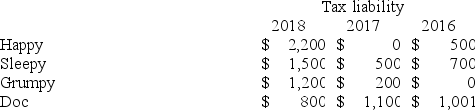
(Multiple Choice)
4.9/5 (82)
(82) The lifetime learning credit can be used toward the cost of any course of instruction to acquire or improve a taxpayer's job skills, no matter the age of the taxpayer.
(True/False)
4.8/5 (86)
(86) Which of the following represents the correct order in which credits are applied to gross tax liability (from first to last)?
(Multiple Choice)
4.9/5 (75)
(75) 
Filters
- Essay(0)
- Multiple Choice(0)
- Short Answer(0)
- True False(0)
- Matching(0)