



 Chat with AI
Exam 4: Individual Income Tax Overview, Dependents, and Filing Status

Exam 1: An Introduction to Tax113 Questions
Exam 2: Tax Compliance, the IRS, and Tax Authorities112 Questions
Exam 3: Tax Planning Strategies and Related Limitations115 Questions
Exam 4: Individual Income Tax Overview, Dependents, and Filing Status125 Questions
Exam 5: Gross Income and Exclusions130 Questions
Exam 6: Individual Deductions98 Questions
Exam 7: Investments74 Questions
Exam 8: Individual Income Tax Computation and Tax Credits156 Questions
Exam 9: Business Income, Deductions, and Accounting Methods99 Questions
Exam 10: Property Acquisition and Cost Recovery109 Questions
Exam 11: Property Dispositions110 Questions
Exam 12: Compensation101 Questions
Exam 13: Retirement Savings and Deferred Compensation115 Questions
Exam 14: Tax Consequences of Home Ownership119 Questions
Select questions type


Jane and Ed Rochester are married with a two-year-old child who lives with them and whom they support financially. In 2018, Ed and Jane realized the following items of income and expense:
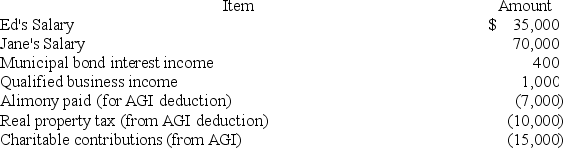 They also qualified for a $2,000 child tax credit. Their employers withheld $5,800 in federal income taxes from their paychecks (in the aggregate). Finally, the 2018 standard deduction amount for MFJ taxpayers is $24,000.
What is the couple's adjusted gross income?
They also qualified for a $2,000 child tax credit. Their employers withheld $5,800 in federal income taxes from their paychecks (in the aggregate). Finally, the 2018 standard deduction amount for MFJ taxpayers is $24,000.
What is the couple's adjusted gross income? (Essay)
4.8/5  (71)
(71) All of the following are tests for determining qualifying child status except the ________.
(Multiple Choice)
4.9/5 (80)
(80) Which of the following statements regarding dependents is True?
(Multiple Choice)
4.8/5 (71)
(71) Anna is a 21-year-old full-time college student (she plans on returning home at the end of the school year). Her total support for the year was $34,000 (including $8,000 of tuition). Anna covered $12,000 of her support costs out of her own pocket (from savings, she did not work) and she received an $8,000 scholarship that covered all of her tuition costs. Which of the following statements regarding who is allowed to claim Anna as an exemption is True?
(Multiple Choice)
4.7/5 (61)
(61) For AGI deductions are commonly referred to as deductions "above the line."
(True/False)
4.8/5 (93)
(93) Which of the following statements regarding realized income is True?
(Multiple Choice)
4.9/5 (86)
(86) The test for a qualifying child includes a gross income restriction while the test for qualifying relative does not.
(True/False)
5.0/5 (80)
(80) In June of year 1, Jake's wife Darla died. The couple did not have any children and Jake did not remarry in year 1 or year 2. Which is the most favorable filing status for Jake in year 2?
(Multiple Choice)
4.8/5 (76)
(76) Mason and his wife Madison have been married for five years. Jaxon, who is 18 years old and unrelated to Mason and Madison, has been living with Mason and Madison for the last two years. In May of year 1, Mason and Madison divorced. Mason and Jaxon stayed in the home and Madison moved out. During year 2, Mason provided all of Jaxon's support and Jaxon lived in the home for all of year 2. Jaxon did not earn any income during year 2. What is Mason's most favorable filing status for year 2?
(Multiple Choice)
4.8/5 (79)
(79) Anna is a qualifying child of her parents. However, she was recently married. Anna and her husband filed a joint return. If they had filed separately, Anna would have owed no taxes, though her husband would have owed just $5. Because Anna herself owed no taxes, her parents can still claim her as a dependent.
(True/False)
4.8/5 (65)
(65) For purposes of determining filing status, which of the following is not a requirement for a married taxpayer to be treated as unmarried at the end of the year?
(Multiple Choice)
5.0/5 (82)
(82) For purposes of the qualifying child residence test, a child's temporary absence from the taxpayer's home for attending school full-time is counted as though the child lived in the taxpayer's home during the absence.
(True/False)
4.9/5 (76)
(76) In year 1, Harold Weston's wife died. Since her death, he has maintained a household for their son Frank (age 3), his qualifying child. Which is the most advantageous filing status available to Harold in year 4?
(Multiple Choice)
4.9/5 (75)
(75) An individual may never be considered as both a qualifying relative and a qualifying child of the same taxpayer.
(True/False)
4.9/5 (75)
(75) Jane is unmarried and has no children, but provides more than half of her mother's financial support. Jane's mother lives in an apartment across town and has a part-time job earning $5,000 a year. Which is the most advantageous filing status available to Jane?
(Multiple Choice)
4.8/5 (80)
(80) When determining whether a child meets the qualifying child support test for the parents, scholarships earned by the child do not count as self-support provided by the child.
(True/False)
4.8/5 (72)
(72) The only from AGI deductions are the standard deduction and itemized deductions.
(True/False)
4.9/5 (79)
(79) In year 1, the Bennetts' 25-year-old daughter, Jane, is a full-time student at an out-of-state university but she plans to return home after the school year ends. In previous years, Jane has never worked and her parents have always been able to claim her as a dependent. In year 1, a kind neighbor offers to pay for all of Jane's educational and living expenses. Which of the following statements is most accurate regarding whether Jane's parents would be allowed to claim Jane as a dependent for year 1 assuming the neighbor pays for all of Jane's support?
(Multiple Choice)
4.9/5 (81)
(81) The Tanakas filed jointly in 2018. Their AGI is $120,000. They reported $10,000 of qualified business income and $26,000 of itemized deductions. They also have two dependent qualifying children. The 2018 standard deduction amount for MFJ taxpayers is $24,000. What is the total amount of from AGI deductions they are allowed to claim on their 2018 tax return?
(Essay)
4.9/5 (88)
(88) 
Filters
- Essay(0)
- Multiple Choice(0)
- Short Answer(0)
- True False(0)
- Matching(0)