



 Chat with AI
Exam 11: The Analysis of Variance

Exam 1: Describing Data With Graphs94 Questions
Exam 2: Describing Data With Numerical Measures186 Questions
Exam 3: Describing Bivariate Data35 Questions
Exam 4: Probability and Probability Distributions136 Questions
Exam 5: Several Useful Discrete Distributions129 Questions
Exam 6: The Normal Probability Distribution196 Questions
Exam 7: Sampling Distributions162 Questions
Exam 8: Large-Sample Estimation173 Questions
Exam 9: Large-Sample Tests of Hypotheses210 Questions
Exam 10: Inference From Small Samples261 Questions
Exam 11: The Analysis of Variance156 Questions
Exam 12: Linear Regression and Correlation165 Questions
Exam 13: Multiple Regression Analysis178 Questions
Exam 14: Analysis of Categorical Data136 Questions
Exam 15: Nonparametric Statistics198 Questions
Select questions type


The completely randomized design is an experimental plan that creates one treatment group for each treatment and then randomly assigns each experimental unit to one of these groups.
(True/False)
4.7/5  (92)
(92) The primary interest of designing a randomized block experiment is to:
(Multiple Choice)
4.9/5 (70)
(70) In one-way ANOVA, suppose that there are three treatments with  ,
 and
 . Then the rejection region for this test at the 5% level of significance is:
, and . Then the rejection region for this test at the 5% level of significance is: (Multiple Choice)
4.9/5 (97)
(97) A professor of statistics in Michigan State University wants to determine whether the average starting salaries among graduates of the 15 universities in Michigan are equal. A sample of 25 recent graduates from each university was randomly taken. The appropriate critical value for the ANOVA test is obtained from the F-distribution with degrees of freedom and is equal to:
(Multiple Choice)
5.0/5 (80)
(80) The analysis of variance helps us compare the means of two, or more quantitative populations. Thus, it might be used by the manager of a farm who wants to know whether there is any difference in:
(Multiple Choice)
4.9/5 (94)
(94) In a two-way ANOVA, there are 4 levels for factor A, 3 levels for factor B, and 3 observations within each of the 12 factor combinations. The number of treatments in this experiment will be 36.
(True/False)
4.7/5 (93)
(93) In the completely randomized design of ANOVA where there are k treatments and n observations, the degrees of freedom for the F-statistic are equal to:
(Multiple Choice)
4.9/5 (82)
(82) Given the significance level 0.05, the F-value for the degrees of freedom  =5 and
 = 8, is 4.82.
=5 and = 8, is 4.82. (True/False)
5.0/5 (75)
(75) One of the assumptions underlying analysis of variance for a completely randomized design is that the observations within each population are normally distributed with unequal variance.
(True/False)
4.7/5 (82)
(82) In analysis of variances, the sum of squares for error (SSE) is zero when all the sample variances are equal.
(True/False)
4.9/5 (76)
(76) In one-way ANOVA, suppose that there are four treatments with  ,
 ,
 , and
 . Then the rejection region for this test at the 5% level of significance is:
, , , and . Then the rejection region for this test at the 5% level of significance is: (Multiple Choice)
4.8/5 (84)
(84) In the analysis of variance, the ANOVA table is a summary table that shows, for each source of variation, the sum of squares, the degrees of freedom, and the ratio of the sum of squares to the associated degrees of freedom (called the mean square) and also shows the F statistic.
(True/False)
5.0/5 (77)
(77) A mechanical engineer at a manufacturing plant keeps a close watch on the performance and condition of the machines. The following data are the weight losses (in milligrams) of certain machine parts due to friction when used with three different lubricants. 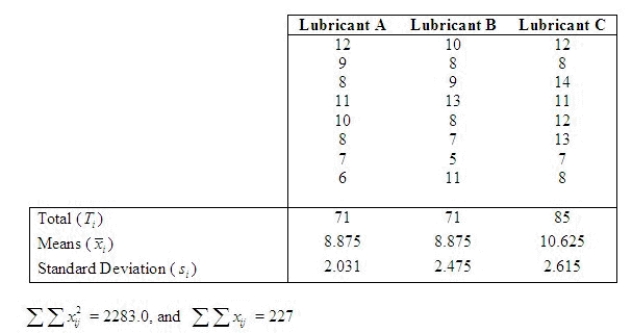 How many degrees of freedom are associated with the F test statistic?
______________
Calculate the value of the test statistic F.
F = ______________
Set up the rejection region for
 = 0.01.
The rejection region is ______________.
What is the appropriate conclusion?
______________
One ______________ conclude that there is a significant difference in average weight loss among the three lubricants.
How many degrees of freedom are associated with the F test statistic?
______________
Calculate the value of the test statistic F.
F = ______________
Set up the rejection region for = 0.01.
The rejection region is ______________.
What is the appropriate conclusion?
______________
One ______________ conclude that there is a significant difference in average weight loss among the three lubricants. (Short Answer)
5.0/5 (90)
(90) Which of the following correctly describes Tukey's method of paired comparisons?
(Multiple Choice)
4.9/5 (85)
(85) Which of the following statements is true in a one-way ANOVA?
(Multiple Choice)
4.8/5 (83)
(83) In a randomized block design of ANOVA, which of the following correctly describes the number of degrees of freedom associated with the sum of squares for treatments?
(Multiple Choice)
4.7/5 (87)
(87) The randomized block design with exactly two treatments is equivalent to a two-tail:
(Multiple Choice)
4.8/5 (82)
(82) Tukey's multiple comparison method determines a critical number,  , such that if any pair of sample means has a difference greater than
 , we conclude that the pair's two corresponding population means are different.
, such that if any pair of sample means has a difference greater than , we conclude that the pair's two corresponding population means are different. (True/False)
4.7/5 (77)
(77) In the  factorial experiment, where a is the number of levels for factor A, b is the number of levels for factor B, and r in the number of replications of each of the ab factor combinations, the degrees of freedom for interaction is given by:
 (Multiple Choice)
4.8/5 (81)
(81) A randomized block design with 4 treatments and 5 blocks produced the following sum of squares values: SS(Total) = 2000, SST = 400, SSE = 200. The value of MSB must be 350.
(True/False)
4.9/5 (86)
(86) 
Filters
- Essay(0)
- Multiple Choice(0)
- Short Answer(0)
- True False(0)
- Matching(0)