



 Chat with AI
Exam 11: The Analysis of Variance

Exam 1: Describing Data With Graphs94 Questions
Exam 2: Describing Data With Numerical Measures186 Questions
Exam 3: Describing Bivariate Data35 Questions
Exam 4: Probability and Probability Distributions136 Questions
Exam 5: Several Useful Discrete Distributions129 Questions
Exam 6: The Normal Probability Distribution196 Questions
Exam 7: Sampling Distributions162 Questions
Exam 8: Large-Sample Estimation173 Questions
Exam 9: Large-Sample Tests of Hypotheses210 Questions
Exam 10: Inference From Small Samples261 Questions
Exam 11: The Analysis of Variance156 Questions
Exam 12: Linear Regression and Correlation165 Questions
Exam 13: Multiple Regression Analysis178 Questions
Exam 14: Analysis of Categorical Data136 Questions
Exam 15: Nonparametric Statistics198 Questions
Select questions type


In the analysis of variance, the sum of the squared deviations between each block sample mean and the grand mean, multiplied by the number of observations made for each block, multiplied by the number of observations per cell (which may well equal 1) equals the blocks mean square.
(True/False)
4.7/5  (67)
(67) The data that follow are observations collected from an experiment that compared four treatments, A, B, C, and D, within each of three blocks, using a randomized block design.  Rank the four treatment means using Tukey's method of paired comparisons with
 = 0.01.
Ranked means (
 is the smallest,
 is the largest).
 = ______________
 = ______________
 = ______________
 = ______________
Conclusion: ______________
Rank the four treatment means using Tukey's method of paired comparisons with = 0.01.
Ranked means ( is the smallest, is the largest). = ______________ = ______________ = ______________ = ______________
Conclusion: ______________ (Short Answer)
4.9/5 (79)
(79) The equation: SS(Total) = SST + SSB + SSE, applies to which ANOVA model?
(Multiple Choice)
5.0/5 (79)
(79) In employing the randomized block design, the primary interest lies in reducing sum of squares for blocks (SSB).
(True/False)
4.9/5 (94)
(94) The randomized block design is also called the two-way analysis of variance.
(True/False)
4.8/5 (73)
(73) In a one-way ANOVA, which of the following statements is true?
(Multiple Choice)
4.7/5 (81)
(81) A travel agency primarily reserves flights with four major airlines. The agency would like to know if the true mean price for the four airlines is the same. Below are the prices for flights leaving from the same city traveling to five different destinations. 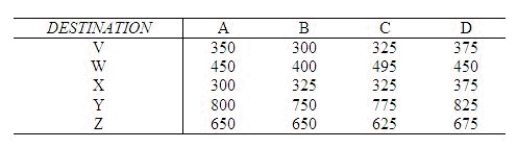 Perform an analysis of variance treating the destinations as blocks.
What is the F-statistic?
______________
Test the null hypothesis of no difference in the true mean price for the four airlines in a completely randomized design. Use
 = 0.05.
Reject Region: Reject H0 if |F| > ______________
Can you reject the null hypothesis?
______________
Why is it necessary to treat the destinations as blocks?
________________________________________________________
Develop and interpret a 90% confidence interval for
 , (use the MSE value in part b).
______________ Enter (n1, n2).
Perform an analysis of variance treating the destinations as blocks.
What is the F-statistic?
______________
Test the null hypothesis of no difference in the true mean price for the four airlines in a completely randomized design. Use = 0.05.
Reject Region: Reject H0 if |F| > ______________
Can you reject the null hypothesis?
______________
Why is it necessary to treat the destinations as blocks?
________________________________________________________
Develop and interpret a 90% confidence interval for , (use the MSE value in part b).
______________ Enter (n1, n2). (Essay)
4.9/5 (82)
(82) In one-way ANOVA, the test statistic is defined as the ratio of the mean square for error (MSE) and the mean square for treatments (MST); namely, F = MSE / MST.
(True/False)
4.9/5 (77)
(77) In a one-way ANOVA, total SS is equal to 12,345, and SST is equal to 10,685, then SSE = 1,660.
(True/False)
5.0/5 (88)
(88) A study will be undertaken to examine the effect of two kinds of background music and of two assembly methods on the output of workers at a fitness shoe factory. Two workers will be randomly assigned to each of four groups, for a total of eight in the study. Each worker will be given a headphone set so that the music type can be controlled. The number of shoes completed by each worker will be recorded. Does the kind of music or the assembly method or a combination of music and method affect output? The ANOVA model most likely to fit this situation is the two-way analysis of variance.
(True/False)
4.9/5 (76)
(76) A randomized block design ANOVA has two treatments. The test to be performed in this procedure is equivalent to dependent samples t-test.
(True/False)
4.7/5 (93)
(93) The equation: Total SS = SST + SSB + SSE, applies to the completely randomized design (one-way ANOVA model).
(True/False)
4.8/5 (77)
(77) When the effect of a level for one factor depends on which level of another factor is present, the most appropriate ANOVA design to use in this situation is the:
(Multiple Choice)
4.8/5 (79)
(79) A randomized block design ANOVA has five treatments and four blocks. The computed test statistic (value of F) is 6.25. With a 0.05 significance level, the conclusion will be to accept the null hypothesis.
(True/False)
4.7/5 (77)
(77) Three tennis players, a beginner, an experienced, and a professional, have been randomly selected from the membership of a large city tennis club. Using the same ball, each person hits four serves with each of five racquet models, with the five racquet models selected randomly. Each serve is clocked with a radar gun and the result recorded. Among ANOVA models, this setup is most like the randomized block design.
(True/False)
4.8/5 (82)
(82) The studentized range is the difference between the smallest and the largest in a set of k samples means. It is used for determining whether there is a difference in a pair of population means.
(True/False)
4.7/5 (79)
(79) The sum of squares for treatments, SST, achieves its smallest value (zero) when all the sample means are equal.
(True/False)
4.8/5 (79)
(79) Randomization is a procedure that eliminates the effects of extraneous factors during an experiment, even prior to the administration of treatments, by creating blocks of experimental units so that all units within any one block are as alike as possible with respect to these factors.
(True/False)
4.7/5 (91)
(91) 
Filters
- Essay(0)
- Multiple Choice(0)
- Short Answer(0)
- True False(0)
- Matching(0)